A new report from the Center for Working-Class Politics, Arizona State University’s Center for Work and Democracy, and Jacobin shows how labor can play to its strengths — and win. The secret? Run more union members for office.

Out east in Maine, the polls show Graham Platner, a union-recruited oysterman, trouncing both current State Governor Janet Mills, the establishment Democrat pick, and Susan Collins, the incumbent Republican senator.
It’s not just blue states either. Down in deep-red Alabama, dues-paying plumber Andrew Sneed is outraising his GOP opponent, incumbent Representative Dale Strong, all while forgoing corporate donations. And in Texas, Taylor Rehmet, a local president of the International Association of Machinists and Aerospace Workers, just stunned pundits by handily winning a runoff for the state senate.
Time will tell how Rehmet fares in office and whether Platner and Sneed notch victories at the ballot box. Regardless, something seems to be happening out there for the very few union-linked candidates we have put out in the field — and in not exactly labor-friendly regions either.
A new report from the Center for Working-Class Politics, Arizona State University’s Center for Work and Democracy, and Jacobin titled “Can Unions Make a Difference?” that appears to get to the crux of the matter. By way of diagnosing the problem, the study demonstrates that the insane wealth stats highlighted by Bernie Sanders and his compatriots on the Fighting Oligarchy Tour are of similar disproportion to the in-real-life class composition of our government.
Today less than 10% of the nation’s voters are in a union — down from more than 30% in the 1960s, when Martin Luther King Jr saw the writing on the wall and decried “right-to-work” as a false slogan meant to eviscerate labor unions.
And yet right now, the percentage of candidates we’re trying to send to congress who also happen to be union members is nowhere close to 10%. The CWCP took the trouble to identify all congressional candidates between 2010 and 2022 and found that just 5% have been union members. CWCP director Jared Abbott says the center is now accumulating evidence that in 2026, Platner and Sneed are among just 3.5% of declared political candidates with organized labor ties.
Strangely enough, among the 90% of us that are not in unions, the general population’s opinion of organized labor is at an historic high — 70% of Americans now approve of labor unions. That’s the highest level of approval we’ve had for the movement since the 1970s. As the report points out:
The central challenge . . . is not public hostility to unions but the movement’s diminished capacity to translate popular support into political power.
A significant part of the problem can be traced to the tsunami of political cash unleashed by the Supreme Court’s 2010 Citizens United v. Federal Election Commission decision. Although “total donations from labor PACs have remained roughly consistent” over the past twenty-eight years at an average of about $42 million (it was up to $57 million in 2025), the total flowing into the system has exploded from $1.45 billion in 1998 to a whopping $5.08 billion in 2025.
This means that while unions have, despite all their challenges, been holding the line with their financial contributions to campaigns, their share of the overall pie has shrunk from 8% of all candidate donations to a truly “miniscule” 2%.
Consider the following data Abbott and the CWCP have assembled:
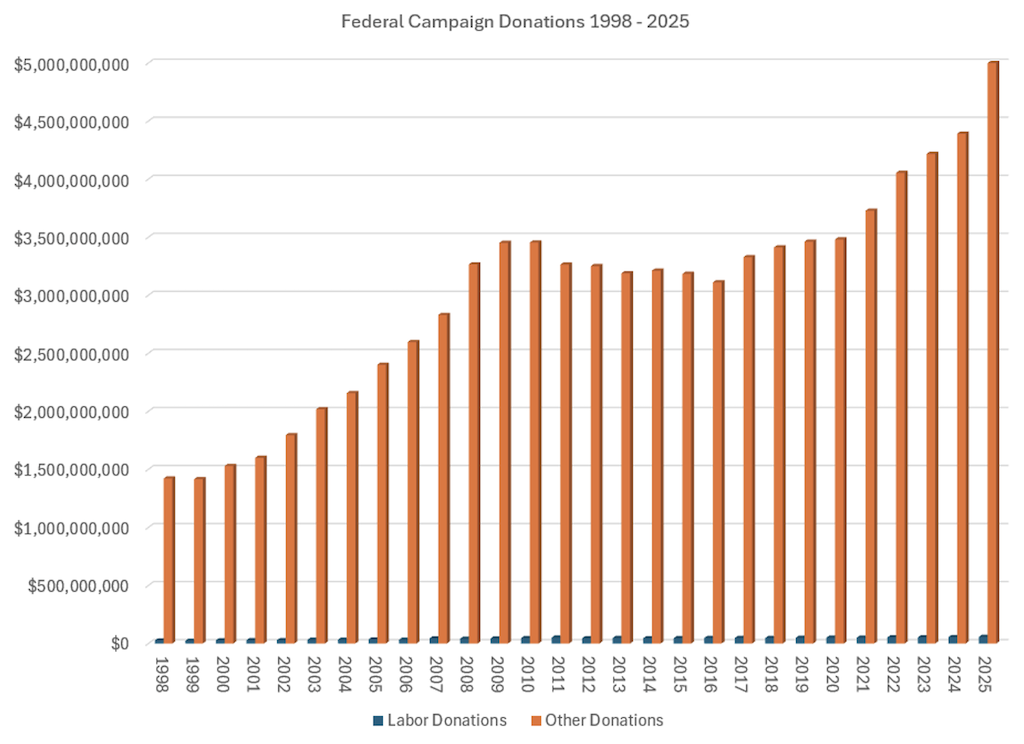
The pressure for unions to make their limited cash work as best it can has led them to be more conservative with their donations: they tend to focus on incumbent Democrats and generally avoid the hurly-burly of the open-seat races that the corporate interests are now drowning with cash.
Labor is clearly up against a growing tidal wave.
But the CWCP report gives reason to hope that the movement will not be swept out to sea. And better yet, that we can reasonably expect our existing blue-collar representation in Washington, DC, not to dip any lower than it is right now.
For one thing, again, organized labor candidates, unlike donor- and managerial-class candidates, fundamentally appeal to most of the electorate from the get-go. Perhaps they have a leg up simply for being authentic both as human beings and as fellow citizens who know what our shared life is like trying to make ends meet.
The study indeed finds that candidates with real-world labor backgrounds differ from their colleagues and opponents in a few important, and provable, ways:
- They are more likely to advocate in favor of worker issues on the campaign trail.
- They are more likely to vote in favor of progressive economic policies once in office, regardless of partisanship.
- Their experience in unions makes them more effective in advancing working-class and union issues.
To the first point, assessing all congressional candidates in our post–Citizens United world from 2010 to 2022, the report finds that those with union backgrounds use 159% more pro-worker rhetoric, 66% more progressive economic language, and 51% more anti–economic elite messaging when compared with nonunion candidates. And this is true even when controlling for district, party, and incumbency.
To the second point, being more progressive on economic issues, the study compares legislators’ average roll-call voting positions and finds union candidates vote left of their peers not only on average but within their own party. Union-affiliated Dems vote well to the left of managerial-class Dems, and even union-affiliated Republicans (including former police officer Rep. Pete Stauber of Minnesota) also vote to the left of their party. Again, the CWCP dug in on this to ensure that a candidate’s union experience — versus their district, their party, or other characteristics — made a difference. It did.
Finally, to the third point — that union-affiliated lawmakers are more effective at advancing working-class and union issues — CWCP researchers interviewed twenty legislators over the past year. It may all seem self-evident, but their specific articulations of how they relate to these issues are helpful and offer handy language and strategic insight for campaigns.
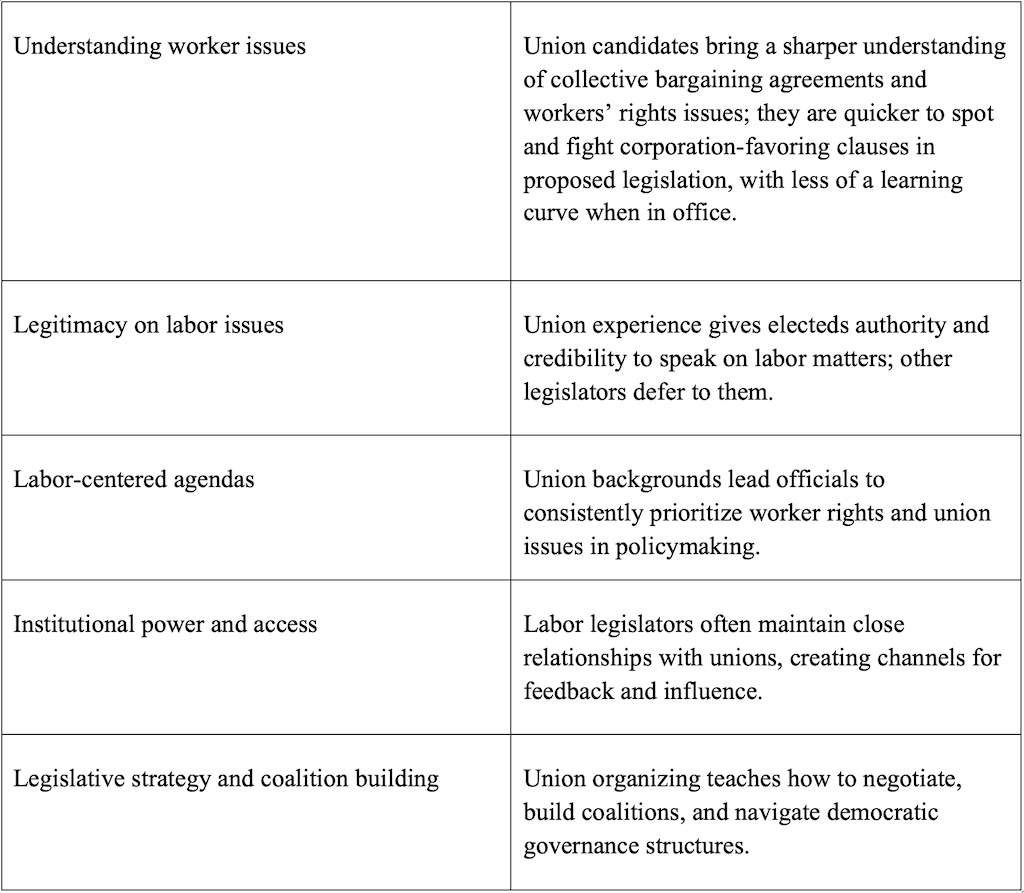
Here are some particularly useful, trenchant insights from their battery of interviews:
There’s no learning curve with a labor candidate: they always already understand the issues working people face and are committed to addressing them.
—Anthony Verrelli, carpenter and New Jersey state legislator
There was a former secretary working on a bill around retirement savings. And the comment they made in a closed-door meeting was around “the average person” with “just” $200,000 in retirement savings. . . . So I did a little research, and that’s about one out of eight people in the country. So their commonplace experience here in Washington, that of course you’d have all this money toward retirement so that you can, you know, drink piña coladas on beaches across the Caribbean in your retirement, is a different reality from someone who’s hoping to get that RV maybe and be able to take some time off in winter . . . there’s this mindset. It isn’t anti–person of average income; it’s just they don’t have the lived experience of it.
— Representative Mark Pocan, Wisconsin District 2
When there are issues of labor, people defer to me. They ask me, what’s the thing to do in this moment? And that is helpful. I can speak from experience as someone who’s come up with the rank and file.
— Hugo Soto-Martinez, Los Angeles councilmember
When you’re in Congress, you are told you can only have three priorities. . . . So, if you really had more people whose primary identity was in the labor movement, they’d be a lot more likely to put labor issues on that list. . . . It would make a big difference if there were more people who bled union.
— Former Representative Andy Levin, Michigan District 9
I was an industrial electrician. . . . Why that is important, at least from my perspective, is that you understand things at just a different level because you’ve been there. I love lawyers. My daughter’s a lawyer, but I don’t need 435 lawyers.
— Representative Donald Norcross, New Jersey District 1
All this wisdom doesn’t just sound good; the CWCP’s analysis ties it to real-world results.
In one of the interviews, the center reveals that the New Jersey American Federation of Labor and Congress of Industrial Organizations (AFL-CIO) has, over the past two decades, tracked 1,300 labor candidates at the state and local levels and that a shocking 76% of them have been successful in their bids for office.
Citing this and the results of other AFL-CIO programs over the years — including the hundreds of candidates trained by the Target 5000 program of the early aughts and the 2000 in 2000 program before that — the report’s final section serves as a mini-primer for unions and labor-class candidates looking to leverage their strengths in the face of daunting financial disadvantage.
Two specific case studies are detailed. In 2022, the inaugural cohort of the Alaska AFL-CIO Arthur A. Allman Labor Candidate School completed their training. The school was set up as an electoral training program for union members and although it’s had just twenty-six graduates so far, twelve have run for office with eight of them (67%) going on to win office.
The other case is the previously mentioned New Jersey AFL-CIO Labor Candidates Program whose achievements can only be described as nothing short of astonishing. In its two decades in the field, the Candidates Program has, from local councils to Congress, notched 1,300 election victories yielding a win rate of over 75%.
Given that such pragmatic solutions exist, obviously a big part of the cure for labor underrepresentation will be to lean into them while avoiding the trap of using the budget-maxing, consultant-written, late-game-adjustments playbook of the current political system. Despite the logic of prioritizing safe bets, unions should not only be leaning into easy contests. Rather, they should be leaning into their native strengths and applying their limited cash not in the waning moments of the campaign but well ahead, even in the candidate-scouting phase.
Again, it’s not that labor’s late-cycle, safe-contest donation pattern doesn’t make sense. It’s entirely understandable that when you have a war chest a hundred times smaller than your opponent’s, you want to be a hundred times more cautious with your money. You of course want to be extra vigilant about ensuring you help where it matters most — and in the bigger, most obviously meaningful electoral contests. It also makes sense to do what you can to ensure your dollars make a noticeable difference not only for the victor but to the victor. That way, when it’s time to vote, they remember who put them there.
But the study shows that this strategic conservatism haunting the labor movement is not just a trend, it’s now an ossified status quo. The CWCP was unable to statistically tease out any exceptions to the labor unions’ bet-only-on-sure-bets game plan.
This is, of course, a shame. One would expect that unions, at least to some degree, would favor candidates with union backgrounds. And, at first glance, it seems like there might be a correlation here. But that turns out to be a geographical hallucination. The researchers note that, when factoring in where candidates are running, the nature of the district — whether it’s a district heavily or lightly populated in terms of organized labor — was the determinant factor in labor support, rather than the individual candidate’s labor bona fides. Unions simply spend more in places where their base lives than where it doesn’t.
Making all this conservatism even worse, unions sometimes also give good money to bad candidates. They appear not to be terribly rigorous about screening for Joe Manchin– or Henry Cuellar–style apostates — candidates who sing from the union hymnal on the way to Washington but end up worshiping other gods on the congressional floor.
Perhaps this all suggests that labor PACs are populated by the same managerial-class election experts and consultants employed by the corporate side. Again, it’s rational to emulate what the winners are doing. But given that labor simply can’t compete in the cash contest, this is one of many areas in which labor is in a unique position.
As the CWCP report puts it,
Running union members and leaders for office offers a way to amplify workers’ voices in government even as union density remains low. . . . Union candidates represent an untapped political resource — one that holds potential not only for strengthening labor’s influence over policy but also for reversing the Democratic Party’s decreasing support among working-class voters.
Not only do union candidates win, the report also details how they draw more favorable crowds to the polls, especially in districts with high union density. Union members in the general population, the organization’s research has found, are 36% more likely to vote for a union-member candidate.
So why don’t unions prioritize finding and nurturing undiscovered talent from their own ranks more often? Andrew Waxman of the national AFL-CIO put it to the CWCP: “Unions, like most donors, tend to back candidates who can raise their own money and demonstrate a capacity to win.”
Joe Murphy of the Arizona AFL-CIO added that the unions only seem to support candidates “who can raise their own funds . . . staff their own campaign . . . knock doors . . . send mailings . . . without labor support — then the support will come in.”
Eleanor Chávez, a state representative in New Mexico, told the CWCP how unions were hesitant to support her when she first ran against an incumbent, only stepping in during her subsequent campaign when the perceived risk of her losing was lower.
The previously cited former Representative Levin from Michigan puts a finer point on this, saying that the union leaders he worked with simply didn’t think recruitment was important. Levin suggested that if they put just 2% of their budgets into the effort, it would in fact make a difference.
But why settle for 2%? It now seems abundantly clear that labor needs to put down the current playbook and instead lean into their abundant strengths — and do so at a competitive scale. Labor already has all the homegrown talent it needs to win and win big. They simply have to fund them. Until they do, labor’s decline isn’t only likely, it’s guaranteed.