As part of a new wave of young socialist candidates, Madison’s Bobby Gronert is running for city council, bringing lessons learned from student organizing to city hall to challenge developers and shape what socialism looks like for a new generation.

In Madison, Wisconsin, a student-led socialist campaign is confronting the state’s corrupt housing system and testing whether campus organizers can translate activism into power at the municipal level. For Bobby Gronert, the race is not just about winning a council seat but about building a durable base that can challenge developers, resist ICE terror, and reshape what socialism looks like for the next generation of workers.
Student Tribunes
Across the country, a new layer of socialist candidates is emerging out of student organizing, testing whether the lessons of campus-based activism can be translated into durable political power. From Burlington to Madison, organizers like Marek Broderick, Hannah Shvets, Reese Armstrong, Will O’Dwyer, and now Gronert constitute this rising tide of young democratic socialists stepping into municipal races to represent their base of students and tenants. Gronert identifies with this movement. So much so that he chose to launch his campaign at a Zohran Mamdani election night watch party, linking it directly to the growing wave of socialist municipal campaigns.
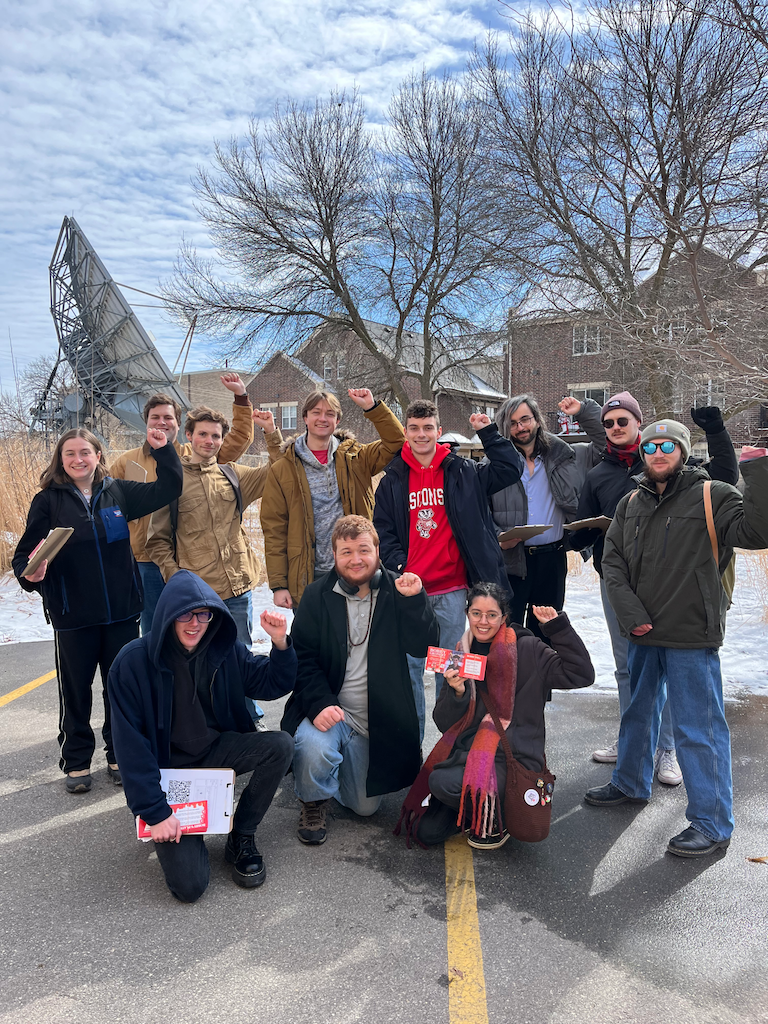
University of Wisconsin Young Democratic Socialists of America (YDSA), where Gronert has spent the past several years organizing around housing, labor, and campus politics, has become a local institution within this movement. Now running for city council in a district dominated by University of Wisconsin students, his campaign is rooted in a simple assessment: the city’s progressive image masks a housing system that overwhelmingly serves landlords and developers while leaving tenants with little real recourse. The issues of housing and affordability are central to Student Tribunes, whose politics are shaped in cities where landlord political machines cast students as the source of the housing crisis while extracting rising rents from them.
Gronert’s decision to run came after a flash point at city hall: the incumbent alderperson cast the deciding vote to dismantle Madison’s only sanctioned homeless encampment. When confronted by constituents, he initially indicated he would reverse course, only to later claim he had been coerced by protest.
For Gronert, the episode revealed the limits of accountability in liberal governance and that meaningful concessions are won not through representation but through sustained mass action. Even in a city that brands itself as forward-thinking, short bursts of public pressure can be absorbed and deflected without producing meaningful change.
That moment clarified both the stakes of the race and the terrain it would be fought on. Madison is growing rapidly, driven in large part by the university, but new development has largely taken the form of luxury housing. At the same time, weak enforcement and legal barriers leave tenants struggling to challenge unsafe or exploitative conditions. In that context, Gronert’s campaign is less about individual representation than about building a base of students and tenants who can contest the structure of the city’s housing system itself.
Housing and Power
Gronert’s campaign is focused on housing because this is where the contradictions of Madison’s political economy are most visible. The city presents itself as progressive, but in practice, its housing system overwhelmingly serves landlords and developers. As Gronert puts it plainly, “Tenants and working people lose. Developers and landlords benefit.”
That imbalance is not accidental. Developers receive generous tax breaks to build new units, but those units are overwhelmingly luxury apartments priced far beyond what most residents can afford. Meanwhile, the city’s ability to enforce even basic housing standards remains limited. Madison has just seven building inspectors for the entire city, leaving over a hundred thousand tenants with minimal protection from slumlords.
For many students, these conditions define daily life. One of Gronert’s campaign volunteers spent months dealing with mice and bedbugs in his apartment only to find that the city lacked the capacity to intervene in any meaningful way. Even when tenants attempt to fight back, they run into a system that is stacked against them. “The legal system is designed to have prohibitive barriers of time and money for working people,” Gronert says. “It’s not financially viable to hold your landlord accountable.”
Madison’s housing pressures are intensifying. The city is growing rapidly, driven in large part by the university, where enrollment continues to rise even as new dorm construction lags. Each year, more students are pushed into the private housing market, competing for a limited number of units. Developers respond predictably, building for those who can pay the highest rents, which are often students with family support, while the broader student and working population is left navigating rising costs and deteriorating conditions.
For Gronert, this is not a simple question of supply but of what kind of housing is being built and for whom. His central policy proposal, a tenant defense council, is meant to directly intervene in that imbalance by providing city-backed legal support for renters. The goal is not just to mitigate the worst abuses but to shift the balance of power. In a city where tenants are routinely priced out, neglected, and blamed for the crisis itself, even the ability to fight back would mark a significant change.
The Dream Team
Gronert’s campaign is made up of organizers from University of Wisconsin YDSA and Madison Democratic Socialists of America, who have spent years building relationships among students and tenants across the district. But beyond the formal structure of the campaign, its strength comes from the material conditions shared by much of the electorate.
Gronert points in particular to the neighborhoods just off campus, often referred to as the “sophomore slums,” where students encounter the realities of Madison’s housing system most directly. “We’ve had the most success in those areas,” he says. “People there understand bad landlords and high rents because they’ve dealt with it.” The experience of navigating leases, dealing with neglect, and paying rising rents has created a level of political clarity that more abstract appeals often fail to reach.
At the same time, the campaign has made a deliberate effort to organize beyond that core. Freshmen living in dorms, who make up a large share of the district, are not yet dealing with landlords in the same way, but they are already encountering the pressures of the housing market. “They’ve had to go through the process of getting a lease months in advance,” Gronert notes. “They understand that rents are high.” The goal is to connect that early awareness to a broader political understanding before students cycle through the system and out of the district.
The electoral terrain itself remains uneven. Many voters will enter their polling place with little familiarity with either candidate, making name recognition and direct contact decisive. Furthermore, Gronert is running against a candidate backed by the city’s political establishment, including the mayor and several sitting alderpeople. Real estate interests, which have already spent heavily in similar races, are likely to line up behind his opponent, while several unions have opted to endorse both candidates.
For Gronert, that alignment is clarifying rather than discouraging. The campaign is not built on establishment appeals but on organized struggle from below. In that sense, success depends on whether he can consolidate and mobilize a base of students and tenants who see their own conditions reflected in its program.
Durable Power
Gronert is clear that the campaign is not an end in itself. “This campaign is about 60 percent winning and 40 percent building a movement,” he says, a formulation that reflects both ambition and constraint. The goal is not simply to secure a seat on the council or flood the airwaves with an ambitious vision but to develop an organized base that can persist beyond a single election cycle.
That orientation shapes how the campaign operates. Volunteers are not just canvassing for votes but being drawn into ongoing organizing, whether through YDSA, DSA, or broader coalitions. Relationships built during the campaign are meant to carry forward into future fights, from housing to labor to immigrant defense. “We’re trying to build something that can outlast me.”
At the same time, he is clear-eyed about the limits of municipal office. City councils operate within constraints set by state governments and existing political institutions, and even a successful election campaign will not be able to fully overcome those impediments. But for Gronert, the key question is where leverage comes from.
“If we win this race, we’ve gone head-to-head with the establishment and beaten them,” he says. That outcome would signal that a socialist base exists in Madison and can be mobilized electorally. Even without formal power, that changes the political terrain. Other elected officials, many of whom will soon face reelection, will have to account for the possibility of organized opposition.
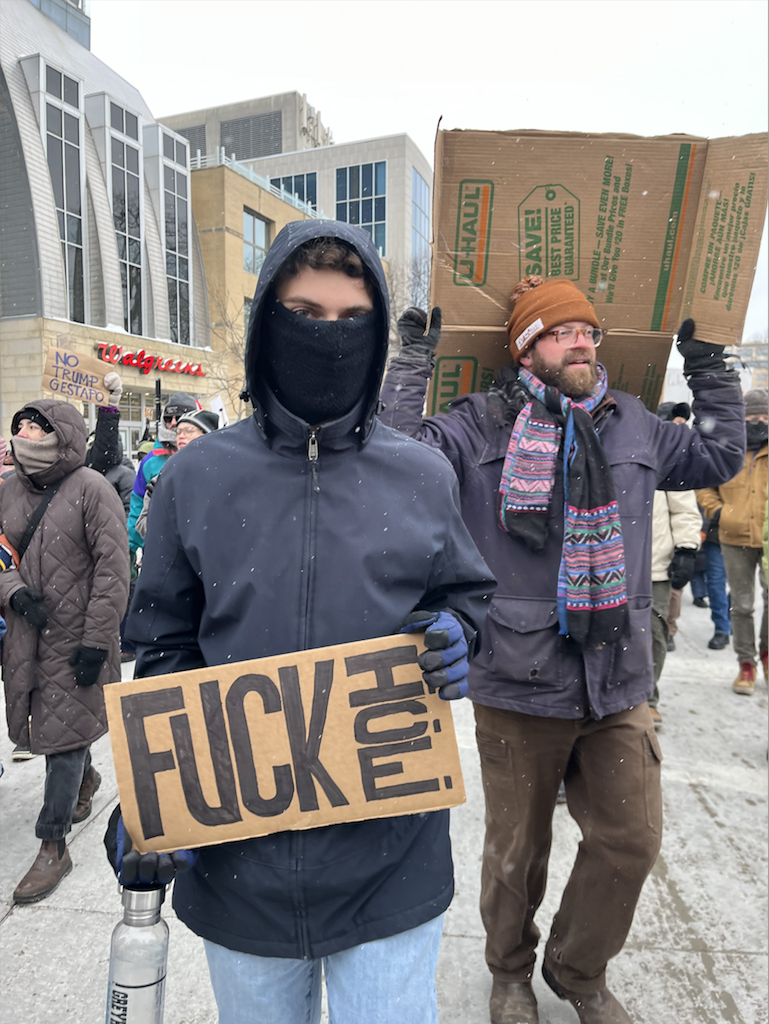
That leverage does not come from inside city hall alone. It depends on whether the campaign can translate electoral success into continued participation, whether supporters show up not just to vote but to organize, protest, and apply pressure. In that sense, the line between campaigning and governing begins to blur. The same base that elects a candidate becomes the source of their power once in office.
The campaign’s approach to immigration enforcement illustrates that dynamic. Gronert argues that federal agencies like Immigration and Customs Enforcement (ICE) are increasingly targeting cities like Madison and that local governments must be prepared to respond. That response includes policy proposals, such as integrating ICE alerts into local systems and leveraging municipal resources, but it also depends on organized resistance. Rapid response networks and community mobilization are central to that effort.
It is also, in his view, a question of who is willing to take risks. “Some of us are safer than others,” he says. “If you have that ability, you need to put yourself on the line.” The implication is that political power is not just institutional but collective, rooted in the willingness of people to act in defense of one another.
Why This Matters
For Gronert, the significance of the campaign extends beyond Madison. It speaks to a broader problem facing student organizing today: a sense that politics is either too distant or too risky to meaningfully engage with. Rising costs, debt, and precarity have made participation itself feel like a gamble many cannot afford.
Gronert does not dismiss that reality. He has experienced it. But he frames it differently. “I’ve been doing this for five years, and I’ve had a lot of losses,” he says. “But I’ve had a lot of wins too.” The point is not that organizing is easy or immediately rewarding but that it is the only way those conditions begin to change.
That perspective runs through the campaign. It is not built on the promise of quick victories but on the expectation of sustained struggle. Gronert puts it bluntly, “You lose a lot, that’s just being a socialist.” What matters is not avoiding defeat but building the capacity to win over time. As the old saying goes, only those who dare to struggle may dare to win.
In that sense, the campaign is also an attempt to redefine what socialism looks like for a generation encountering it for the first time. Not as an abstract ideology or distant historical example but as something concrete and local. A tenant who successfully challenges a landlord. A student who sees rents stabilize. A community that organizes to defend its neighbors.
Whatever the outcome on April 7, this campaign’s impact will not be measured solely in votes or even policy wins but in how those experiences reshape political memory. When students who pass through Madison think back on what socialism meant in their lives, it will not be as an abstraction; it will be something that materially improved their conditions and demonstrated the power of collective action.