The Iran war was such a fiasco that Donald Trump had no choice but to find a way out. Whether it sticks will partly depend on Democrats resisting the urge to irresponsibly goad him back into it.
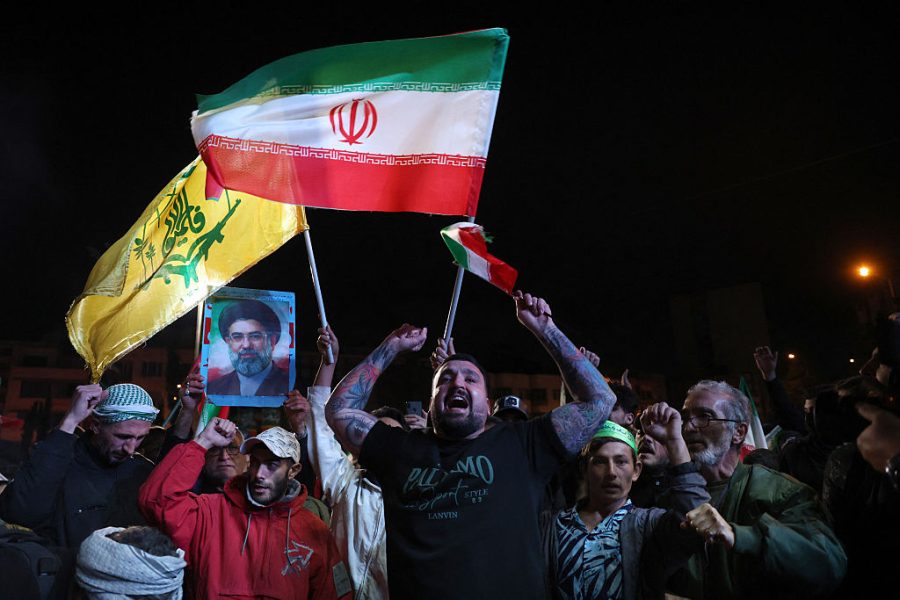
Despite having lasted only six weeks, Donald Trump’s war with Iran was somehow shaping up to be the worst foreign policy decision of a short twenty-first century full of them, a ballooning disaster on almost every level, for almost everyone involved, that we should all be thankful now has a chance to end. Whether it actually does, unfortunately, is up to a lot more than the fickle and easily distracted president.
Trump’s announcement of a two-week ceasefire with Iran yesterday and coming negotiations for a permanent settlement of hostilities was a rare acknowledgement of reality by the president: that the unappealing option of cutting and running while failing to achieve any of the goals he originally set — in fact, making several of the problems the war was meant to solve much worse — is still by far the best option on a menu of garbage.
This utterly pointless war has been so strategically and politically disastrous for both Trump’s presidency and the country that it effectively leaves him with no other reasonable choice. The fact that the president seemingly agreed to use Iran’s ten-point proposal, and not his own fifteen-point set of maximalist demands, as the basis for talks is a quiet acknowledgement of the war’s failure as a policy choice. As hard as this course of action might be for Trump to swallow, the alternatives are much worse.
Extracting Iran’s uranium is a dangerous fantasy. If you need proof, look at what a debacle rescuing just one man from deep in the country became for US forces. As his hurricane of contradictory public statements about the Strait of Hormuz’s closure suggests, Trump can’t militarily reopen the strait, where ships can easily be threatened and harassed by the thousands of cheap drones Iran can make each month. Holding this card, Iran’s leaders refuse to capitulate in spite of the immense punishment Trump is inflicting on the country, and his options for escalating that punishment are all unpalatable.
Ground troops would be politically toxic and lead to skyrocketing US casualties at the best of times, let alone just as temperatures in the Persian Gulf are set to climb deeper into a hundred-plus degree territory. Ratcheting up the scale and violence of bombing, as Trump threatened to do yesterday, not only risks regional disaster that would likely leave Israel devastated (whose security Trump has repeatedly pointed to as justification for the war), but was widely and harshly condemned even by a chorus of right-wing voices who are usually his allies. While Iran holds the world economy hostage, Trump can only threaten to kill and destroy more. That tactic has reached the limit of its usefulness.
All the while, the longer the war goes without Iranian surrender, the worse it gets for Trump and the United States. The US economy is already headed for major pain going into this year’s midterms, and weeks and months more of supply chain disruptions would send it entirely off a cliff, if it isn’t headed that way already. US munition stockpiles continue to be depleted at unsustainable rates, meaning the US military is reaching the limit of its ability to actually wage war, threatening a worse future embarrassment than voluntarily backing out. Public humiliations rack up by the day as extravagantly expensive military equipment and vehicles are very publicly destroyed or malfunction.
Trump has, as a matter of practical necessity, been forced to choose the best of a set of bad options for himself, the painful choice that so many before him have preferred to set their presidencies on fire rather than take. That doesn’t mean peace is inevitable. There is the gaping distance between the positions of Iran’s leaders and the White House, a distance that will be difficult to bridge.
But the biggest problem, as always, will be Israel.
Israeli officials are apoplectic at the prospect of this deal and are already trying to sabotage it, refusing to end their genocidal war in Lebanon as required by Iran’s ten-point plan and actually carrying out their largest wave of bombings of the country this morning. Israel has the incentive and, unfortunately, the ability to torpedo any future peace, albeit an ability that rests entirely on the US president’s willingness to indulge them.
The one saving grace is that there’s a chance this war may end up transforming Trump’s relationship to Israel and its prime minister, Benjamin Netanyahu. According to numerous reports, including a detailed New York Times piece that dropped just hours before yesterday’s ceasefire announcement, Netanyahu and other top Israeli officials played a central role in convincing Trump this fiasco was a good idea, including by feeding him a host of fantastical assurances that soon proved embarrassingly wrong. Soon after, we watched Trump embarrass himself by regurgitating many of those Israeli claims in public, including the idea that it would be over quickly, that decapitating Iran’s leadership would lead to regime change, and that there would be a mass uprising from the Iranian people, none of which proved true.
The president should be furious that he was clearly misled, used, and humiliated by the Israelis. In a world that made sense, this would make it easy for him to bring the hammer down on Netanyahu and put an end to Israel’s constant warmongering on the US dime. But that would require a modicum of a backbone, which neither Trump nor his predecessor have shown much sign of in their dealings with Israel. In fact, at least according to an anonymous US official, last night when Trump had the opportunity to tell Netanyahu to back off Lebanon in a phone call, he declined to do so — a worrying omen, if it points to this same old cycle repeating again.
The other wild card is Trump’s Democratic opposition, prominent members of which are being distinctly unhelpful as the world prays for this thing to really be over. First among them is Connecticut senator Chris Murphy, a prominent Democratic foreign policy voice who, virtually the moment a ceasefire was announced last night, flipped from screaming about how the war was spinning out of control and that Trump must urgently be removed from power to save lives, to ceaselessly assailing a peace deal with Iran and effectively baiting Trump into restarting hostilities — even apparently taking on Trump’s absurd, maximalist demand that Iran get rid of its conventional, nonnuclear missiles.
This is the same poisonous role that prominent establishment Democrats like Murphy played in the lead-up to this mess, relentlessly goading Trump and charging he would be a coward unless he got more aggressive with Iran. Thankfully, this is not the case with all Democrats, some of whom, like Representative Yassamin Ansari, favor sense and reason. But the likes of Senator Murphy, working in tandem with the right-wing warmongers in Trump’s ear like Lindsey Graham and Mark Levin, have ample time and opportunity in the coming weeks to scuttle peace and plunge us all back into intolerable chaos, whether for the sake of run-of-the-mill political point-scoring or something more nefarious.
As tempting as it is to say otherwise, the current ceasefire is not really a victory for the forces of peace. Rather, it is a stunning defeat for militarism and, more specifically, for a president drunk on military power and a misplaced faith that the United States can magically bomb his desires into existence. The paradox is that, to make any peace stick, we will all have to help him maintain the fiction that he won, bigly.