Workers in Michigan became the first Chipotle employees to ever win union recognition. Three years of fighting management for a contract they didn’t get taught them everything the next Chipotle union campaign will need to know.
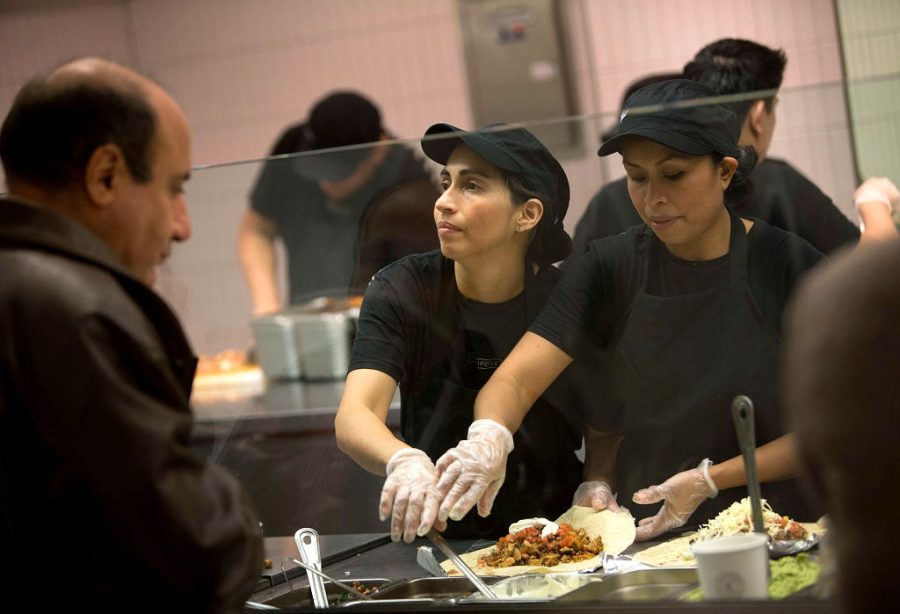
In August 2022, workers at a Chipotle in Lansing, Michigan, voted 11-3 to unionize, becoming the first and only employees at the chain to ever win union recognition. Three years later, they still don’t have a contract. After years of bargaining, the Chipotle corporation and Teamsters have indefinitely paused negotiations, and workers no longer anticipate a collective bargaining agreement at their store.
The Chipotle Union of Teamsters (CUT) is now winding down its campaign, but the organizers who built it don’t consider it a failure. Core members of the CUT organizing committee, Atuyla Dora-Laskey and Harper McNamara, are now looking back on their three-year campaign and its anticlimactic close and still finding reasons for optimism.
Despite the outcome in Lansing, Dora-Laskey told Jacobin, “I think it’s really possible. I know this is hopeslop but actually doing it and getting so close to it happening made it actually feel like way more possible than it was when it first started.” If workers are interested in organizing other locations or other restaurants altogether, she advises, “You should unionize.”
Maine and New York Efforts
In 2022, before the Lansing effort was public, workers at a Chipotle location in Augusta, Maine, announced their campaign to unionize. Augusta workers formed an independent union called Chipotle United just weeks after organizing a walkout protesting unsafe working conditions in their store. The Chipotle corporation declined to voluntarily recognize the union, and Chipotle United never had the opportunity to hold an National Labor Relations Board (NLRB) election. In a textbook anti-union move, the company temporarily closed the store just after the union went public and soon announced a permanent closure alleging that they were “unable to adequately staff” the location.
In New York City, workers had been organizing even longer and took a different approach. Chipotle workers across the city have organized with and received support from 32BJ Service Employees International Union (SEIU). This collaboration falls under the umbrella of the SEIU’s Fast Food Union, although no New York City locations have filed for union election. Instead, the effort has sought to enforce existing labor law.
In 2017, 32BJ SIEU led efforts to garner support for a package of five bills benefitting fast-food workers that are collectively known as the “Fair Workweek Law.” The Fair Workweek Law contained a package of potentially life-changing provisions for workers that would require two-week advance notices of work schedules, the option to refuse schedule changes and “clopens,” (when an employee closes the restaurant and also opens it the next morning) premium pay for schedule changes and clopens, and more.
Chipotle was among the employers who consistently violated these laws and subjected workers to inconsistent and untenable scheduling that impacted worker income, sleep, and quality of life. The company also routinely violated the 2014 Paid Safe and Sick Leave Law. In late 2018, a group of 160 affected workers at Chipotle organized and sought the support of 32BJ in filing a complaint over these violations. Amid their ongoing organizing in 2019, some Manhattan Chipotle employees were subjected to harassment and intimidation from managers, which led to an additional complaint.
In 2020, Chipotle workers and 32BJ adapted to meet the emergent needs of Chipotle employees in New York City. This included labor action protesting unaddressed rodent infestations as well as health and safety concerns that arose during the early days of the COVID-19 pandemic. In 2022, the 2018 complaint finally reached resolution. In a breakthrough settlement that August, the workers who partnered with 32BJ secured an award of a $20 million settlement distributed among 13,000 affected Chipotle workers who worked for the company between 2019 and 2022.
Over the last six years in New York, campaign awareness and density of union support has varied widely. Yet despite not holding a union election or securing a collective bargaining agreement, the Chipotle Fast Food Union is an important case study, demonstrating the scale of impact in enforcing pro-labor legislation where it exists. The Chipotle Fast Food Union also presents new questions: What else would be possible if workers were able to maintain a high density of union support, and what specific challenges are holding them back?
Chipotle Union of Teamsters
The union at the West Lansing location of Chipotle began to take shape in April 2022 after months of one-on-one organizing conversations among coworkers. Workers soon voted to affiliate with the Teamsters, forming CUT, and by July, organizing committee members had collected signed union cards from 83 percent of their store. In August, crewmembers voted 11-3 to unionize and became the first Chipotle location to win union recognition. This was a triumph that brought CUT and Teamsters Local 243 new organizing challenges and opportunities.
For Dora-Laskey, the path forward often felt uncertain. She recalled, “We were so focused on unionizing we didn’t really think to ask them for a plan.” None of the Chipotle employees who voted to unionize had ever been a part of a union before, and affiliating with the Teamsters was a crash course in understanding the structure and mechanics of large international unions.
It was new territory for Teamsters 243 as well. Chipotle workers at CUT’s Lansing location were all part-time and particularly young, almost entirely Gen Z (see: “hopeslop”). Fighting a national corporation with a unit of around twenty workers was another fresh challenge for the Teamsters. To mount a battle against a national employer from one store in Lansing, Local 243 would need support from leadership in the Food Processing Division and the International.
That September, Chipotle workers at other locations tried to get in contact with CUT so that they could assess the possibility of building organizing committees and starting unions at their own stores. Managing the intake of requests for organizing assistance was beyond the capacity of CUT and its greater union local.
CUT turned to the Emergency Workplace Organizing Committee (EWOC) to help field requests from interested Chipotle workers. Soon they developed a plan to set up and promote an intake form through EWOC’s web presence. The intake form gained further traction after being retweeted by the International Brotherhood of Teamsters (IBT). CUT continued to hear about possible campaigns at other stores as they elected a bargaining committee and prepared to go to the table.
The beginning of contract negotiations in December further illustrated what CUT and the Teamsters were up against. Chipotle flew out corporate lawyers and representatives and pushed for an exhaustive management rights proposal. CUT and the Teamsters reasoned that only two sessions in, the company was pushing hard for an impasse. Negotiations slowly continued in the coming months and the CUT organizing kept fielding interest from other Chipotle workers while maintaining the engagement of coworkers in their own workplace.
Organizing Reboot
In May 2023, CUT experienced a breakthrough in bargaining when the IBT flew out legal counsel to join bargaining sessions. Dora-Laskey remembers that “up until that point it was the entire Chipotle corporation up against this one Teamster local and Chipotle wasn’t taking that very seriously.” This was a new era of bargaining, a “reboot” as some CUT members called it.
As the union worked with the IBT to develop a media campaign that foregrounded how poor working conditions contributed to health and safety issues in all Chipotle locations nationwide, organizers switched gears. For the time being, they decided to focus on the single store in Lansing rather than expansion. It was a high point for enthusiasm. Before the year ended, members of Teamsters 243 had rallied in front of the Lansing store for a “practice picket,” and CUT had reached tentative agreements on some of workers’ most pressing concerns. CUT also started a newsletter designed to introduce new crew members to the union and keep union members updated on developments in bargaining.
Even with bargaining victories and enthusiasm from Teamsters 243 and Metro Detroit Democratic Socialists of America (DSA), the organizing committee had to work hard to keep the entire crew engaged. Employee turnover was constant. And in addition to young workers including both high school and college students, the store frequently employed parents. “There was a consistent mom demographic” during one period, Dora-Laskey remembers. “There’s a lot of unique issues moms are facing, especially in regards to scheduling,” McNamara added. Folding both uniquely busy and newer crewmembers into existing work involved a combination of strategies for promoting engagement, and organizers worked hard to get campaign input from parents.
CUT established a welcoming committee for new employees, held social gatherings, and created a newsletter, “The CUT Up.” Newsletters included worker-created art, seasonally modified versions of the CUT logo, poems, a short article questioning if AI was evil, bargaining updates, and more. In April 2024, when Chipotle corporate directed members to stop including chicken in their crew meals, CUT fought back through consultation with the Teamsters and by going to the press. The corporation backed down. The June newsletter asserted, in bold text, “We used our union to win back chicken.”
There were wins to celebrate, and the union was strong. Nevertheless, the burnout was real as bargaining slowed and stalled.
On-Again, Off-Again
At this juncture, CUT members report that they entered a new era of bargaining. That spring, decisions about the direction of the contract campaign were transferred into the jurisdiction of leadership within the Teamsters’ Food Processing Division. McNamara remembered it caught the organizing committee off guard “because it was essentially a change that had nothing to do with our situation but had some of the most severe implications for our entire campaign.”
Union members felt that the possibility for national boycotts and handbilling was constantly taken off and put back on the table. After a frustrating twelfth bargaining session, the Teamsters issued a press release announcing the potential for a national boycott starting January 2025. CUT organizers didn’t think then that they needed to strike in order to see a boycott, but as conversations with leadership shifted toward a strike vote, organizers understood that a strike might be the only way they would get sustained support from the international.

A proposed in-person vote for January, which would have been during winter break for college student employees, was pushed to February after worker advocacy. Core organizers within the union didn’t worry that their coworkers wouldn’t strike, but they worried that the in-person strike vote would not be accessible to all members of the bargaining unit. Around 25 percent of bargaining unit members requested a virtual option because they were out of town or lacked childcare.
At the in-person-only strike vote, eleven out of twenty members attended and voted 9-2 to go out on strike. Although a simple majority of members voted overwhelmingly to strike, the turnout was deflating, and the organizers didn’t know how the international would handle it. For a few months, their campaign was suspended in time. Was it really over?
For McNamara and Dora-Laskey, closure came in the form of a phone call at the end of April 2025. They report being told that their union hadn’t demonstrated a credible strike threat and that returning to the table without it could result in a risky impasse. The Chipotle corporation was holding out on standard language for Teamsters contracts. Without what they recognized as a credible strike threat, Teamsters leadership was reluctant to escalate or continue bargaining. It was over, at least at this location this time.
Still, organizers don’t see the Chipotle Union of Teamsters as a failure. McNamara summarizes, “Within the major loss of the contract campaign, it’s easy to forget that we have this big win of organizing and actually winning an election at our Chipotle.” Chipotle workers in Lansing, like those in Augusta and New York, have knocked at organized labor’s door.
Even though prior efforts have yet to result in contracts, these workers and their campaigns demonstrate what is possible. In New York, workers enforced labor law that Chipotle had flouted for years. In Augusta, worker efforts exposed how seriously the company takes the threat of organization. And in Lansing, part-time workers carried out a multiyear campaign in a college town while continuously folding in new coworkers. They built community and won back chicken.
McNamara continues, “It was obviously a lot of work, but you really didn’t have to be an expert. It really just took asking your coworkers how they felt about the situation and coming up with a plan together.” Although they weren’t able to reap the fruits of early tentative agreements, they got further than anyone ever had. McNamara and Dora-Laskey believe that other workers can learn from their campaign, build on their experience, and finally win Chipotle workers’ first contract.