The United Workers Union is one of Australia’s largest unions, and an upcoming ballot will see members choose between militancy and the status quo.
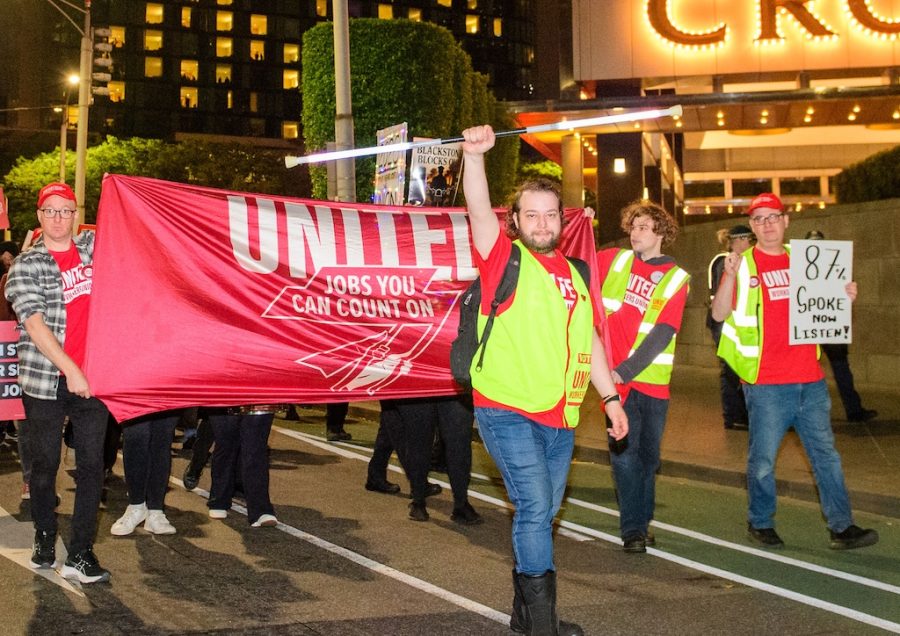
Union density in Australia has been in free fall for decades. In 1992, nearly 40 percent of workers were union members; today, that figure hovers around 12.5 percent for public sector unions. In the private sector it is closer to 8 percent. Strikes and industrial action have collapsed even more dramatically.
Militancy has not simply ebbed — it has been legislated out of existence. Unions face draconian penalties for unprotected action, meaning industrial agitation not preapproved by industrial courts. “Protected strikes” require navigating an obstacle course of ballots and bureaucratic approvals. In practice, withdrawing labor without state sanction risks crippling fines, rendering the right to strike conditional upon judicial permission.
This is the hostile terrain in which the United Workers Union (UWU) operates. The largest blue-collar union in the country, the UWU was formed in 2019 through a merger between the National Union of Workers and United Voice. The UWU is currently facing retaliation from Woolworths, the country’s largest employer, for a series of successful warehouse strikes last year.
Now a battle over the soul of the new union has erupted within its leadership. At stake are competing visions of what a trade union should be: an organization that provides services and support to workers who pay or a fighting organization that facilitates workers winning greater power in the workplace. In a May election this year, 150,000 members will decide which vision they want to endorse. A ticket called Members First, consisting of members, organizers, and some current leaders, has emerged to promote the idea of more militant trade unionism.
Jacobin spoke with UWU national secretary Tim Kennedy, who is leading Members First, about the upcoming election and the new ticket. This interview has been edited for clarity.
How has this election come about and who are Members First?
UWU holds democratic elections every four years to decide the executive leadership team. The Members First ticket is a national collective of members, delegates, organizers, and leaders who are running as a team in the forthcoming 2026 UWU election.
A serious commitment to democratic renewal requires more than rhetoric. It demands institutional reforms that expand member control and limit the concentration of executive authority. Members First is committed to rebuilding rank-and-file industrial capacity by investing in delegates, strengthening workplace organisation, and putting decision-making powers back with members. We will do all this, but without transparency and accountability these things will not survive. It’s time to bring sunlight into every level of our union, especially our elected executive.
We initially formed UWU to rebuild the power of working people, to deal with inequality, and to confront the cost-of-living crisis. We cannot wait any longer. The union has reached a tipping point. A democratic election will allow members to decide which vision they support and what kind of union they want to be.
Union members put everything on the line when they stand up to bosses and take strike action to improve their lives. And so it’s my responsibility to put everything on the line too. Members have a genuine choice this election. I am throwing my support behind Katie McGinn to be the union’s first rank-and-file national president. I will support members and organizers to step up into leadership roles across the country. As national secretary my job will be to make space for the next generation of leaders. Together we will ask members: What will we fight for and how will we win?
It seems strange that a national secretary of a union is backing a ticket to reform the union he currently leads. Could you explain the dynamics here?
Robust debate and disagreement are healthy benchmarks of a living, breathing democratic institution. But what happens when decision-making is structured such that an internal bloc can function as a de facto veto? When structural safeguards are weak, disagreement ceases to be productive and instead becomes paralyzing. This is the structural challenge confronting UWU.
The current leadership structure permits a small group of people to govern through obstruction and predetermined alliances that pay little regard to member’s wants and expectations. What appears as collegial governance operates, in practice, with brute force.
Over the last four years at UWU, many significant union-wide changes have been made not as a result of genuine debate and engagement with members, but because a majority group of directors have voted like a caucus again and again, pushing through procedural and structural changes without debate.
UWU’s world-class training and education team was outsourced. Union directors were removed from their portfolios without forewarning or consultation. Further, the current leadership majority has remained unsupportive of providing members access to the minutes of executive meetings to see how decisions have been voted on — something which we have made a core part of the Members First platform. These decisions are illustrative rather than exhaustive, reflecting a broader pattern of behaviors.
The current leadership majority has also strategically removed important functions and portfolios from the office of the national secretary. This includes governance, finance and administration, and communications. Attempts were made to limit my ability to directly communicate with politicians and the media. As national secretary, I have maintained public visibility and accountability without genuine decision-making powers at the governance level. The issue here is not a personal desire for power, but one of institutional incoherence whereby a union leader holds great responsibility without corresponding ability to have a say in how the union is run.
Union membership has been falling in Australia for decades. What’s behind this decline?
The decline of union density and strike rates is often blamed on external forces; hostile labor laws, globalized capital, employer aggression, precarious work, and the like. These are certainly powerful forces. However, there is another crisis the labor movement is less willing to confront: the erosion of democracy within our own unions. How can workers expect to exercise power in their workplaces if they do not meaningfully hold power in their own unions?
Over time, many unions — in Australia and elsewhere — have professionalized leadership and consolidated authority in executive bodies and structures. This centralization is often justified in terms of efficiency due to the many complexities of coordinating a large organization. There is some truth in that. But efficiency must not come at the expense of democracy.
The Australian Labor Party has a firm grip on almost all of the nation’s trade union bureaucracies. This results in unions orienting toward electoral politics. Why is this problematic?
A union’s structural problems are an issue of power. What is the purpose of a union? How does it build power to achieve its goals? These are not abstract philosophical questions. A union’s understanding of power shapes how it allocates resources, defines priorities, and engages politically. Does power reside primarily in parliamentary relationships and political patronage? Or does it reside in everyday workers taking collective action over the issues they care about?
This need not be a zero-sum game. Electoral politics matters. Legislative reform matters. But too often the collective power of union members is mobilized primarily for political pressure or electoral campaigns. Members are treated as placard-wielding props, not revolutionary agents capable of changing their own lives for the better. Without industrial power, political gains are fragile and short-lived. The history of labor movements internationally has shown that power in the workplace is not gifted by sympathetic governments but sustained through constant collective struggle.
The contrast between these approaches rests on competing theories of power and is nowhere more apparent than in attitudes toward the Australian Labor Party. This is not simply a tactical disagreement but a dispute over the source of working-class power itself. Some view the election of a Labor government as the culmination of union struggle. But the only way that any party can start to deliver for workers again is if we can rebuild strong, industrially powerful, and democratic unions. Free and democratic unions underpin free and democratic societies. Our power to affect positive political change comes from organizing, growing union membership, showing solidarity, and taking action in workplaces and across industries.
If unions define their role primarily as electoral backers rather than independent power centers, they narrow their strategic horizon. Industrial strength and political engagement are not mutually exclusive. But the former must anchor the latter. If unions primarily become vehicles for electoral influence — funding campaigns in the hope that favorable governments will deliver — they risk neglecting the very source of their strength. Organized labor must not outsource its power.
Internal union disputes and elections can be fairly bruising. What kind of pushback are you anticipating from your opponents?
Efforts to democratize entrenched structures rarely proceed without resistance. Across institutions, be they political parties, corporations, or unions, those who benefit from concentrated power tend to defend it. Those who seek change are frequently accused of destabilization or disloyalty. Internal debate is reframed as division.
Throughout the current contest within UWU there have been personal attacks targeting me and others who have stepped up to call for greater transparency and accountability. This is one of the challenges of living in an era of misinformation. These tactics are a regrettable yet predictable response when people that hold authority are challenged through democratic processes. I am committed to maintaining a focus on the positive program outlined by Members First for rebuilding a strong, transparent, and democratic union.
Democracy dies in darkness. The union must be protected from structural vulnerabilities that allow disproportionate power to accumulate in too few hands. In the UWU, executive bodies now operate with limited transparency. Directors sit on the very oversight bodies that are meant to hold them accountable. Members cannot access minutes, voting records, or decision-making processes. Democracy has become procedural rather than substantive. It exists on paper but not in practice.
The promise of unionism has always been that ordinary workers, acting together, can change the conditions of their lives. That promise must begin inside our own unions. If we cannot practice democracy at home, we cannot credibly demand it from governments. Renewing the labor movement will require confronting uncomfortable truths. It will require structural change as well as cultural change. But if unions are serious about rebuilding working-class power in an era of deepening inequality, union democracy is a necessary first step. Democracy is not a procedural burden to be managed, it is the precondition for collective strength.