As the 2026 World Cricket Cup unfolds under diplomatic strain, rising tensions between India, Pakistan, and Bangladesh show that the sport is no longer just a game but a stage where politics, nationalism, and media capital collide.
In a barbershop in downtown Srinagar, in what locals still call Shehr-e-Khaas, the crowd is not waiting for haircuts. They are waiting for the toss — the coin flip that determines who bats first.
The shop is narrow — its walls lined with mirrors that multiply the room into reflections of reflections. Hair gel, talcum powder, aftershave bottles, and shaving creams crowd the glass shelves. The scent of talc and trimming spray lingers in the air.
A television is mounted high in a corner, tilted slightly downward so it can be seen from every chair. Loose cables dangle beneath it. On the screen, the green outfield fills the room with a glow.
Customers sit half-caped in barber chairs, clippers paused mid-trim. Others stand shoulder to shoulder behind them. An elderly man occupies the waiting bench along the wall. A young boy leans forward between two chairs, eyes fixed upward. In the mirror, their faces reflect the same expression — anticipation.
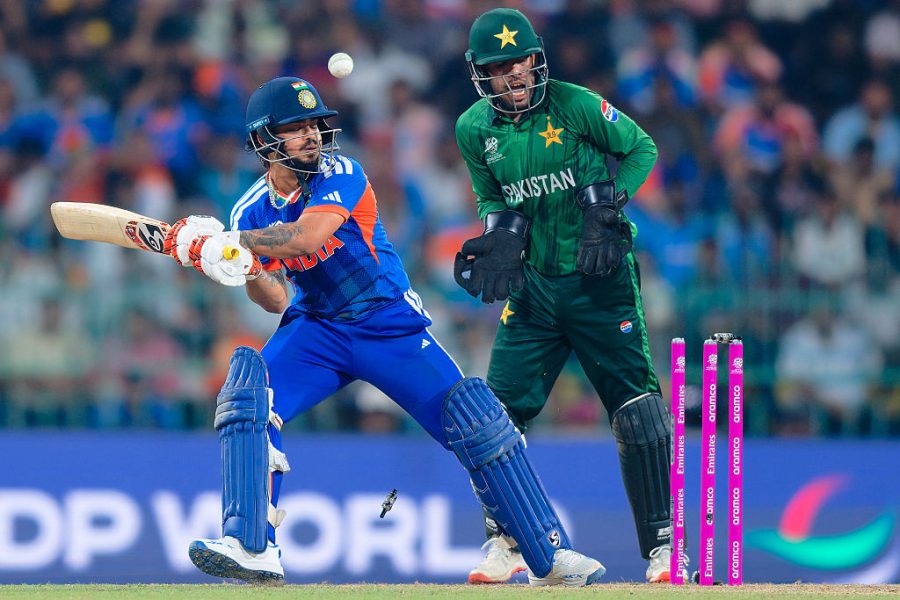
India versus Pakistan. Even before the first ball, the room feels political.
“I swear streaming is ahead by a few seconds,” a young man says, glancing at the score on his phone.
“Satellite never fails in the tight overs,” another replies, as if signal strength were a matter of national pride.
Someone joked that nobody should blame the barber if Suryakumar Yadav gets out. Laughter ripples briefly through the shop. The clippers buzz again, then stop.
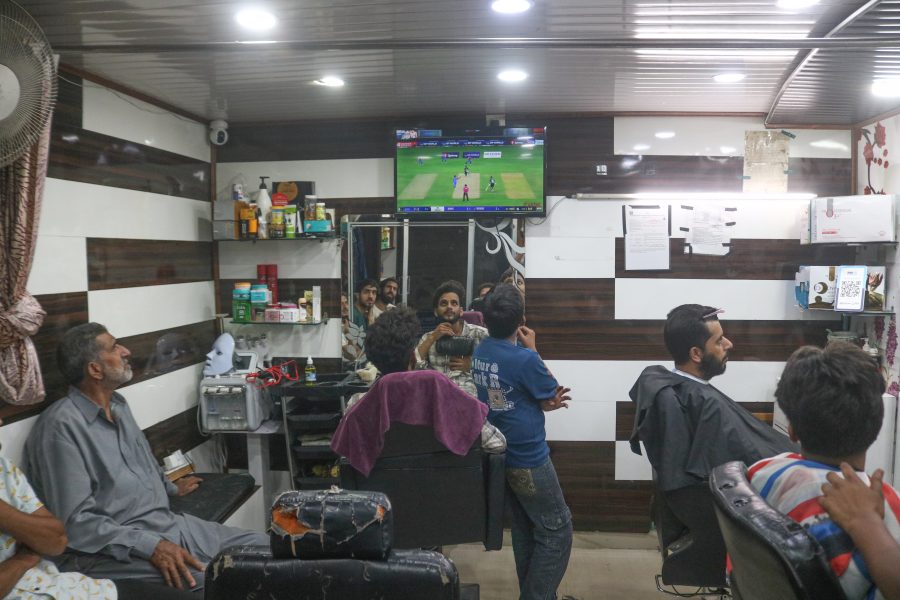
The screen freezes. In the mirror, half-shaven faces stare upward at a buffering circle.
“Even the signal wants to stay neutral,” someone mutters. “Doesn’t want to pick a side.”
But the joke lands with slight unease. In 2026, cricket in South Asia no longer feels insulated from politics.
The tournament has already been reshaped by diplomatic strain: Bangladesh requested relocation of its fixtures from India, Pakistan signalled its discomfort, the International Cricket Council (ICC) scrambled for compromise, and the India-Pakistan match was ultimately shifted to Colombo under the so-called hybrid model.
“Cricket politics ke beech latka hua hai,” says Adil Mir, a twenty-four-year-old student in the room — “Cricket is hanging between politics.”
He shrugs. “It feels like our happiness depends on politicians.”
He laughs, but he isn’t joking.
The Tournament Before the First Ball
The 2026 ICC Men’s T20 World Cup was marketed as a celebration — cricket’s most explosive format delivered to its most passionate markets. But before the first boundary was struck, the tournament had already been renegotiated diplomatically.
Bangladesh raised security concerns over playing in India amid heightened regional tensions. Pakistan’s cricket board, under pressure from domestic political currents, signaled solidarity. The ICC rejected relocation requests but moved certain high-voltage matches to neutral venues to avoid escalation. The compromise was administrative, but the implications were structural.
India-Pakistan, cricket’s most commercially lucrative rivalry, was played not in either nation but in Sri Lanka — physically neutral but emotionally combustible.
In Delhi, marketing executive Raghav Sharma told Jacobin over the phone: “Fans don’t care about where. They just want it to happen. India-Pakistan is the Super Bowl for us.”
But fans don’t decide where matches are held. Governments do. Boards do. Sponsors do. Cricket today operates less like a league of equal nations and more like a multinational enterprise navigating geopolitical risk.
Formally, the ICC governs global cricket. In practice, India’s economic dominance gives it outsize influence in how the sport is run. The Board of Control for Cricket in India (BCCI) receives the largest share of ICC revenue distribution under current arrangements, reflecting the massive broadcasting market India represents.
Indian television and streaming rights generate a disproportionate percentage of global cricket income. Prime-time windows are aligned with Indian audiences. Advertising premiums surge during India fixtures. This difference confers a huge advantage to the country.
When India declines bilateral cricket with Pakistan, the loss is felt economically across the sport. When India insists on hybrid hosting rather than touring Pakistan, tournament structures bend accordingly.
A Mumbai-based lawyer, Arun Mehta, put it bluntly: “When one board funds the system, governance becomes negotiation, not democracy.” As cricket has gone global, power has followed revenue — and revenue flows disproportionately through India.
Bangladesh’s relocation request exposed this imbalance. Smaller boards rely heavily on ICC distributions; open confrontation carries financial risk. Flexibility becomes a form of survival.
As one fan, Mohammad Salman in Dhaka, told Jacobin over the phone: “We are proud, but we are also dependent.”
Rivalry as Revenue Stream
India-Pakistan is not just a rivalry. It is a business model.
Streaming concurrency spikes. Advertising slots sell at extraordinary rates. Sponsors design entire campaigns around a single match. Television debates frame the match as destiny.
When India defeated Pakistan in Colombo this year, social media exploded within seconds. The phrase “How is the neighbor?” — a loose English translation of the viral Hindi-Urdu taunt “Padosi kaisa hai?” — trended across platforms.
It’s shorthand for teasing the rival nation after defeat — and the meme culture is relentless. Within minutes come the edited clips, the sarcastic overlays, the mock scorecards reimagined as report cards.
Reacting to the defeat in a recent game with India, former fast bowler Shoaib Akhtar criticized Pakistan’s approach, saying the team tends to get “bogged down” against India. He also questioned decisions around planning and execution with remarks that reignited debate over the team’s direction and preparation.
On the Indian side, current and former players were equally active. Tweets praising resilience, celebrating key wickets, or subtly reinforcing national pride went viral almost instantly. Even when messages are apolitical, they are read politically.
After nearly every India-Pakistan encounter, timelines flood with celebratory emojis, flag icons, and coded jabs. The match does not end at the boundary rope. It migrates to digital battlegrounds.
A software engineer in Bengaluru told Jacobin over the phone that, “Honestly, half the fun now is refreshing Twitter after every wicket.”
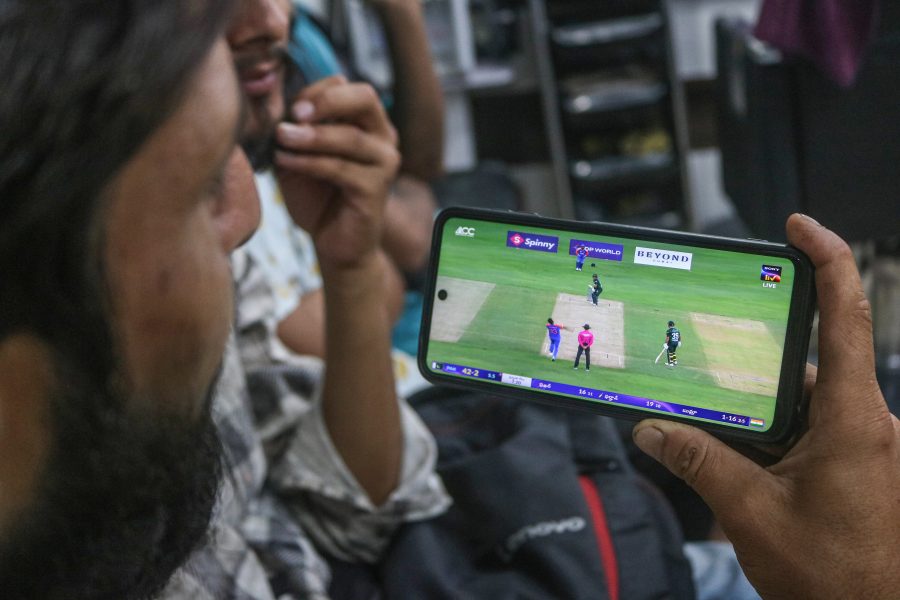
But that “fun” is algorithmically curated antagonism.
Digital platforms reward provocation. Memes mocking the “neighbor” generate engagement. Engagement generates revenue and rivalry becomes monetized nationalism.
Politics does not merely shadow cricket in South Asia; it sometimes shares its heroes. Former Pakistan captain Imran Khan remains both a cricket legend and a deeply polarizing political figure. His imprisonment and ongoing legal battles have generated global commentary.
Recently, a group of former international captains, including respected Indian players, had publicly appealed for humane treatment and medical care for Khan. Their intervention was framed in terms of dignity, not partisanship. But in South Asia’s charged climate, even appeals for basic decency acquire political color.
Cricket icons speaking about political leaders underscore the permeability between domains. In Pakistan, cricket has often been intertwined with state narratives. In India, political rhetoric frequently appropriates cricketing symbolism.
In Kolkata, political science lecturer Naveen Singh told Jacobin over phone, “Cricket is the safest space to express nationalism. That is why politics borrows it.”
Safe nationalism is still nationalism. When ex-captains comment on imprisoned leaders, when ministers tweet match results as metaphors for national strength, when broadcasters use military language to describe overs, it becomes impossible to deny the overlap between sport and politics.
The Cost of Concentration
The ICC’s “hybrid model” has become the default solution to South Asia’s diplomatic impasses. Matches involving politically sensitive pairs are moved to neutral venues. Official statements stress logistics and security.
But the hybrid model is not so much a solution as a symptom. It preserves broadcast revenue while acknowledging diplomatic fracture. It avoids forcing governments into overt concessions. It allows rivalry to continue without reconciliation.
In Ahmedabad, earlier tournament matches were wrapped in spectacle, choreographed ceremonies, patriotic montages, and fireworks synchronized to drumbeats. In Colombo, the India-Pakistan match felt geographically displaced yet commercially intact — neutral ground does little to neutralize sentiment.
The model reveals cricket’s dependence on adversarial states. Without India-Pakistan, advertising projections dip. Without Bangladesh, the South Asian bloc fractures. The sport’s economic engine relies on precisely those tensions that destabilize it.
As the match in Srinagar reaches its middle overs, phones buzz incessantly.
One man reads aloud a tweet mocking Pakistan’s middle-order collapse. Another counters with a Pakistani meme predicting an Indian batting choke.
The phrase “the neighbor couldn’t handle the heat” appears in English-language posts — a translation that sanitizes the more biting original taunt.
Digital spectatorship is no longer passive. It is participatory antagonism.
Influencers, comedians, former players, and anonymous accounts all compete to shape narrative within minutes of each wicket. Satirical edits circulate. Old match highlights are resurrected to reinforce patterns of dominance.
A Delhi-based journalist told Jacobin over the phone, “India-Pakistan is less a match now and more a content cycle.”
Content cycles have sponsors. Sponsors have metrics, and metrics reward emotional intensity. Behind the verbal jousting and memes lies an increasingly consolidated sports economy.
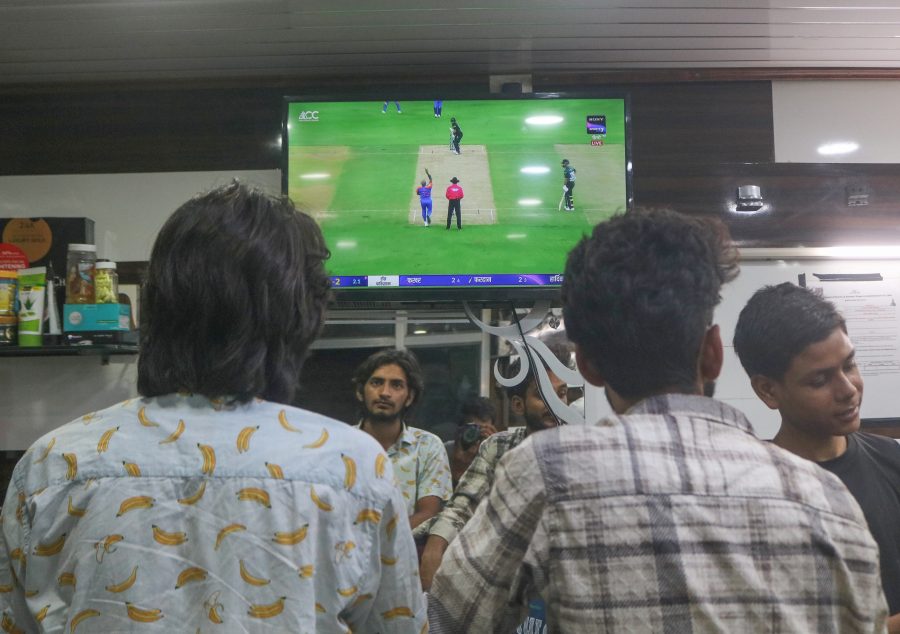
Broadcasting rights are fragmented across subscription platforms. Fans often require multiple paid services to follow a full tournament. In Srinagar’s barber shop, the wall-mounted TV shared one connection of a practical adaptation to a monetized ecosystem.
“Individually it’s expensive,” Adil Ahmad explains. “Together we manage.” At the top of the pyramid, boards negotiate billion-dollar deals while, at the bottom, fans pool passwords.
The neoliberal model of sport centralizes revenue while dispersing cost. And because India represents the most lucrative market, tournament schedules orbit its time zones, its advertisers and its political comfort.
Smaller boards navigate carefully. Bangladesh’s brief resistance over the venue underscored its limited leverage. Pakistan’s solidarity signals were calibrated. Nobody wants to risk exclusion from the revenue pool — a reality that leaves precious little room for political autonomy.
The Last Over
Back in Srinagar, the match enters its final overs. The shop tightens. Every run is debated. For a few moments, cricket feels elemental again — bat, ball, tension.
When the winning runs are scored, the shop erupts. Shouts spill into the narrow lane outside. Firecrackers crackle in the distance. Phones light up immediately. Tweets. Reels. Memes. “How is the neighbor?” in polished English fonts.
Reaction videos from players circulate within minutes, dissecting tactical failures. Indian players post celebratory graphics. Hashtags trend.
The match migrates from field to feed.
Ghulam Nabi Dar watches quietly. “Game khatam,” he says. “Politics baqi.” (The game is over. Politics remains.)
The 2026 T20 World Cup will likely conclude with statistics celebrating viewership records and revenue milestones. Administrators will cite resilience. Sponsors will highlight engagement metrics.
But the tournament has illuminated a structural contradiction. Cricket’s economic heart lies in a region defined by enduring geopolitical tension. Its most profitable rivalry is also its most diplomatically fragile. Its governance model concentrates power in markets that are themselves political actors. Sport, once imagined as neutral ground, now mirrors the asymmetries of global capitalism and nationalism.
In the barbershop in Srinagar, people experienced joy, frustration, laughter, and pride. None shaped the venue decisions. None negotiated the hybrid model. None influence revenue-sharing formulas. But they are part of the audience that sustains it all.
Cricket remains emotionally powerful. It still gathers people into rooms. It still produces moments of collective transcendence. While the buffering circle disappears once the signal stabilizes, the political one does not.
And so cricket continues — suspended between rivalry and revenue, spectacle and statecraft — watched from crowded shops and living rooms where the stakes feel both intimate and impossibly distant.