Mallory McMorrow, who is running against Medicare for All champion Abdul El-Sayed for US Senate, recently went viral presenting herself as a populist crusader against surveillance pricing. Her record as a Michigan state legislator tells a different story.

In her high-profile campaign for Michigan’s Democratic Senate nomination, Mallory McMorrow has suddenly gone viral with an explainer video depicting herself as a crusader against surveillance pricing. It’s a solid video boosted by legacy media and online lefty groups, and it touts a crucial cause pioneered by leaders like former Federal Trade Commission Chair Lina Khan as well as by state and federal lawmakers who are bravely challenging the power of Big Tech.
So, as I watched my own state’s legislators this week doing the hard work to advance a bill to curtail surveillance pricing, I went looking for how McMorrow has championed this cause as one of the top leaders of her own state’s legislature. She purports to believe deeply in stopping corporations’ practice of spying on consumers and then using the data to charge different consumers different prices. So surely she must have a detailed voting record on the matter that will tell us exactly how she’s going to change the game in the US Senate, right?
So I looked. And looked. And looked — and I ultimately found nothing other than what appears to be a cartoonish level of cynicism . . . and a series of McMorrow votes to provide state tax incentives to build the data centers that power the surveillance-pricing system she’s now going viral for saying she opposes.
I started my search in the Michigan legislature and found a whole list of bills that reference pricing. I did find HB 5771 and HB 5222: Democratic legislation in the state’s GOP-led House that’s designed to curtail surveillance pricing. McMorrow is not listed as a sponsor of these bills nor do there appear to be versions of these bills in Michigan’s Democratic-led Senate, where McMorrow serves as the chamber’s majority whip.
Was I looking in the wrong place? I decided to ask the surveillance system itself: I logged on to ChatGPT and asked. Here’s what it told me:
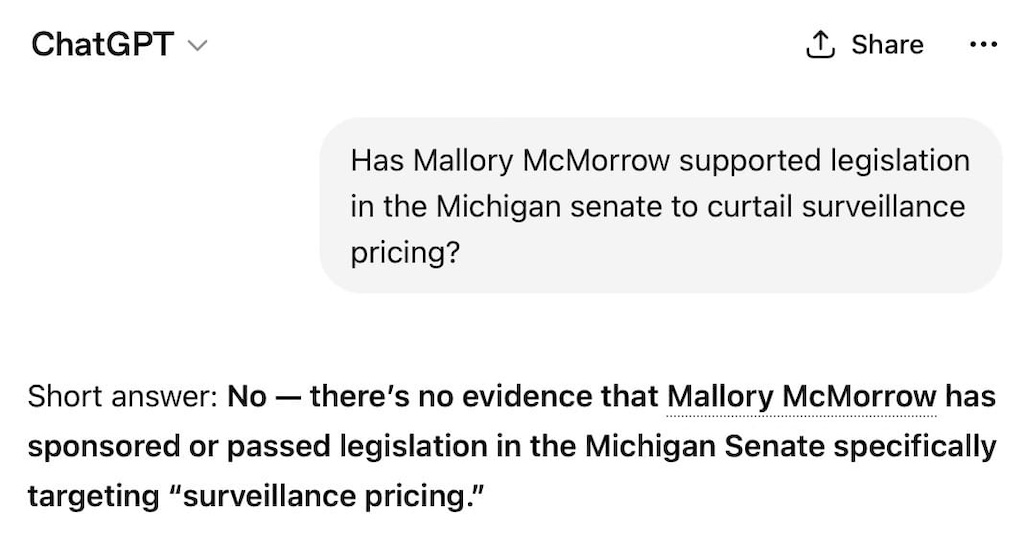
OK. ChatGPT sometimes gets stuff wrong. Was it wrong here? Apparently not.
“There’s a bill to ban surveillance pricing in McMorrow’s legislature right now. She hasn’t sponsored it,” tweeted the American Economic Liberties Project’s Lee Hepner, one of the architects of such legislative proposals popping up across the country. “McMorrow’s own Congressmember, Rep. [Rashida] Tlaib, introduced a ban in grocery stores. Sen. [Ruben] Gallego and Rep. [Greg] Casar have economywide bans. Bizarre to say she’ll ‘introduce a bill.’”
I called up Hepner to double-check about his tweet.
“The Michigan bill is very much on our radar, and it resembles bills we’ve been working on in other states and it would be a good one to support,” he told me, and then added that “it’s just so weird” for her to promise to introduce legislation in the US Senate . . . that she hasn’t introduced in the state senate that she currently leads.
Cynical All the Way Down
Having worked in and around politics for decades, I believe in the better-late-than-never axiom: If a politician is belatedly arriving to a righteous cause, then maybe don’t treat them as a great leader of that cause but definitely welcome them. See them joining the cause as a sign the movement behind that cause is gaining momentum. And so on that level, it’s good news that McMorrow is centering the anti-surveillance-pricing cause in one of the country’s most important US Senate races.
What’s not good news is that she appears to assume that as a US Senate candidate, she can make an influencer video depicting herself as a leader of a cause and be lauded as a hero by credulous media and the clickslop attention economy. . . all while refusing to actually take on Big Tech and lead the fight for that cause in her current position of very real power. Instead, she used her power to help pass data center tax breaks for Big Tech (her spouse reportedly had ties to an energy company that aimed to power the data center boom).
Taken together, this is a deep level of cynicism that stands out even in this political era defined by cynical politics. In this case, the influencer candidate gets to present themselves to voters as a fighter against a wildly unpopular tech industry while not actually doing anything to antagonize Big Tech donors (and instead supporting tax incentives that enrich those donors). It is a wink-and-nod move that assumes that inside the attention economy, nobody will bother to interrogate any piece of content that’s slickly packaged for the algorithm.
Of course, perhaps McMorrow’s assumption will prove correct in a society that forgets its entire world every fifteen minutes and barely ever scrutinizes anything on our screens. But if the assumption is validated — if candidates can pull off that kind of trick and be rewarded for that deception with a victory in a US Senate Democratic primary — then we shouldn’t expect them to do much to change anything when they win office. After all, they’ve learned that Democratic voters will reward their cynicism.
The Rise of Clickslop Campaigns
To me, this example illustrates not just the cartoonish cynicism of one candidate but also the larger downside of so-called influencer candidates who rely on online virality rather than their records as the backbone of their campaigns.
Digital sophistication and fluency are important for modern campaigns, and those assets can be used for good when they are used to boost a candidate’s substantive record (see Zohran Mamdani’s mayoral campaign). But those assets can also be used to deceive.
In this particular case, there’s a link between the issue itself and the soft deception-by-omission. The same algorithms, AI systems, and data centers that let corporations engage in surveillance pricing also add virility to slickly deceptive videos from influencer candidates — all while downgrading and shadow banning substantive reporting that might debunk those influencers’ clickslop.
The original democratic promise of the internet was that it would give voters more access to more information so that they could cast more informed votes. But here we see the opposite is now the case: in the age of influencer politicians exploiting the attention economy, deceptive information is often rewarded online by clicks, likes, and algorithmic boosting — while inconvenient truths about what’s happening here in the offline world are ignored.
This article was first published by the Lever, an award-winning independent investigative newsroom.