As a movement builder, spokesperson, and candidate for the presidency, Jesse Jackson’s accomplishments were massive. He was one of the towering figures of American progressive politics in his era — or any era.
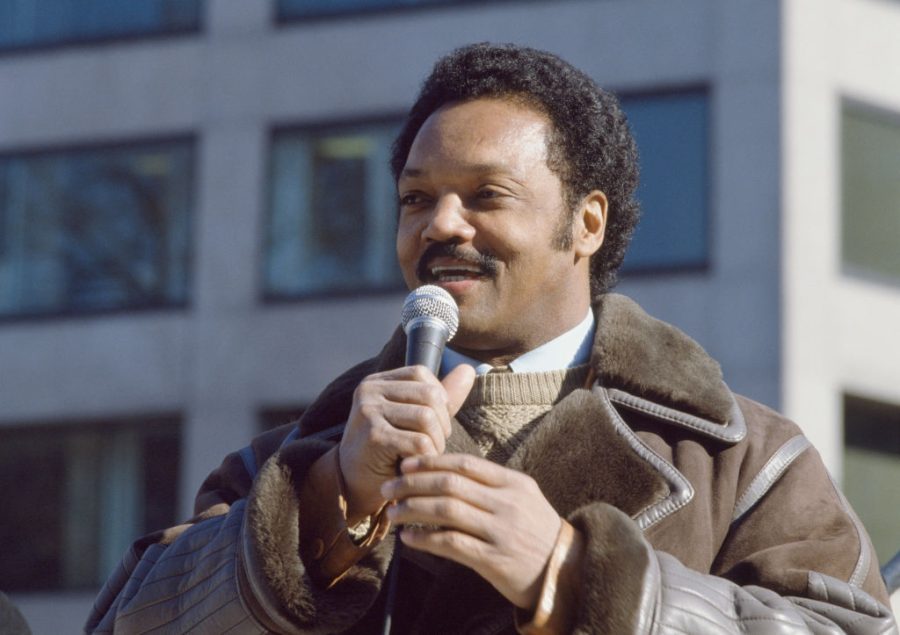
One of the most famous photographs of Martin Luther King Jr shows him standing on the balcony at the Lorraine Motel in Memphis, Tennessee, with three of his top aides — Ralph Abernathy, Hosea Williams, and Jesse Jackson. The next night (April 4, 1968) on that same balcony, King was murdered. Jackson was one of several staffers with King at the hotel that fatal night.
Jackson had been drawn into King’s inner circle at a young age. After King’s death, some activists considered Jackson to be the slain leader’s heir apparent, although others considered Jackson too young, inexperienced, and brash to assume King’s mantle. By the 1970s, however, Jackson had become the nation’s most visible civil rights leader. By the time he ran for president in 1984 and 1988, he had transcended the “civil rights” label to become the most visible progressive leader in the country, with a racially and economically diverse following that he called a “rainbow coalition.”
Twenty years later, in 2008, another photo symbolized the long journey that Jackson, and the nation, had taken. It showed Jackson standing in Chicago’s Grant Park, holding a small American flag, with tears in his eyes, as he listened to Barack Obama speak to a huge crowd on the night he was elected president of the United States. The photo did not require a caption. Jackson had clearly paved the way for Obama’s victory.
Eight years after that, then again four years later, Sen. Bernie Sanders — a longtime supporter of Jackson’s dating back to the Vermont socialist’s days as mayor of Burlington — would take up the mantle of Jackson’s mission in his own transformative presidential campaigns.
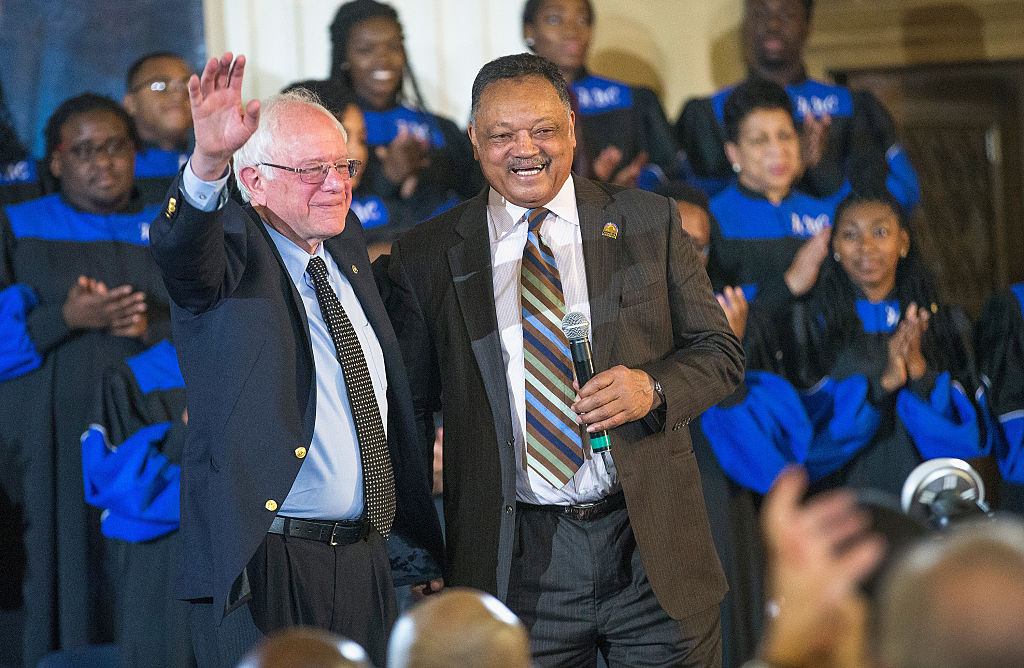
In the forty years that separated King’s assassination and Obama’s election, and the half century separating that assassination and Bernie’s two presidential runs, Jackson, who died on Monday at age eighty-four, played a pivotal role in progressive politics, as a movement builder, a spokesperson, and a candidate for office.
Origins
Jackson was born Jesse Louis Burns on October 8, 1941, in segregated Greenville, South Carolina. His mother, Helen Burns, a sixteen-year-old high school student, was known for her soprano singing voice. His father, Noah Robinson, a thirty-three-year old former boxer who lived next door, was married to another woman and was not involved in raising young Jesse. When Jesse was a year old, his mother married Charles Henry Jackson, a post office worker. He later adopted Jesse, who eventually changed his last name from Burns to Jackson.
His outrage about segregation started early. In later interviews and speeches, he recalled the first time his mother steered him to the back of a bus. He remembered that Claussen’s bakery, where he worked on Saturdays, had two water fountains, one for whites, another for blacks.
Jackson attended Sterling High School, a segregated school, where he was a good student and a football star. He graduated in 1959 and went to the University of Illinois on a football scholarship, his first experience outside the Jim Crow South.
During the winter break of his freshman year, Jackson returned to Greenville and went to the city’s segregated “colored” branch library to borrow books for a college assignment. The black library did not have the books he needed, but the librarian told Jackson that the all-white main library had them. She called her counterpart at the main library, who told her that the books would be there waiting for Jackson to pick up. He came in through the rear entrance and saw several police officers talking to the librarian. The librarian told Jackson that none of the books was available, and the police told him to leave the library.
Angry and humiliated, Jackson stared at the sign “Greenville Public Library” and cried. When he returned from Illinois the next summer, he and seven other students, under the tutelage of Rev. James Hall, an activist minister, staged a forty-minute sit-in at Greenville’s downtown library. They were arrested, charged with disorderly conduct, and held for forty-five minutes in jail before Hall posted bail. The protest made the local television news that night.
Frustrated that he was not allowed to play quarterback at Illinois, he transferred to North Carolina Agricultural and Technical College, a historically black institution, which gave him a chance to play the position. Although the campus was a hotbed of civil rights activism — its students had triggered the first lunch counter sit-in on February 1, 1960 — Jackson did not immediately join the movement, focusing on his academic and athletic endeavors. But leaders of the campus Congress of Racial Equality chapter recruited Jackson — who was student-body president and a football star — as they were planning to protest segregation in Greensboro’s downtown businesses in the spring of 1963. As a gifted orator and charismatic figure, Jackson quickly became a leader of the demonstrations to integrate the theaters and cafeterias. For the second time in his life, Jackson was arrested, this time for “inciting to riot.”
After completing a degree in sociology in 1964, Jackson attended the Chicago Theological Seminary. But Jackson’s interest in activism won out over his formal studies, and he dropped out. (He was ordained a minister in 1968.) In March 1965, he traveled to Selma, Alabama, to participate in the civil rights marches. There he met King for the first time, and he was soon hired as an organizer for the Southern Christian Leadership Conference (SCLC).
The Organizer
After Jackson had helped organize the open housing marches in 1966 to challenge racial discrimination by landlords and real estate agents, King put him in charge of Chicago’s Operation Breadbasket, an SCLC project to increase employment opportunities for blacks. Within a year, the project had obtained 2,200 jobs for African Americans in white-owned businesses.
By 1967, Jackson was Operation Breadbasket’s national director. To secure agreements regarding fair employment practices, Jackson organized protests and boycotts of corporations that were heavily patronized by black consumers. To avoid bad publicity, some companies signed agreements to hire more African American employees and to do business with black-owned firms as suppliers. Conservative critics blasted such agreements as “shakedowns,” but the civil rights movement had a long tradition of such boycotts, starting with the “Don’t shop where you can’t work” campaigns of the 1930s.
After King’s death, SCLC leaders resented Jackson’s visibility and ambition. Jackson left the SCLC in 1971 and founded Operation PUSH (People United to Serve Humanity) in Chicago. He would direct that organization until his 1984 run for the White House. It expanded Jackson’s strategy of using the threat of boycotts to pressure companies to hire and promote black employees and to do business with black-owned firms. Operation PUSH signed agreements with many high-profile companies, including Coca Cola, Anheuser-Busch, Southland Corporation, Heublein, Burger King, and Seven Up.

By the end of the 1970s, Jackson had become a household name and was a major spokesperson for progressive views on a range of policy issues.
He condemned the Republican attacks on social spending and their support for increased military budgets. He also tied together the struggles for self-determination at home and around the world in a universal message of solidarity, human rights, and self-respect. He punctured his speeches with the phrases “I AM somebody” and “Keep hope alive,” to inspire black Americans to expect equal treatment and challenge racist abuses.
After the passage of the 1965 Voting Rights Act, more blacks were elected to public office, and white Americans got used to seeing blacks in powerful positions. A growing number of white Americans began to vote for black candidates. These trends and momentum made it possible for Jackson to consider running for president.
An Eye Toward the Presidency
Jackson already had a track record of pushing the Democratic Party to be more inclusive. In 1972, he and Chicago alderman William Singer unseated Chicago mayor Richard Daley’s Cook County delegate slate at the Democratic convention in Miami, Florida, replacing it with a more diverse group. But he remained a loyal Democrat, despite efforts by some leftists to convince Jackson to run as a third-party candidate. In 1980, he campaigned for President Jimmy Carter in his unsuccessful reelection bid.
In 1983, Jackson gave a speech highlighting blacks’ unrealized political influence, referring to the results of the 1980 election:
[Ronald] Reagan won Alabama by 17,500 votes, but there were 272,000 unregistered blacks. He won Arkansas by 5,000 votes, with 85,000 unregistered blacks. He won Kentucky by 17,800 votes, with 62,000 unregistered blacks. The numbers show that Reagan won through a perverse coalition of the rich and the registered. But this is a new day.
A growing segment of the Democratic Party’s leaders was obsessed with winning back the white middle-class suburban voters and attracting campaign contributions from business groups. Jackson wanted to stem the party’s rightward shift and the growing influence of its “centrist” wing, embodied by the Democratic Leadership Council.
Jackson’s galvanizing speeches at the 1984 and 1988 Democratic conventions, which outlined his progressive vision, made the Democratic Party establishment nervous, worried that Jackson’s visibility would undermine their appeal to independent and centrist voters.
“My constituency is the desperate, the damned, the disinherited, the disrespected and the despised,” Jackson said at the 1984 convention. “They are restless and seek relief.”
But Jackson campaigned for Walter Mondale in 1984 and Michael Dukakis four years later, helping to attract working-class voters as well as voters of color to the Democratic tickets.
Before he launched his own presidential campaign in 1984, Jackson helped secure the release of Navy lieutenant Robert O. Goodman Jr from a Syrian prison, where he was incarcerated after his plane was shot down. Jackson also secured the release of forty-eight prisoners from Cuba. These were the first of his diplomatic efforts, making him perhaps the second most well-known black American around the globe after Muhammad Ali.
But three weeks before he was scheduled to launch his campaign, he made a serious gaffe that almost thwarted his political career. During informal conversations with black reporters, he used the terms “Hymie” and “Hymietown” to describe New York’s Jewish population, a blunder reported by the Washington Post. Over the years, he apologized for those remarks numerous times.
When he declared his 1984 candidacy for president, he was following in the footsteps of former Rep. Shirley Chisholm, who sought the Democrats’ nomination in 1972.
Jackson’s two presidential runs achieved far more than many pundits had predicted. In 1984, he won 3.2 million votes in Democratic primaries — nearly 20 percent of the total primary votes cast — finishing third (behind Walter Mondale and Gary Hart) in a field of eight candidates.
He won about 80 percent of the black vote. He helped register two million voters, including many black voters, and won several primaries in Southern states with large black populations. The large black turnout for Jackson helped elect other Democrats to Congress and contributed to the party taking back the Senate in 1986.
These efforts gave Jackson leverage as a party power broker. He persuaded the Democrats to change its rules — like lowering the threshold to win delegates and eliminating the winner-take-all delegate process — which made it possible for Obama to defeat Hillary Clinton in the 2008 primaries.
By 1988, Jackson had become a crossover politician, appealing to black voters but also winning support from white voters, particularly white workers thrown out of their jobs by corporate mergers and outsourcing and white farmers losing customers to food imports from abroad. He stressed the theme of economic opportunity for all Americans and the undue influence of big business.
“If whites begin to vote their economic interests and not racial fears, and blacks vote their hopes and not despair, we can change America,” Jackson said.
His speeches included a clear and concise progressive policy agenda around the concentration of wealth and income, job insecurity, housing, poverty, health care, the environment, workers’ rights, racial injustice, women’s equality, gay rights, US militarism, and the centrality of human rights in foreign policy. He called for paid family leave, making it easier for workers to form unions, raising the minimum wage and indexing it to inflation, equal pay for women, global environmental and labor standards, and strengthening regulations on corporate America’s greed and predatory practices.
In early 1988, two weeks after Chrysler announced it would be closing a large car assembly plant in Kenosha, Wisconsin, Jackson organized a rally outside the plant. He attacked Chrysler, saying, “We have to put the focus on Kenosha, Wisconsin, as the place, here and now, where we draw the line to end economic violence!” He compared the workers’ fight to that of the civil rights movement. The United Auto Workers union local voted to endorse Jackson.
Jackson vigorously attacked American-based multinational companies that built plants in Asia, sending jobs overseas. He argued that the weakness of trade unions in Third World countries should be considered an unfair trade practice. “Let’s stop mergin’ corporations, purgin’ workers,” he told the Teamsters at their annual convention. “Let’s shift, to reinvestment in America.” As the New York Times reported in November 1987, “The overwhelmingly white audience roared its approval of Jesse Jackson, as most audiences he speaks to, black and white, generally do these days.”
He challenged stereotypes to help build bridges among diverse Americans.
“Most poor people are not lazy. They are not black. They are not brown. They are mostly white and female and young,” Jackson said.
But whether white, black, or brown, a hungry baby’s belly turned inside out is the same color — color it pain, color it hurt, color it agony. Most poor people are not on welfare. They work hard everyday. They catch the early bus. They raise other people’s children. They clean the streets. They drive dangerous cabs. They change the beds you slept in in these hotels last night and can’t get a union contract.
By 1988, Jackson was a well-known figure. Some pundits believed he had a shot at winning the Democratic nomination, which worried party leaders who thought that a more centrist candidate would have a better chance to defeat Republican George H. W. Bush., the sitting vice president.
On March 8, Super Tuesday, Jackson came in first or second in sixteen of the twenty-one primaries and caucuses. He eventually won thirteen primaries and caucuses, doubled his total votes to seven million, and garnered 29 percent of the total vote, finishing second to Massachusetts governor Dukakis, who then lost to Bush.
He won the Michigan primary with 55 percent of the vote. Again, he won almost the entire black vote, but he also won 22 percent of the white vote in Connecticut and almost one out of four white votes in Wisconsin. Exit polls showed that more than half of Wisconsin’s white voters had a favorable view of Jackson.
Overall, he significantly increased his support among white voters. About 40 percent of the white voters who supported Jackson in 1988 had voted for Reagan four years earlier, indicating that his appeal was broadening beyond white liberals.
The campaign made Jackson an influential figure within the Democratic Party. His campaigns did not succeed in building a permanent progressive organization, but tens of thousands of volunteers, especially young people, got their first taste of organizing in Jackson’s efforts and went on to become key activists in a wide spectrum of electoral and issue campaigns and progressive organizations.
Laying Foundations
In 1990, District of Columbia voters elected Jackson as their shadow US senator, a position he held until 1996. The role did not carry formal power, but Jackson used its platform to advocate for DC statehood and increased political representation and rights for Washington, DC, residents.
Jackson decided not to run for president again in 1992. President Bill Clinton made Jackson a special envoy to Africa and in 2000, he awarded Jackson the Presidential Medal of Freedom, the nation’s highest civilian honor.
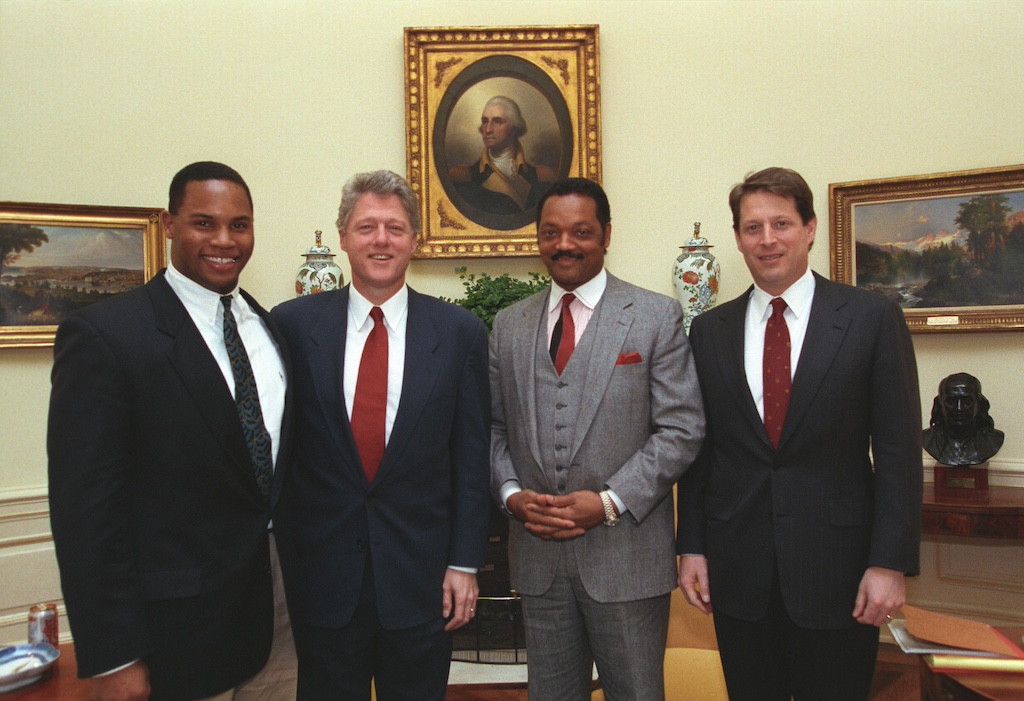
He traveled to Asia to investigate treatment of workers in the Japanese automobile industry and in apparel factories in Indonesia. He has played mediator in several hostage cases, most famously when he helped secure the release of hundreds of foreign nationals held in Kuwait by Saddam Hussein.
Until 2017, when he announced that he had Parkinson’s disease, Jackson remained a visible presence in American politics, speaking out on a wide range of issues. Even as his illness worsened, he made occasional forays into the world of protest. In 2021, he was among the activists arrested in Washington, DC, while protesting the GOP’s efforts to suppress the right to vote. During the 2024 election season, he traveled around the country urging young people to vote. Last year, he lent his name to a boycott of Target after the company rolled back its DEI. program.
Jackson probably walked more picket lines and spoke at more labor rallies than any public figure until Sanders ran for president in 2016. Jackson had laid the foundation for Sanders’s rise as a left-wing political figure who the Democratic Party establishment had to deal with and who eventually helped move public opinion and the party in a more progressive direction.