As Luiz Inácio Lula da Silva seeks his final term as Brazil’s president, the Left’s electoral strategy — who runs, which factions align, and how the coalition balances pragmatism with principle — is already shaping the post-Lula era of Brazilian politics.
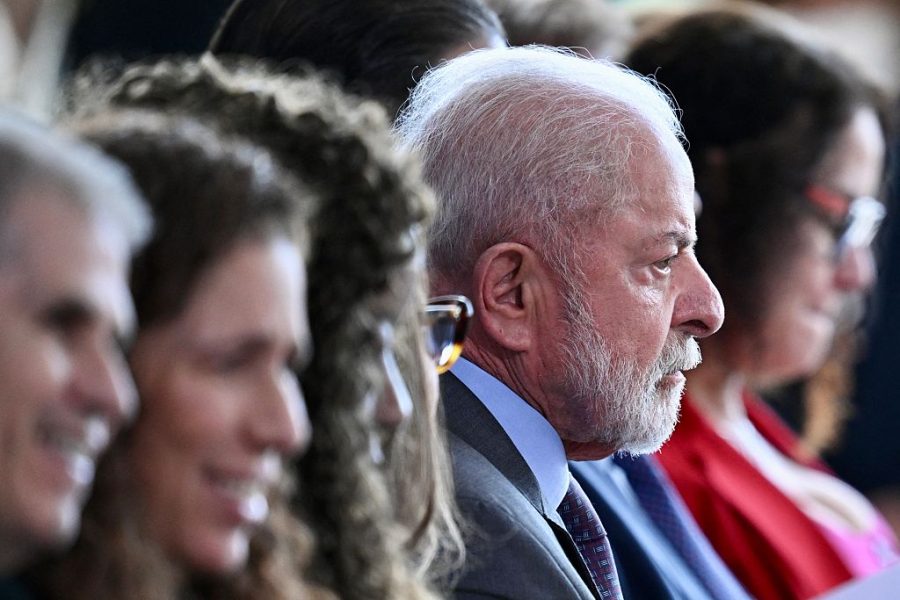
“Here in South America, we present ourselves as a region of peace,” Brazilian President Luiz Inácio Lula da Silva declared last week as he hosted South African leader Cyril Ramaphosa, adding that “nobody here has an atomic bomb.” Normally the genial Lula might have left it at that, celebrating his country’s peaceful, collaborative foreign policy tradition. This time, however, he ended with a warning: “If we do not prepare ourselves in terms of defense, one day someone will invade us.”
Back in office since 2023 and seeking a fourth (and final) term later this year, the eighty-year-old confronts a world reshaped by Trump-era shocks to the global order. As his foreign policy advisor, Celso Amorim, recently put it, “Whereas two decades ago I would have said that we lived in a world of opportunities, today we live in a world of difficulties.”
The geopolitical uncertainty has upped the ante of what was already set to be a deeply contentious race this October between Lula’s broad coalition of moderates and leftists and the far-right challenger, Senator Flávio Bolsonaro, the forty-four-year-old son of the imprisoned former president Jair Bolsonaro. Much will be written about the campaign in the months ahead, but a critical story is already unfolding within the Left itself. Decisions made in 2026 — over who runs, which factions align, and how the progressive coalition balances pragmatism with principle — will shape not just this campaign but likely the early post-Lula era.
Two high-stakes decisions this month in particular are worth examining: whether Finance Minister Fernando Haddad will once again risk a difficult race for governor of São Paulo, and whether the Socialism and Liberty Party (PSOL) will enter into a formal federation with Lula’s Workers’ Party (PT) or preserve its independence. At first glance, these questions seem merely tactical. In fact, we already know the answers: yes to the former; no to the latter. But these are actually weighty debates marking early skirmishes in the contest to define the Brazilian left after Lula.
Four years ago, Haddad ran for governor of São Paulo, Brazil’s largest and wealthiest state. He lost but did better than any PT candidate ever had and, in the process, helped ensure a robust statewide campaign for Lula’s successful presidential bid. He then took on arguably the most important position in Lula’s cabinet.
It is no secret that Haddad harbors presidential ambitions. In 2018, with Lula behind bars on corruption charges that have since been vacated, he was the PT nominee who took the fight to the elder Bolsonaro. Most observers posit he is the party’s strongest name for a future presidential contest. But first he must make it through 2026.
Party leaders have maintained that Haddad should once again run for São Paulo governor. They have no illusions about his prospects: he would almost certainly lose to the incumbent Tarcísio de Freitas, the former Bolsonaro cabinet minister who bested him in 2022. But polls show he is the only one who could keep the race close, which would help bolster Lula’s candidacy in a contest widely assumed to be decided by slim margins.
Should Haddad subject himself to a grueling campaign only to go down in likely defeat? Would doing so help or hinder his chances of succeeding Lula at the national level? Will he be seen in the future as a team player who took one for the team time and again, or would he be tarred as a perennial loser? After all, Haddad — who served as secretary of education in Lula’s first administration — has not won an election since prevailing in the 2012 mayoral race in the city of São Paulo, falling short in his 2016 reelection, his 2018 presidential run against Bolsonaro, and his 2022 gubernatorial campaign.
Haddad has made his opinion on the matter clear. Over the past year, he has repeatedly insisted he had no intention of running for office in 2026. Instead, he said he preferred to step down from the finance ministry early in the year to help coordinate Lula’s reelection campaign, a task he argued was incompatible with the demands of managing the country’s economic portfolio.
Lula’s insistence — and Flávio’s surprising strength in the polls — has reportedly convinced the reluctant Haddad to accept the task put to him by the president and the PT. Although he has not confirmed his candidacy as of this writing, it is reportedly a done deal. He has a campaign team in waiting and will leave the finance ministry on Thursday to prepare for the election.
The episode illustrates the peculiar position Haddad occupies within Brazilian politics broadly and within the PT specifically. As finance minister, he has spent the past three years playing the role of institutional stabilizer, crafting a fiscal framework aimed at reassuring markets after Bolsonaro’s chaotic final years, while simultaneously defending the government’s social spending priorities.
The balancing act has been largely successful, if not without friction. Haddad’s more orthodox fiscal posture has periodically clashed with influential voices inside the party, including Lula’s powerful Chief of Staff Rui Costa and former PT President Gleisi Hoffmann, both of whom have pushed for a more expansive approach to public spending and economic policy. In that sense, Haddad’s technocratic stewardship of the economy has elevated his national profile while also revealing the ideological and strategic tensions simmering within Lula’s governing coalition.
Haddad’s likely candidacy in São Paulo is thus also an early test of how the PT might manage the transition to a post-Lula era. A strong performance — even in defeat — could consolidate Haddad’s status as the party’s most plausible national standard-bearer. But another decisive loss could embolden alternative figures within the party and encourage a broader debate about the party’s leadership, strategy, and ideological direction. None of this is lost on Haddad himself, who has repeatedly signaled his discomfort with the role of sacrificial candidate.
His reluctance reflects not simply personal caution but an awareness that the political terrain Lula once navigated with ease has grown far more treacherous. Brazil’s electorate is more polarized than at any time since the return to democracy, and the Right’s institutional strength in states like São Paulo remains formidable. Still, loyalty to Lula — and to the party that shaped his career — appears to have carried the day. If Haddad does ultimately enter the race, he will do so knowing that victory is unlikely but that the campaign could prove decisive in helping determine who inherits Lula’s political mantle when the era of the metalworker-turned-president finally comes to an end.
The question of who might eventually succeed Lula is only one dimension of the broader strategic debate unfolding on the Brazilian left. Equally important is how the Left will organize itself politically once the gravitational pull of Lula’s leadership inevitably weakens. Here, a second decision taken this month offers an instructive glimpse of the tensions ahead.
In early March, leaders of PSOL confronted a proposal that would have reshaped the institutional architecture of Brazil’s progressive camp: whether to enter into a formal electoral federation with Lula’s PT. Under Brazil’s electoral rules, federations bind parties together nationally for at least four years, effectively requiring them to operate as a single bloc in congressional contests while sharing television time, campaign resources, and electoral calculations. In practical terms, a federation between the PT and PSOL would have consolidated much of the Brazilian left into a single parliamentary vehicle.
This proposal had influential supporters within the party. Allies of Brazilian Secretary-General Guilherme Boulos — including figures such as Erika Hilton and the current minister of indigenous peoples, Sonia Guajajara — argued that the growing strength of the far right demanded a more unified response. In a fragmented party system shaped by increasing pressure for small parties like PSOL to surpass minimum vote thresholds in order to retain access to public funding and television time, a federation with the PT promised to protect PSOL’s parliamentary presence while expanding the overall left’s representation in Congress.
Boulos himself is also often discussed as a potential future presidential contender, presenting a different profile from Haddad; younger, from an upstart, nominally more left-wing party, and associated with a more combative, activist-oriented wing of the Left, his rise would signal both generational and strategic diversification in the post-Lula era.
But the federation proposal triggered a backlash within PSOL. Many of the party’s leaders warned that federation risked dissolving the political independence that had defined the party since its founding in 2004 by dissidents who broke with the PT over what they saw as excessive concessions to neoliberal orthodoxy. For these critics, PSOL’s role has always been distinct — less a governing party than a vehicle for programmatic clarity and social mobilization, capable of pressing the broader left on issues such as racial justice, environmental protection, and labor rights.
Strategic considerations reinforced these ideological concerns. A federation would require PSOL to coordinate candidacies with the PT and its existing partners, potentially limiting the number of PSOL candidates for Congress and obliging the party to support state-level alliances with centrist figures the party has long opposed. For many activists, the risk was that PSOL would become little more than a junior partner to the much larger — and establishment-oriented — PT.
In the end, the party rejected the proposal decisively, with its national leadership voting overwhelmingly against federation while simultaneously reaffirming its strong support for Lula’s reelection bid. The outcome preserved PSOL’s autonomy but also underscored the delicate balancing act facing Brazil’s progressive camp: how to combine unity against the far right with the pluralism that has allowed different strands of the Left to flourish.
Taken together, the uncertainty over Haddad’s candidacy this year and the PSOL federation debate reveal the contours of a political moment that extends beyond the immediate electoral cycle. One touches on the question of leadership (who will inherit Lula’s mantle?), while the other concerns the structure of the Left itself: whether its future lies in consolidation under the PT’s umbrella or in a more plural configuration of allied but independent parties.
These internal debates matter not only for Brazil but for the region and the world. Indeed, as the far right advances across Latin America and beyond, decisions over coalition-building, party autonomy, and generational leadership will shape whether progressive forces can present a credible counterweight to authoritarian currents in this hemisphere and beyond.
This year’s election, then, is partly about the time horizon for those decisions. A Lula victory would push back the reactionary tide and buy space for strategic planning. Defeat would likely intensify pressure and accelerate the timelines for difficult choices about the Left’s future in Latin America’s largest nation.
In either case, the stakes extend beyond electoral arithmetic. They speak to a broader uncertainty about Brazil’s place in an increasingly unstable world — one in which old assumptions of regional security no longer hold. In that sense, Lula’s warning that an unprepared region risks “invasion” resonates as a literal prediction but perhaps even more so as a reflection of a shifting geopolitical reality in which external pressures and internal divisions are increasingly intertwined.