Victor Serge lived through a remarkable sequence of revolutionary upheavals before dying in Mexican exile at the age of 56. Serge’s life and work, caught between hope and despair, can help us understand Europe’s turbulent 20th century.
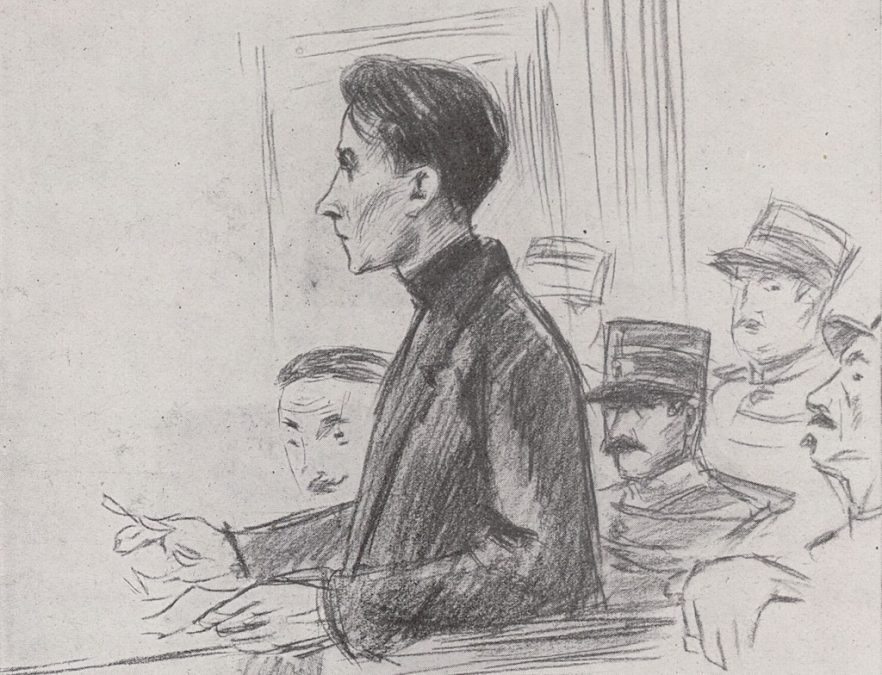
Review of Victor Serge: Unruly Revolutionary by Mitchell Abidor (Pluto Press, 2025)
Many readers will be familiar with Victor Serge’s literary work: his novels, notably The Case of Comrade Tulayev, and his fascinating autobiography Memoirs of a Revolutionary. All his work centers around the great historical events of the first half of the twentieth century, the hopes aroused by the Russian Revolution of 1917, and its subsequent disastrous outcome.
Now Mitchell Abidor has written a biography of Serge, based on extensive research and using documentation collected by the great Serge scholar and translator, Richard Greeman. While Abidor does not fundamentally challenge the account Serge himself presented in the Memoirs, he does add much fascinating detail that places Serge’s political evolution in context.
Anarchism and Bolshevism
Born to a Russian family in Belgium with the name Viktor Lvovich Kibalchich, Serge went through a remarkable process of intellectual development while still a teenager (he never went to school). He moved to Paris and became active as a writer and editor in the anarchist milieu, ending up in jail for five years.
Abidor devotes the first quarter of the book to Serge’s time as an anarchist. Revolutionaries are not born such, but make themselves, often through a path marked by difficulties and contradictions. Though Serge always retained a certain sympathy for anarchism, Abidor shows that there were some deeply reactionary elements in the Parisian anarchist scene.
The influence of radical individualism and a marked pessimism about the possibility of social change meant that Serge was very skeptical about the viability of collective action. It was his later experiences of mass action, first in Spain and then in Russia, that would lead to a fundamental reorientation of his political activity.
The Russian Revolution of 1917 was the vital turning point in Serge’s development. For Serge, as for a whole generation devastated by the horrific mass slaughter of World War I, the rise to power of the Bolshevik Party was a moment of hope — hope that it would be possible to construct a quite different social order.
The young Serge had engaged in speculation about the possibility of revolution. Now a real revolution had happened, and even if it diverged from his earlier ideas, he was determined to play his part in it. With great difficulty, he made his way across Europe and put himself at the service of the Bolsheviks.
Postrevolutionary Russia was no paradise. The main reason — and one which Abidor might have stressed more — was the efforts made by the great powers of the West (Britain, France, the United States, etc.) to subvert and overthrow the new regime and to prevent the hope it embodied from infecting working people elsewhere in the world. Foreign armies invaded Russia to join up with native counterrevolutionaries; the so-called civil war was a war of national defense. Serge, who fought in the armed defense of Petrograd and wrote a powerful history, Year One of the Russian Revolution, understood this well.
Certainly Serge had, as Abidor shows, criticisms and reservations about the earliest years of the revolution. But there is no doubt that his main motivation in these years was a commitment to defend and propagate the revolution. He even supported the suppression of the Kronstadt revolt against the Bolsheviks in 1921 (though he changed his mind about this later). Serge developed the concept of “double duty”: the need to confront the external enemies of the revolution but also at the same time the negative factors within the revolution.
Like Vladimir Lenin and Leon Trotsky, Serge was convinced that the revolution could only survive and develop if it spread westward. In the mid-1920s, he moved to central Europe, aiming to play his part in the hoped-for German revolution that would have transformed the balance of forces throughout Europe. However illusory the hopes of a German revolution may appear to have been in retrospect, the Germany of 1923, described by Serge in a series of press reports, was on the verge of social and economic collapse — it really did look like a society on the brink of revolution.
Midnight in the Century
The ten years of revolutionary commitment were, in a sense, the most important years of Serge’s life. They gave him an ideal and a vision of hope against which subsequent deformations and betrayals of the revolution could be measured. By the late 1920s, things had changed catastrophically. Lenin was dead, Trotsky had been sent into exile, and Joseph Stalin was increasingly in control of the USSR.
Serge’s sympathies were with Trotsky, a figure whom, despite differences between them, he always admired. But the regime could not tolerate Serge’s support for the Left Opposition, despite — indeed because of — his record as a supporter of the revolution. He was arrested, savagely interrogated, and sent into exile over nine hundred miles from Moscow.
In a sense Serge was lucky: he was exiled, but not sent to a concentration camp. Most of his contemporaries who had oppositional sympathies ended up dead. One of the main reasons Serge avoided this fate was the fact that a significant group of friends and comrades in France waged a vigorous campaign for his release. Stalin, who needed allies on the French left, decided to exile him rather than put him on trial.
Like many people, I have often been asked to express support for people imprisoned in foreign countries, and wondered if there was any point to it. Serge’s release shows that such campaigns can work, sometimes at least.
Serge returned to Belgium, then France. He continued to write copiously, both journalism and novels. While he had escaped Stalinism, other threats remained. Throughout Western Europe, fascism was on the rise.
After Francisco Franco’s triumphal march into Madrid and Barcelona in 1939, France was surrounded on three sides by fascist regimes in Germany, Italy, and Spain. It was, in a phrase Serge coined as the title for one of his novels, “midnight in the century.” When France was occupied by German troops the following year and a viciously right-wing, antisemitic regime established, Serge aimed to get out of Europe and escape to North America.
This was the phase of Serge the asylum seeker. Perhaps few asylum seekers have a political past like Serge’s, or a literary talent like his. But in his efforts to find a place on a boat bound across the Atlantic, Serge reminds us of the problems and torments faced by all refugees from his time to our own.
Serge found sanctuary in Mexico, which welcomed many refugees from Europe. Leon Trotsky had been exiled (and murdered by a Stalinist agent) there. Serge spent his last years surrounded by European exiles, with a variety of hopes and aspirations for the postwar world. He continued to write, both for publication and in his notebooks. He died in 1947, aged only fifty-six, in deep poverty (there were holes in his shoes), worn out by a life of struggle and persecution.
Unanswered Questions
For those like myself who have long admired Serge, the concluding section of Abidor’s book is perhaps the saddest. Abidor has carefully examined Serge’s published and unpublished writings from his last years, and he convincingly concludes that in his last years, Serge saw communism as the “main enemy.”
In one sense, this is scarcely surprising. Stalinist violence was not confined to the USSR: the pro-Stalin Communists in Mexico had physically attacked Serge and may even have tried to kill him. It was small wonder that he would come to see them as his principal enemy.
In fact, it is difficult to know how Serge would have developed had he lived longer. He died in the autumn of 1947; the Cold War had begun only earlier that year, with the proclamation of the Truman Doctrine as the US president promised material support to nations resisting communism and the turn to militant strikes by the Communist Parties of Western Europe. For the next forty years, world politics would be dominated by the confrontation between the US and Soviet blocs.
Some ex-Communists, like Arthur Koestler, became loyal and enthusiastic supporters of the Western camp. But there was also a much smaller current, represented by figures such as C. L. R. James, Hal Draper, Cornelius Castoriadis, and Tony Cliff, who took a different view. While arguing that Stalinism had nothing in common with socialism, they sought a political path that would be independent of both Washington and Moscow. Would Serge have backed the Americans in Korea and Vietnam, or would he have stood by the spirit of revolutionary independence that had characterized his life so far? We can only speculate.
The range of choices facing Serge can be illustrated by looking at some of the companions who shared his exile in Mexico. Marceau Pivert had been the leader of the French Socialist Party’s far-left faction during the 1930s before breaking away to form a group of his own. In 1945, he returned to France and rejoined the Socialist Party.
While he opposed all cooperation with the French Communist Party, Pivert became increasingly dissatisfied with the Socialist Party’s rightward drift. In particular, he remained committed to the cause of colonial liberation and strongly opposed the repression of the movement for Algerian independence; this led to his final break with the Socialist Party leadership shortly before his death in 1958.
Another of Serge’s close associates, Julián Gorkin, followed a different path. During the Spanish Civil War, he had been a leader of the POUM (Workers’ Party of Marxist Unity), which confronted the Communist Party of Spain from the left. Exiled in Mexico, he helped Serge obtain a Mexican visa, and together with him had faced violence from Mexican Stalinists.
However, by the time he moved to Paris in 1948, Gorkin had firmly aligned himself as an anti-communist in the Cold War. He became editor of a Spanish-language journal, Cuadernos, on behalf of the Congress for Cultural Freedom, which (as became widely known) was financed and controlled by the US Central Intelligence Agency.
Hope and Betrayal
One thing is clear: Serge’s perspective is primarily European. Although he had written a very perceptive article on the Chinese rising of 1927, he otherwise showed little interest in Africa and Asia. Yet the collapse of the old colonial empires was one of the most important developments after 1945. Britain was forced out of India, while France fought two bloody and disastrous wars in Indochina and Algeria. How Serge would have responded we cannot know.
If Serge’s death left unanswered questions, his life was a remarkable contribution to the politics of the socialist left. Abidor’s account is a fascinating and well-documented story; it deserves to be read and hopefully will encourage more people to read Serge’s own writings.
All of Serge’s life and work was dominated by a contradiction — the way the very real hope inspired by 1917 gave way to the betrayal of Stalinism. As Serge summed it up: “Out of a magnificent workers’ victory we have seen the rise, on the basis of the socialist ownership of the means of production, of an inhuman regime, profoundly anti-socialist in the way it treats human beings.”
It was this contradiction that shaped the world of the twentieth century. The heritage is still with us, as we face midnight in our own century. Thus rebels against the system are labeled “Marxists,” often by people who know little or nothing of what Marxism is. The memory of the Cold War and McCarthyite anti-communism remains with us. There is still much to be learned from the life and work of Victor Serge.