Yoon Suk-yeol, the disgraced conservative president who tried to mount a coup against South Korea’s democracy in December 2024, has received a life sentence in prison. The popular resistance to Yoon shows the way for other countries facing authoritarian threats.
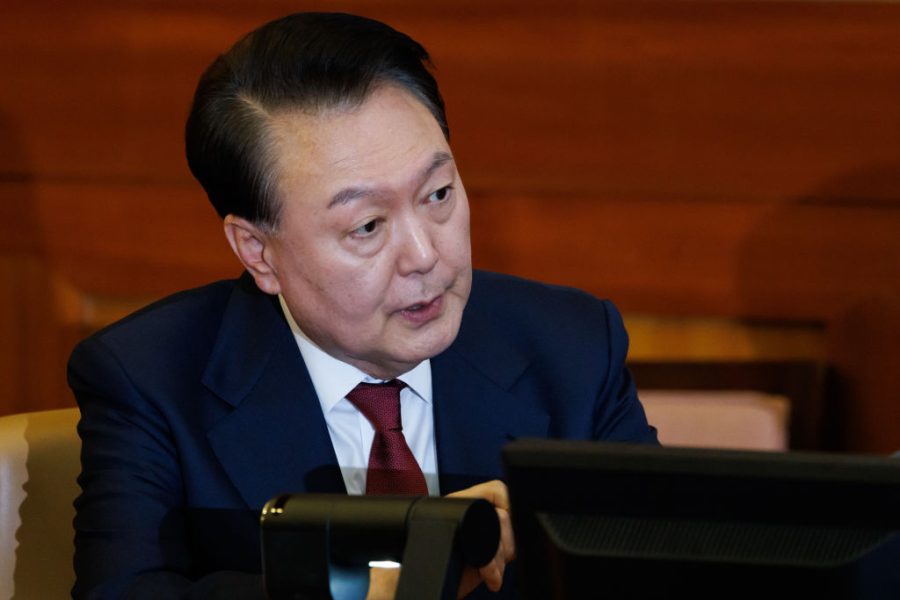
The verdict is finally in. Yoon Suk-yeol, South Korea’s impeached conservative president, was sentenced to life in prison on February 19 by a Seoul court for insurrection.
The court’s decision came 443 days after Yoon’s abrupt attempt to overthrow the constitutional order in a December 2024 self-coup. The effort collapsed within six hours as a unanimous legislature rejected it, and spontaneous protests erupted across Seoul.
Justice nevertheless remains incomplete, as the ruling is entangled with simmering political tensions that had been engulfing the country long before Yoon’s failed power grab.
For the global left, what has been unfolding is deeply significant. South Korea is the only advanced economy to date that has been attempting to defeat a far-right surge through a combination of mass protests and electoral power even amid a regrouping of far-right forces.
Deepening Political Divides
The deepening political rift was inscribed in the language of the verdict handed down by Ji Gwi-yeon, the presiding judge who had briefly released Yoon from detention on a technicality in July 2025. Drawing on a broad range of historical precedents, from the execution of Charles I in seventeenth-century England to Charles de Gaulle’s French constitution, judge Ji appeared to vacillate between the imperatives of the rule of law and the prerogatives of a strong presidency. He stopped short of defining Yoon’s declaration of martial law as part of the attempt at insurrection, appearing to acknowledge Yoon’s own reasoning before the court.
Yoon maintained that his imposition of martial law was meant to be an “enlightening” warning to the public about what he depicted as the rising threats from the Left and foreign (Chinese) interference in the country’s voting system. Yoon even coined a term for it, calling his martial law declaration “gyemongryung,” a portmanteau blending the Korean words for martial law and enlightenment.
Defending himself against a possible conviction for insurrection, he even pleaded incompetence: “How could a fool like me carry out a coup?” The former top prosecutor’s blend of cynical legal logic and shrewd self-deprecation helped spare him the death penalty, the maximum punishment for insurrection (although it has to be noted that South Korea has not carried out an execution on any grounds since the late 1990s).
Resurgence of the Far Right
Judge Ji convicted Yoon of insurrection for masterminding a putsch that sent special forces soldiers to the National Assembly and the National Election Commission to arrest lawmakers and officials. However, he effectively provided another rallying point for the far right when he appeared to justify Yoon’s stated goals, invoking an old English proverb: “Do not steal a candle to read the Bible.”
From the attempted coup to the mass resistance that resulted in Yoon’s impeachment and conviction, the events that have unfolded since December 2024 have shown that Yoon’s putsch was no mere aberration in South Korea’s young democracy. Rather it marked a breaking point at which decades of tension between the far right, liberals, and the Left finally surfaced.
In retrospect, the prompt surge in far-right counterprotests in response to the much larger pro-impeachment demonstrations should have been no surprise. There has been an upsurge in the strength and influence of an anti-China, pro–United States far right among South Koreans in their twenties, which has galvanized a traditional conservative bloc long sustained by older people in their sixties and seventies. Ever-tightening job and housing markets and the rapid erosion of upward social mobility have drawn much of the younger generation to far-right ideas.
On the surface, the schism often appears to be a generational one. Young men and women see themselves as resisting the nationalist, often left-leaning upper and middle tiers of their parents’ generation. The latter cohort has monopolized economic and political opportunities for itself and its children, even though many of its members fought as young men and women for equality and democracy against dictatorship during the 1970s and ’80s.
In a sense, their antipathy is reactive: they are pro–United States and anti-China because their earlier generation was anti–United States and more sympathetic to China. Their impulses are increasingly shaped and articulated by the preachings of YouTube influencers and activist Christian ministers.
Further emboldening them is support from the MAGA and Christian nationalist networks in the United States. Seoul was the final overseas destination of far-right activist Charlie Kirk before his September 2025 assassination. He delivered the keynote address at the annual rally of Build Up Korea, the Korean clone of his organization Turning Point USA.
Following Kirk’s death, young far-right elements erected an impromptu altar for him in the heart of Seoul. Build Up Korea and Free University, a college group, regularly organize campus debates modeled on Kirk’s signature style as well as anti-China protests, while also emerging as young foot soldiers for “Yoon Again” campaigns advocating the restoration of Yoon to office.
Far-right ties between South Korea and the United States date back to the war of 1950–53, after which Washington propped up Cold War–era authoritarianism in Seoul. The relationship was hitherto largely military rather than ideological. This has been the first time in recent memory that the US civilian far right has directly exported its ideas and methods to its South Korean counterpart.
Through their US connections, South Korean ultraconservatives appear to have already gained the ear of Vice President J. D. Vance, who often represents Christian nationalism within the Trump administration. In a January meeting with his South Korean counterpart, Vance raised concerns about the detention of a far-right Presbyterian minister, Son Hyun-bo, who was accused of organizing political rallies and campaigns in breach of electoral regulations.
In February, a court released Son, waiving his six-month prison sentence. Upon his release, he claimed that his two adult sons had been invited to the White House on two separate occasions while he was awaiting trial under detention.
The far right has already seized control of Yoon’s People’s Power Party (PPP), which holds about one-third of the seats in the three-hundred-seat National Assembly. Following the court’s ruling, PPP leader Jang Dong-hyuk cited the judge’s decision not to classify Yoon’s martial law imposition as part of the insurrection charge and insisted upon the deposed president’s innocence. This was in spite of growing calls from within the party for a clean break with Yoon’s legacy.
Liberal Euphoria
It was the liberal Democratic Party of Korea (DPK) and its leader Lee Jae-myung that benefited most from the aftermath of Yoon’s self-inflicted downfall. However, despite a political landscape tilted in favor of his party, Lee fell short of an absolute majority in the snap presidential election that followed Yoon’s impeachment in May 2025. His shortfall reflected both the surge of the far right and lingering concerns about his political integrity stemming from a series of corruption allegations that have dogged him.
Nevertheless, six months into office, Lee’s popularity soared, with his Gallup Korea approval rating hovering around 60 percent. Lee reached this milestone before achieving any significant political or economic reforms. Clearly, the post-coup sense of stability the new government imparted to the public helped his image.
Above all, his big selling point is the country’s flagship stock index, the KOSPI composite index, which soared to an all-time high last month. Reaching this psychologically important milestone had been Lee’s campaign pledge in a country where one in every four adults trades on the stock market.
A close look at the South Korean economy, however, reveals a picture of overheating and unevenness. Two semiconductor giants, Samsung and SK Hynix, boosted by the global AI boom, make up about 40 percent of the index’s value. This unusually high concentration is risky, even compared with the S&P 500, a primary bellwether for overall stock performance, in which the top ten stocks, all closely tied to AI, account for about 41 percent of the index.
While Lee clings to a soaring stock index as his main political asset — one that does not directly translate into broader economic gains — different factions within his party have begun squabbling.
The party’s old guard, rooted in the left-nationalist student movement of the 1980s, has been attempting to quell the rise of a new cadre largely recruited from a liberal pool of professionals and nouveau-riche tech and financial elites. The latter faction, which is closely aligned with Lee, has gravitated toward the DPK as an alternative to the PPP, long regarded as an old-fashioned authoritarian party of retired bureaucrats and entrenched industrialists.
While this has been happening, the DPK has started backpedaling on labor reforms it once promised. Lee’s government has yet to revise South Korean labor law to extend protections to freelancers and platform workers. Whichever faction ultimately prevails, the DPK will continue to sideline labor and shed the last vestiges of its pro-labor rhetoric, regardless of ongoing support from the country’s unions, including the independent Korean Confederation of Trade Unions.
It was a remarkable and inspiring accomplishment when the South Korean people defeated the coup attempt within six hours and brought its mastermind to court within a month, at a time when the rest of the advanced capitalist world continues to face the rapid encroachment of the far right. Yet the South Korean experience also indicates that without an independent left, any popular gains are at risk of being slowly eroded or misdirected before the threat of the far right can be fully subdued.