The late Umberto Bossi dreamed of breaking Italy’s north away from the rest of the country. Instead he helped refound Italy itself, as he forged an alliance with former fascists and the billionaire Silvio Berlusconi.
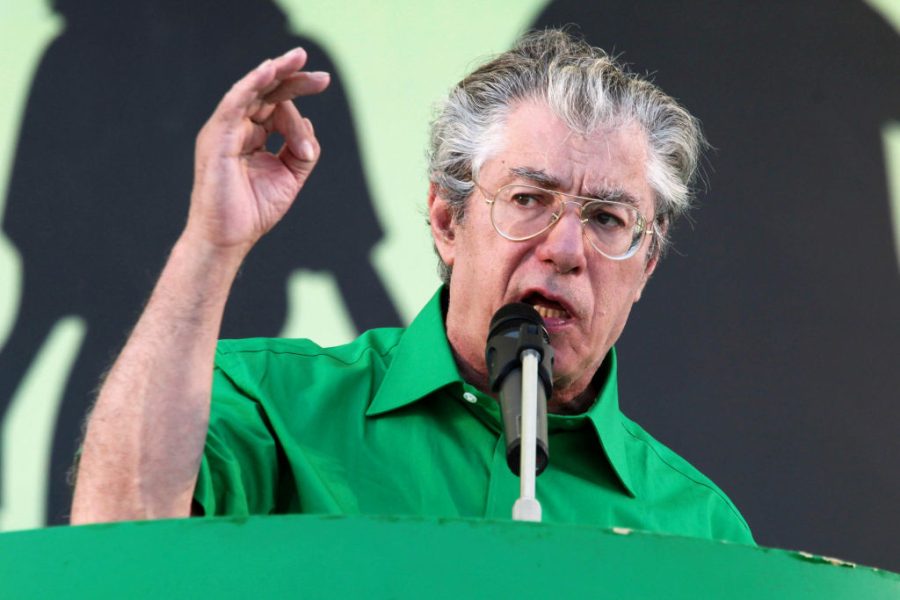
Umberto Bossi died last Thursday after being confined to the political margins since 2012, when a party funding scandal forced him to resign as leader of the Lega Nord, which he founded in the 1980s. Yet it is hard to deny how profoundly, and enduringly, Bossi and the party he created transformed Italian politics.
The Lega was pioneering in its form (its absolute leader-centrism), in its political focuses (regional autonomy, hostility to taxes, an exclusionary model of welfare, immigration), and in its structure (the emergence of a right-wing alliance combining neoliberalism, conservatism, and nationalism).
It also made a mark on legislation, from a reactionary immigration law cosigned by Bossi to a constitutional reform devolving powers to regions — though this was introduced by the center-left government in 2001 to compete with his Lega. Perhaps most innovative was the Lega’s language: the normalization of vulgarity, profanity, and violent aggression as key elements in the artificial construction of the “popular leader.”
Bossi aspired to be a “founding father,” and in a sense he was. He never did found the nation of his dreams — the mooted split that he termed Padania, in a now-sidelined project to separate northern Italy from the rest of the country. Yet Bossi was a founding father of the nation he pretended to hate and, in fact, helped govern for two decades: Italy itself.
Seen from the outside, he embodied every stereotype of Italianness: genius, braggadocio, vanity, undisciplined talent, verbal incontinence, provincialism, a tendency toward trickery and subterfuge, inconsistency, and a taste for melodrama. Bossi was the creator of the only political movement capable of weathering the great crisis of the early 1990s: the Lega Nord. For a long time, before being transformed by his successor Matteo Salvini, it was the oldest surviving party in Italy. Now that Bossi’s political trajectory has come to an end, it is worth taking stock of his lasting impact.
The Barbarians and the Post-Fordist Vendée
Umberto Bossi, the son of a factory worker and a doorwoman from Cassano Magnago in the far north of Italy, entered politics in the early 1980s after the failure of his career as a singer and his medical studies. He founded a small autonomist movement in Lombardy that, merging with others (in particular the older, more rooted Liga Veneta, already represented in parliament), would give rise in 1989 to the Lega Nord, spanning all the regions north of Tuscany.
The movement’s agenda was already the one that would define it in future decades: territorial autonomy, hatred of “Rome,” understood as an invariably corrupt central government, and contempt for southerners portrayed as lazy and living off welfare. Essentially, it was a tax revolt of the northern regions, extra-urban but highly industrialized areas characterized by the pervasive presence of small businesses.
But more than its content, what broke through was Bossi’s style and language. Amid the cold, diplomatic politics of tie-wearing bureaucrats from Christian Democracy and its allies and opponents, Bossi was like Bart Simpson on a skateboard crashing into a conclave. Wrinkled striped and checked shirts, rarely a tie, and more often shabby cardigans than suits. No more diplomacy, no more circumlocution, but crude shouting and unrestrained swearing. “The Lega has a hard-on!” Bossi would shout from the stage during his endless rallies.
The early Bossi thundered against the dominant Christian Democratic “regime,” just as the Left did, but from a completely different standpoint. There was no grand narrative, no systemic change, no class struggle: regional autonomism as a device to invent as broad and cross-cutting a “we” as possible, community-wide and cross-class, to oppose power in the most classic populist framework.
In 1987, he entered the Senate with 0.42 percent of the vote, thanks to a proportional electoral system that set no minimum threshold. He became a television personality, one of many challengers emerging during the final crisis of Christian Democracy, expressing the widespread frustration with the immobility of a political system that had seen essentially the same governing arrangement, with few variations, for forty years.
The systemic crisis prompted competing diagnoses: the Lega said the system was failing because it was corrupt and wasteful, that this waste was particularly concentrated in Christian Democratic patronage networks in central and southern Italy, and that greater territorial autonomy would be an effective solution, allowing lower taxes.
This simple message was crafted by sensing the mood of the Po Valley provinces. This was an expanse of northern Italy that combined prosperity and dissatisfaction, economic growth and political resentment, and whose new productive structure, after the decline of the great factories of old, no longer found expression in the Christian Democratic/Socialist/Communist competition.
It placed Bossi in pole position for the system’s collapse. Indeed, the Lega’s success in the pivotal 1992 general election — when it became the fourth party with 8.7 percent of the votes despite running only in a few regions — accelerated the crisis. In the following months, the Christian Democrats, the Socialists, and their governing allies would be swept away by corruption scandals, fueling the Lega’s narrative. “Thieving Rome, the League won’t forgive!” began to be written on every overpass in the Po Valley. After all, they had been saying for years that the problem with Italy was government graft in Rome.
At this stage, even some progressive intellectuals, such as Giorgio Bocca, fell in love with those they called the “barbarians,” identified, like in Tacitus, as the rough-and-ready purifiers of a corrupt metropolis. It was, after all, a Lega MP who waved a noose in parliament to threaten those accused of corruption in 1993.
It later emerged that the Lega itself — by then integrated into the Lombardy region’s system of power — had also taken part in the great Enimont corruption scandal. Yet this had no effect on its support. Why? Because the Lega was different. Because Bossi was different. A bribe was not enough to make him just another politician.
The Lega electorate’s identification with Bossi was anthropological. Pierre Ostiguy, in his studies on populism, points to the politicization of sociocultural differences, of ways of being and behaving, between a “low” — characterized by blunt and vulgar language, uninhibited behavior, and personal authority — and a “high” — characterized by good manners, cold detachment, education, and formal authority.
Does this model not bring to mind, in outline, the image of the white tank undershirt Bossi wore during a live television appearance in 1994? His shouting, his unbuttoned shirts, his strong accent, his crude jokes made him appear completely different from the educated, tie-wearing politician of the so-called First Republic (1946–92), and perfectly similar to one of the many regulars of small-town bars in the Po Valley. Here was born, at least in Italy, the political leader cast as “one of us” rather than “better than us.” Someone who spoke plainly, slammed his fist on the table, and could make himself heard in Rome.
It is no coincidence that this happened in the first years of commercial television in Italy, of the spectacularization of everyday life and the ordinary man. Bossi in politics, just like the early private TV channels of those years, held up a mirror, showed part of the population a reflection of themselves, and made them proud of what they were. Bossi was the first to say to certain segments of the Italian population: not only am I like you but you can be like this, you are right to be like this, it is only right to be like this. You can be angry, ignorant, and brazen, even on TV, even in parliament: indeed, these traits can gain aesthetic and political dignity. The notion of basing political strength on northerners’ pride in their distinctiveness, their social and cultural status, their impulses, and their language was key to the Lega’s success.
It is no coincidence that this success took years to break through in urban centers (beyond rural areas), and always with great difficulty. Apart from one brief interlude in Milan, no Lega politician has ever been mayor of a regional capital in these forty years. It was in smaller-town areas around Varese, Bergamo, Treviso and Vicenza that the Lega took root, as a movement of provincial revolt.
A Vendée, like every revolt of the provinces? The political outcome might look like that, but the social reality does not. What was rebelling was a part of Italy that was perhaps politically backward but economically at the cutting edge.
“The Chief,” People, and Producers
The new political centrality of the Po Valley provinces, expressed in the slogan “No More Taxes, No More Rome,” stemmed, as mentioned, from the end of the large factory and the emergence of an industrial model built on territorial networks of small firms. Christian Democratic laissez-faire governance was no longer enough; what was needed was a guarantee of deregulation and tax cuts in order to withstand global competition. The Lega promised exactly that: there would no longer be any need to send money to Rome.
In 1994, with the fall of the Christian Democratic “regime,” Bossi turned to the Right, building an alliance with Silvio Berlusconi, who shared much of the Lega’s rhetoric: the centrality of the entrepreneur as producer, antagonism toward the party-based system, and a post-ideological promise of prosperity without class distinctions. That first experiment of right-wing government also included the post-fascists of Alleanza Nazionale (forefathers of today’s Fratelli d’Italia), despite Bossi, who has always declared himself an anti-fascist, having promised the opposite until just a few days earlier.
In this phase, federal reform of the state, with greater powers for the regions, was the political proposal through which the Lega sought to give itself a veneer of seriousness and credibility nationally. After only a few months, the alliance broke down, and Bossi launched the Lega into its secessionist phase: once again, a completely opportunistic turn, dictated by the need to hold the movement together by radicalizing it.
In 1996 came the so-called “Declaration of Independence and Sovereignty of Padania,” a fictional name used by Bossi to designate a future state in northern Italy. These were also the months of the assault on the bell tower of St Mark’s in Venice by a group of Venetian separatists, whom Bossi described as “Padanian martyrs.” But the talk of ammunition costs and of a hundred thousand people ready to take up arms would remain just that: talk. After all, the Lega was already a governing party in half of Italy, and in 2001, it would return to power again with Berlusconi, with secession transformed into “devolution.”
Autonomism, federalism, secession, and devolution: the agenda constantly shifted depending on the opportunities of the moment. Bossi equipped the Lega with an endless repertoire of folkloric kitsch, drawing on a medieval legendarium and ranting for years about a Padania that had never historically existed. In truth, its inhabitants shared exactly as much with each other as they did with the rest of Italy in terms of history and culture — except, of course, for widespread economic prosperity and the desire to defend it from the rapacious hands of central government.
But the identification of the party’s base was always, above all, personal. The Lega, at least until the 2012 scandal, was its leader Bossi, and Bossi was the Lega. There was no local election in any northern municipality in which a significant number of preference votes (at least in the dozens) were not annulled because voters, next to the Lega symbol, even for municipal councils, had written “Bossi.”
In the 2004 European elections, two months after the stroke that he had suffered on March 11 of that year, when his condition was completely unknown and he had not yet appeared in public since the incident, 183,000 voters in the northwest wrote “Bossi” on the ballot, electing him without a single minute of campaigning. The identification of the party with “the Chief,” as he was commonly called within the self-styled Lega “movement,” was total. No party before had made such extensive use of expulsions, decimating entire leadership groups to ensure that no one overshadowed the Chief. This set up the leader’s power as the regulating principle of a fully post-ideological party.
Bossi’s Lega was declaredly post-ideological, yet from the very beginning destined to end up on the Right. It was certainly a party of the people but never a class party. Bossi’s discourse was always cross-class. When he spoke of “the people” he always referred to “workers, artisans, entrepreneurs.”
Territorial identity was the keystone of Italian-style populism. On the one hand, there is a conception of politics in which the local community is everything, its internal contradictions almost always concealed, and which expresses its interests in an organic, unified way. On the other hand lies so-called “producerism,” an ideology that fuses the interests of labor and capital in the shared goal of producing as much wealth as possible, and thus pits those who work and produce, across classes, against a vast social group of “parasites,” variously embodied by southerners, migrants, politicians, and public employees.
Bossi’s people were the “producers,” never the working class. And territorial identity, even at the outset, was always exclusionary. Racism, first against southerners and later against migrants, is a direct consequence. This community-centered particularism is the exact opposite of socialist universalism: a territory in constant competition with others rather than a class seeking to liberate all. This was sure to lead to right-wing conclusions.
It is hard to lay much store by Bossi’s claims of anti-fascism given his central role, together with Berlusconi, in legitimizing the heirs of fascism as part of a new right-wing coalition with liberal, conservative, and nationalist strands. Personally, he may well have felt anti-fascist. History tells a different story, and it tells us that Bossi was one of the principal figures responsible for the emergence of today’s reactionary right.
In 2012, a scandal over the private misuse of public funds allocated to the party forced him to resign. The Lega Nord seemed destined to disappear without its founder. A young successor, Salvini, would relaunch it, transforming it from a northern territorial party into a national far-right party specializing in anti-immigration campaigns. But Salvini invented nothing: already in the 1990s and 2000s, behind the rhetoric of territorial autonomy, Lega support had grown around figures such as the mayor of Treviso, Giancarlo Gentilini, who suggested dressing migrants as hares “to train our hunters”; the Lega delegation that brought pigs to graze on land designated for a mosque in Padua; and minister Roberto Calderoli, who appeared on television wearing a T-shirt offensive to Muhammad.
Is it so different from today’s Lega? The difference lay in Bossi’s extraordinary ability to hold everything together: radical right-wing rhetoric and responsible administration, pseudo-secessionism and national government. Once he was destroyed by the 2012 scandal, it was inevitable that some of these contradictions would have to be resolved.
What remains of Umberto Bossi, in any case, is not Padania. It is, rather, the Italy of 2026, the country of which Bossi ultimately became a founding father: a country of reactionary and racist right-wing politics, of leader-centered and shouted political spectacle, of territorial and corporatist particularism replacing universalist traditions, whether socialist or Catholic. Not a great legacy.