The Trump administration is considering purchasing a number of private immigrant detention centers across the US. Doing so may allow Immigration and Customs Enforcement to bypass state laws geared at curbing abuses in the facilities.
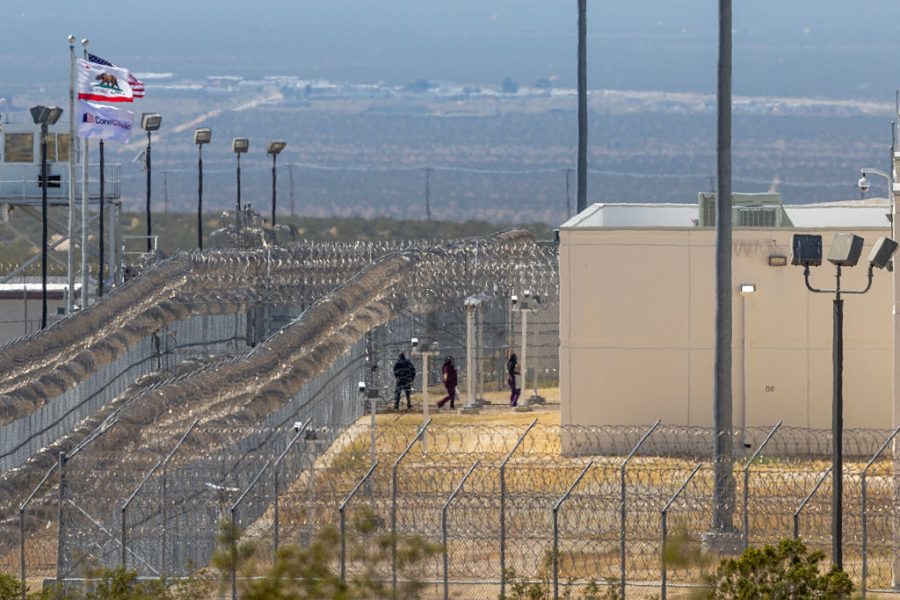
A White House plan to buy up private immigrant detention centers nationwide could be used to bypass state laws geared at curbing abuses amid President Donald Trump’s immigration crackdown, insiders and experts tell the Lever.
Several of the detention centers reportedly short-listed for government takeover are located in the states that have been the most aggressive in their attempts to monitor and regulate private Immigration and Customs Enforcement (ICE) detention facilities.
In February, internal documents first made public by New Hampshire state officials laid out in detail the Trump administration’s ambitious plans for ICE’s “new detention model,” amid the agency’s ongoing immigration crackdown. The documents proposed purchasing vacant industrial warehouses and transforming them into “mega” detention centers, an effort that has sparked significant public backlash.
But a second proposal in the document has largely flown under the radar: ICE’s plan to purchase ten “turnkey facilities,” private detention centers where its Enforcement and Removal Operations arm already operates.
By buying facilities currently owned by private prison companies, ICE could help shield those detention centers from state oversight and some lawsuits tied to alleged abuse, including labor violations.
In response to public pressure, states like California have passed laws that empower state officials to inspect private immigration detention centers. And in both Washington state and Colorado, ICE detainees who were forced to work for as little as a dollar a day at facilities owned by private prison giant GEO Group have sued for alleged violations of state labor laws.
But if the federal government owned these facilities outright, the Department of Homeland Security could try to claim additional legal immunity from many of these state restrictions, thanks to the broad immunity shield the federal government enjoys from lawsuits. How broad that immunity could ultimately extend will depend on the courts.
One source with direct knowledge of the calculus behind ICE’s turnkey facility proposal confirmed to the Lever that additional legal immunity was seen as a potential benefit of the plan.
ICE did not return a request for comment.
“Hell-Bent on Exploiting Loopholes”
Though it appears ICE has not yet acted on its plans to purchase facilities from prison firms, a draft document obtained by the Washington Post indicated the agency is considering acquiring multiple facilities in California as well as facilities in Washington and Colorado.
All three of those states have laws on the books that target private ICE detention centers — and the GEO Group facilities in Washington and Colorado under consideration are currently embroiled in high-profile legal battles over state law violations.
Those cases have turned in part on whether privately owned detention centers should be treated as federal facilities under the law.
Anya Bidwell, a senior attorney at the public interest law firm Institute for Justice, which submitted an amicus brief this fall in one of the cases against GEO Group, said she believed ICE’s intent to circumvent state laws by purchasing the facilities is “not just possible, but likely.”
Bidwell noted that was especially true given that Trump’s White House had proven to be “hell-bent on exploiting loopholes in the federal accountability regime.”
“There are many immunity doctrines that are incentivizing the federal government to outright own the place,” Bidwell said of ICE’s proposal. “You don’t have to leap too far to figure out why it is that they’re doing that.”
It would not be the Department of Homeland Security’s only recent attempt to evade local accountability, as states and cities try to fight back against ICE operations in their neighborhoods.
As the grassroots research outfit Project Salt Box reported this month, ICE is employing a novel strategy to circumvent a recent New Mexico law banning state and local federal detention contracts. To dodge the ban, ICE has stopped contracting with county governments in the state and instead negotiated directly with the private prison firm CoreCivic.
Changing of the Guard
The Department of Homeland Security’s sprawling detention apparatus has always relied heavily on private operators. Of the hundreds of facilities in which ICE detains immigrants, the agency owns vanishingly few outright.
With the plans to buy warehouses and buy back some of its biggest private prisons, that arrangement may now be changing.
While ICE detains people in a variety of locations across the country — including holding rooms, county jails, and state prisons — the majority of its detention beds are managed by private prison companies.
Together GEO Group and CoreCivic, two of the world’s largest prison firms, oversee at least 32,000 beds for ICE, a number that is increasing rapidly given ICE’s efforts over the last year to double its detention capacity. (As of February 2026, there were nearly 70,000 people in ICE custody.)
For the most part, GEO Group and CoreCivic own and operate these facilities under contract with the Department of Homeland Security. As of December 2025, the GEO Group operated nineteen facilities in partnership with ICE, all but one of which the prison firm owned. CoreCivic owns fourteen out of sixteen facilities that it operates for ICE. Two of the remaining facilities are owned by private companies, and the third is owned by a state corrections agency.
It’s not clear whether the prison giants are amenable to ICE’s stated plans to acquire their facilities. CoreCivic, in its most recent annual filing with the Securities and Exchange Commission (SEC), mentioned the proposal as a potential financial risk to its business.
“If we were to sell one of our owned facilities to a governmental customer, such as ICE, we may be unable to invest the proceeds from the sale in . . . properties that yield as much cash flow as the property sold,” the private prison company wrote, noting that there would also be no guarantee that the firm would be kept on as an operator following the sale.
But the lawsuits the private prison giants face over their ICE detention centers are also costly. In recent SEC filings, the GEO Group warned its shareholders about the Washington and Colorado lawsuits, noting that they posed a financial risk if the legal outcomes forced it to pay detainees fair wages for work.
CoreCivic and the GEO Group did not return the Lever’s requests for comment on the proposal.
Deteriorating Conditions
ICE’s turnkey-facility plans indicate the detention centers it is eyeing for purchase are among its largest. In March, the Washington Post, citing a draft solicitation document, reported that facilities on the list include the Northwest ICE Processing Center in Tacoma, Washington, and the Aurora ICE Processing Center in Colorado, both GEO Group facilities with over 1,500 beds.
Conditions at the Tacoma facility — which have long been poor — have reportedly deteriorated significantly in recent months as ICE, flush with cash, has ramped up detention operations. Over the last year, the facility has been found to be overcrowded with detainees. Reports have documented inadequate food and medical care. And last month, several detainees sued, alleging violence and sexual assault at the hands of guards.
Advocates in Washington have fought for years to improve conditions and increase external oversight at the detention center. Last year, under grassroots pressure, state legislators passed a law that would allow state health officials to inspect all “private detention facilities” at any time. (GEO Group has for years refused to allow state officials to enter the Tacoma facility.)
Despite an ongoing legal challenge from GEO Group, which is arguing that the law violates intergovernmental immunity, a federal appellate court upheld the law in a September ruling, basing its finding in part on the fact that “the federal government neither owns nor operates” the detention center.
That ruling was one of several recent legal opinions that upheld Washington State laws targeting the detention center in part on the basis that the facility was privately owned. Last year, in the course of a lawsuit brought by Tacoma detainees against the GEO Group over minimum wage violations, the Ninth Circuit supported its finding in favor of the detainees by noting that the detention center “is not a ‘federal facility.’”
“Rather,” the court found, “it is a private facility, operated under contract with the federal government.”
The ruling was a clear example of why ICE might be looking to purchase the Tacoma facility, Bidwell said. The panel of judges found “that if the federal government owned these facilities, we would be having a different conversation,” she said.
Forced Labor and Low Pay
Even if ICE goes through with its plan to buy these private facilities, it wouldn’t necessarily put an immediate end to related legal battles. Kellen Funk, a law professor at Columbia University, noted that the impacts of ICE’s purchases would likely depend on how the agency changed prison operations.
“To the extent [a private prison company] is contracted to supply personnel, set their hours and working conditions, etc., there may be a number of suits that could be brought against [the company] where ICE’s title over the facilities would make no practical difference on immunities,” Funk wrote in an email to the Lever.
The Colorado detention center under consideration for purchase by ICE has also been mired in a yearslong legal battle that began in 2014, when detainees sued over alleged forced labor at the facility.
GEO Group, which owns the center, argued that as a government contractor, it enjoyed the same blanket immunity from such claims as the federal government. But in February, the Supreme Court handed down a relatively narrow but unanimous ruling against that argument, meaning GEO Group could not quickly shoot down the lawsuit.
By that point, ICE had already drafted plans to buy the detention center.
This article was first published by the Lever, an award-winning independent investigative newsroom.