War, and now a fragile ceasefire, is not bringing collapse in Iran but reinforcing and reorganizing its existing structures of power and inequality.
An Iranian acquaintance of mine living in Istanbul has barely turned her phone off in recent months. She has internet access. Her daughter and son-in-law, still in Iran, do not. They fled from Tehran to the north of the country. She would do anything for a few seconds of connection. One question is constantly on her mind: Are they okay? Has something happened to them?
Her heart is full of anxiety, her tongue full of curses, her eyes full of tears.
She wishes she could talk to them, if only for a moment, to determine if they’re safe. But the deeper problem is not something a few seconds can answer. The real issue is that neither she nor any Iranian truly knows what will happen next. And perhaps the hardest part is this: no one is sure whether this war will actually change anything. Although a fragile ceasefire is now in effect, the uncertainty shaping daily life in Iran has not. For different reasons, both Washington and Tehran seem to need this fragile pause. Trump is already framing the conflict as a concluded chapter, while Iran, despite its defiant rhetoric, needs time to recover from the economic and political damage caused by the war.
In Western political circles, a recurring view has been that the war in Iran could create a rupture; that pressure and chaos could weaken the regime and pave the way for a new order. Indeed, in recent years, analyses by various think tanks and talking heads have described the Iranian regime as a “zombie regime,” arguing that the system now survives only through its coercive apparatus and that this fragility could evolve into a “Gorbachev moment.” The protests and economic collapse at the beginning of 2026 were widely seen to provide Israel and the United States with a “strategic window of opportunity.”
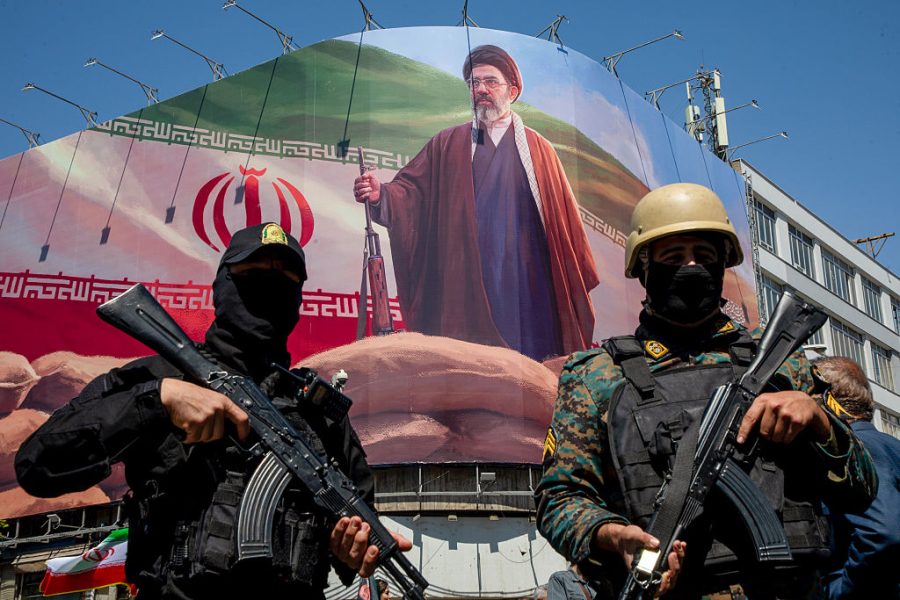
The US-Israeli assault of February 28 was interpreted within this framework as an attempt to accelerate a “rupture moment.” By targeting the upper echelons of the regime, the aim was to create a command vacuum and rather than imposing regime change from the outside, trigger the system’s internal collapse.
However, for experts from different disciplines and perspectives who have long studied Iran, the picture is far harsher.
“Iran is caught in a meat grinder,” says Hossein Askari, a professor emeritus at George Washington University:
The Iranian people have to decide what they are going to do. Much of the problem comes from the government, but a very large part also comes from the United States. America has never acted outside its own self-interest, and it will not give Iran an inch.
This is not just a geopolitical assessment. It is also a diagnosis of the nature of the crisis in Iran: Iran is not heading toward a rupture but toward compression.
By compression, experts refer to a situation in which sociopolitical and economic pressures intensify simultaneously without producing a clear breaking point, instead tightening the system and limiting the space for collective action.
Caught Between Fear, Anger, and Paralysis
This compression exists not only within the state but also within society. “There is a wide spectrum of what people feel, both inside and outside Iran,” says Askari. Within this spectrum, “There are people who want to return to Iran and reclaim their wealth, others who want to govern, those who are suffering and want any kind of change, and those who are waiting for something magical to happen. But there is no magic solution.”
That fragmentation lies on top of a larger problem. Historian Peyman Jafari, known for his work on Iran’s social history, labor movements, and oil politics, notes that “many Iranians are not in favor of the Islamic Republic, but they are caught between a system that has repressed them and foreign powers that have always intervened in Iran.” This result is not simple political tension but disorientation. As Yassamine Mather of Oxford University puts it, “Many Iranians are trapped between two fears: the continuation of an authoritarian state and the chaos that might follow its collapse.”
When these two fears converge, what emerges is paralysis. “Ordinary Iranians are increasingly preoccupied with survival,” says Jafari.
When external intervention is added to this picture, the situation becomes even more complex. Because external intervention does not produce change — it directs it. “The logic of intervention,” says Jafari, “is to prevent change from emerging from below and impose it from above.” When cases like Libya and Iraq are examined through a historical lens, this reality becomes starkly visible. In both cases, external intervention dismantled existing state structures but failed to produce stable political alternatives, leading instead to prolonged instability, fragmented authority, and new forms of coercion.
In such conditions, society weakens, the state becomes stronger — or at least appears to — and the military structure becomes more centralized. Mather is blunt:
This is not a war between two reactionary states. The alternatives that the United States has in mind may be as bad as, if not worse than, the current regime. External intervention will not lead to democratic change. It will most likely create another failed state.
Jafari underscores the point: “US officials have openly stated that they are not interested in democracy in Iran. There is nothing positive to build on from that.”
Askari places this in a historical framework: “America has never been benevolent. . . . This goes back to 1953, and it will not give Iran an inch.”
External pressure does not produce freedom. It reorganizes power. In practice, this means that outside intervention tends to reshape who holds power rather than dismantle the structures that produce inequality. What appears as pressure from above often ends up reinforcing new hierarchies instead of opening space for democratic agency from below.
Not Just a Regime but an Economic Order
Reading Iran solely as a regime misses the deeper structure. Because this system is not only ideological but also economic. “The Islamic Republic,” says Jafari, “built a populist alliance by promising to improve the lives of ordinary people. But at the same time, it maintained a capitalist system that benefits a nomenklatura embedded within state institutions and the Revolutionary Guards.”
This hybrid structure allows political power and economic privilege to reinforce each other, creating a system in which loyalty is rewarded not only ideologically but materially. The system in Iran survives not only through repression but through the distribution of interests. That is also why, even if the regime changes, the system itself may endure.
In recent years, this dynamic has only become more pronounced. As Mather points out, roughly 85 percent of industries have been privatized. The result is precarious workers without a proper living wage on one side and, on the other, extreme concentrations of wealth. Poverty, in this context, is not a deviation from the system but one of its effects.
For Mather, the implications are dire: “In a country like Iran, the end of corruption can only come with the end of capitalism.”
From the outside, there is a common assumption that rising poverty will cause the system to collapse. But in Iran, poverty also weakens the ability to organize. “US sanctions,” says Jafari, “have made it harder for Iranians to build organized alternatives.” And as Mohammad Reza Farzanegan, professor of Middle East Economics at Philipps University of Marburg, adds, “economic shocks trigger protests, but they do not necessarily lead to system collapse.”
In other words, poverty produces anger, but in Iran’s case, it does not produce power. The weakening of unions, the informalization of labor, and constant economic precarity make sustained collective organization increasingly difficult, even when dissatisfaction is widespread. External military pressure — sustained air strikes — further complicates this picture. Few things produce a rally ’round the flag effect more reliably than being bombed. If the goal is internal change, escalation is exactly the wrong strategy.
Looking at the moments when the Iranian system has truly been shaken, one common factor emerges: labor. “The lesson of every revolutionary movement,” says Jafari, “is that protests must move into workplaces.”
This is what happened in 1979. Protests in the streets signaled unrest, but it was striking oil workers who brought the system down.
Today the situation is different. Precarious labor is widespread, contract work dominates, and organization is weaker. But it is not entirely gone. As Mather notes, a history of working-class struggle in Iran remains — one that cannot be made to “simply evaporate.”
Jafari situates this continuity across more than a century. He observes that “there is a long tradition of struggle, from the Constitutional Revolution of 1906 to the nationalization of oil in 1951, to the revolution of 1979 and beyond.” This is why change in Iran cannot come only from the streets. It must also pass through production.
Is a Return to the Shah Possible?
From the outside, a frequently invoked scenario is the return of the monarchy. But inside Iran, it carries very little weight. “Do we want a more equal society?” asks Jafari, “or do we want to return to the dictatorship of the shah?”
This question is not only about the past but also about the present. Askari expresses this disconnect in an almost sarcastic tone: Reza Pahlavi “left as fast as he could . . . dancing in his house in Virginia. He has no relation to Iran. He does not belong to Iran.” What this reflects is not just skepticism toward a figure but a deeper rupture between external projections of change and internal political realities.
It is often assumed that war weakens regimes. But it can also do the opposite. As Farzanegan notes, high civilian casualties “can reignite nationalist sentiments and increase support for the system.” War may strengthen rather than weaken the system, while deepening distrust toward the West and pushing Iran closer to China and Russia.
And there is a darker possibility: a divided Iran, a country that may struggle to rebuild.
The question, then, is simple: What is the way out?
Askari recalls a telling conversation from 1992, with a man who would later become president. He laid out what he would do differently if he were in power. The response was not disagreement but refusal.
Why? Short-term risk.
“As long as people’s stomachs are full, maybe we can get by.”
This logic endures. As Askari puts it, “There is no magic solution.”
Today it continues in harsher conditions: war, sanctions, repression. The risk of nuclear escalation is higher than ever. Yet despite all the losses, the system continues to function much as before.
Iran is not heading toward a rupture. It is moving toward a reconfiguration.
This war — whether or not it ends with the current fragile stalemate — will not resolve the tension between internal repression and external pressure. For now, rather than opening a clear path to transformation, it appears likely to only reshape the conditions under which the system will continue.