Gore Verbinski’s new film, Good Luck, Have Fun, Don’t Die, is so strangely ineffectual that the main fascination while watching it is trying to figure out why nothing the film does is working.
While watching the new movie in theatrical release, Good Luck, Have Fun, Don’t Die, an eccentric experiment in dystopian sci-fi black comedy adventure, you might be inclined to wonder what ever happened to Gore Verbinski.
He’s the film’s director and was once a hugely successful figure in the American film industry. His breakout was the kinetic slapstick comedy Mouse Hunt (1997), which became a global hit. The remarkably spooky The Ring (2002) demonstrated his range when working in film genres, showing it was possible to remake a Japanese horror film in American terms and get something excellent out of it. His splendidly oddball and enormously popular Pirates of the Caribbean trilogy (2003–7) put him on top of the Hollywood heap. And his brilliantly scabrous Rango (2011), which deserved and won the Best Animated Feature Oscar, showed us how fantastic CGI animated films might have been if the cutesy Disney–Pixar approach hadn’t so dominated the genre.
Verbinski always took big swings at whatever he tackled, as his short record of immense hits and disastrous misses attests. The Lone Ranger (2013) was so protracted and troubled a production, and cost so ungodly much and was so badly received, that it cast a long shadow over his subsequent career. He began to back off from directing, attaching himself to projects and then either dropping out or retreating to a producer-only role. He also went off and got involved with computer gaming. When he eventually returned as a director with A Cure for Wellness (2016), it bombed. Since then, Verbinski the director has been missing in action for ten years.
Good Luck, Have Fun, Don’t Die has gotten mixed reviews, including several avid welcome-back appreciations from critics recalling Verbinski’s former liveliness. But it’s tanking at the box office. And the public is right — the film is DOA onscreen. It’s so strangely ineffectual that the main fascination, as the images crawl by, is trying to figure out why none of it is working.
Verbinski pulls out all the stops trying to make the movie pop with energy. It’s up-to-the-minute in its topicality, with the looming threat of AI central to the plot, and it’s riddled with big close-ups, fast cuts, and satirical commentary on contemporary mores.
It opens on a brisk montage characterizing Norms diner in LA — panning down the retro NORMS sign (“norms,” get it, as in social norms that are proving to be disastrous for the human race). It bobs through eye-filling shots of a piece of pie being delivered to a patron at the counter, hamburgers being grilled, coffee cups being refilled, jotted orders being attached to a spinning rack, and so on, all while the diner patrons, mesmerized by their cell phones, fail to respond to the busy server’s remarks.
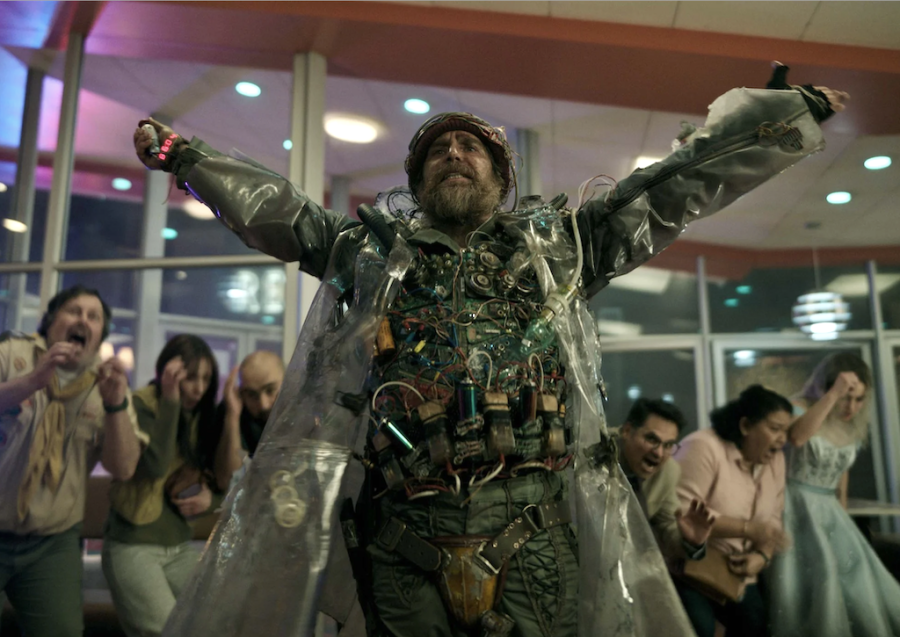
Suddenly a man bursts into Norms. He’s dirty, bearded, dressed in a see-through plastic coat wired up with tubes and other oddments. He’s immediately assumed to be a mentally ill unhoused man. He’s shouting something about having come from the future to save humanity from its catastrophic course toward technological Armageddon. He’s trying to recruit a team from the roughly forty patrons in the diner to come and help him complete his world-saving mission.
And it would be a mistake to call the cops on him, he says — though one of the servers already has — since he’s wired with bombs. Plus, he carries a portable button that, if pushed, resets the whole scenario so he can try again to get the right combination of diner patrons to save the world.
This, he claims, is his one-hundred-and-seventeenth try. He has the tired but wired glee of an obsessed gamer who’s prepared to carry on like this indefinitely.
Sam Rockwell plays the never-named man from the future. Rockwell is a fine actor, and he gives it everything he’s got. But for all the noisiness and activity of his character, the weird inertia of the film drags him down. Everything that’s happening in the long first sequence in the diner is overexplained and overemphasized and runs on too long.
After all, we’re familiar with movies in which characters from the future show up here trying to get people to do urgent things. We’ve seen dystopian sci-fi films with time-travel plotlines, and we don’t need to see lengthy harangues and multiple attempts at persuasion before the main characters are simply forced to do the urgent things that must be done or there’s no movie.
Famously, in Terminator (1984), the pitch to accompany the future-guy who’s trying to save the world was accomplished in eight words: “Come with me if you want to live.”
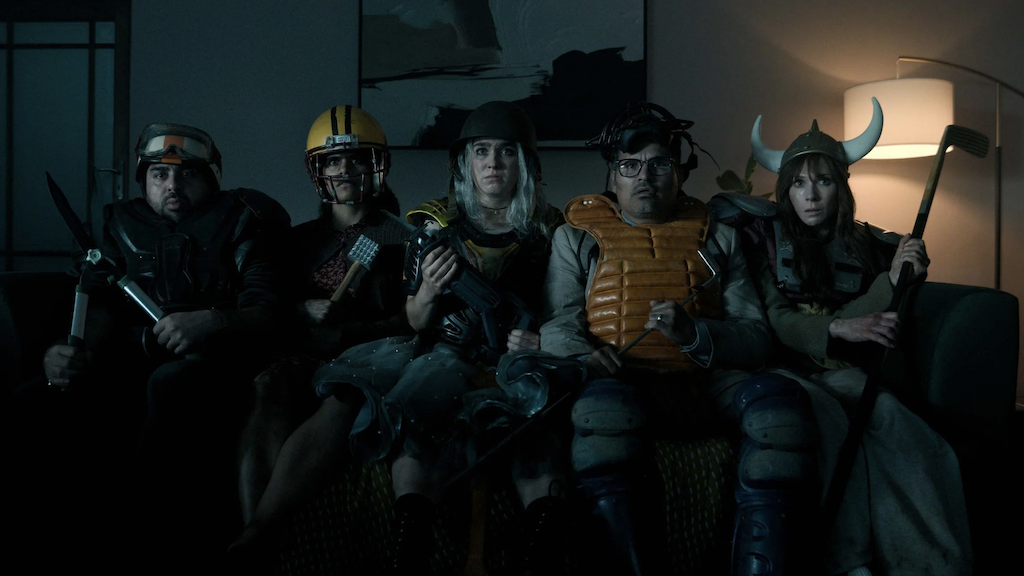
Verbinski adds a flashback structure to an already busy movie, so we can learn about several of the seven-member team he eventually recruits from the diner to go on the dangerous mission. Flashback structures can work wonderfully, but here again, the detail-filled sequences tend to run quite long, and they occur at points when, perhaps, they’re too much of an impediment to the action. After the diner scene, it’s definitely time to move, and we seem to trip over a long character bio at every turn. Possibly the original plan for Matthew Robinson’s script, which was to create a TV series out of it, made more sense.
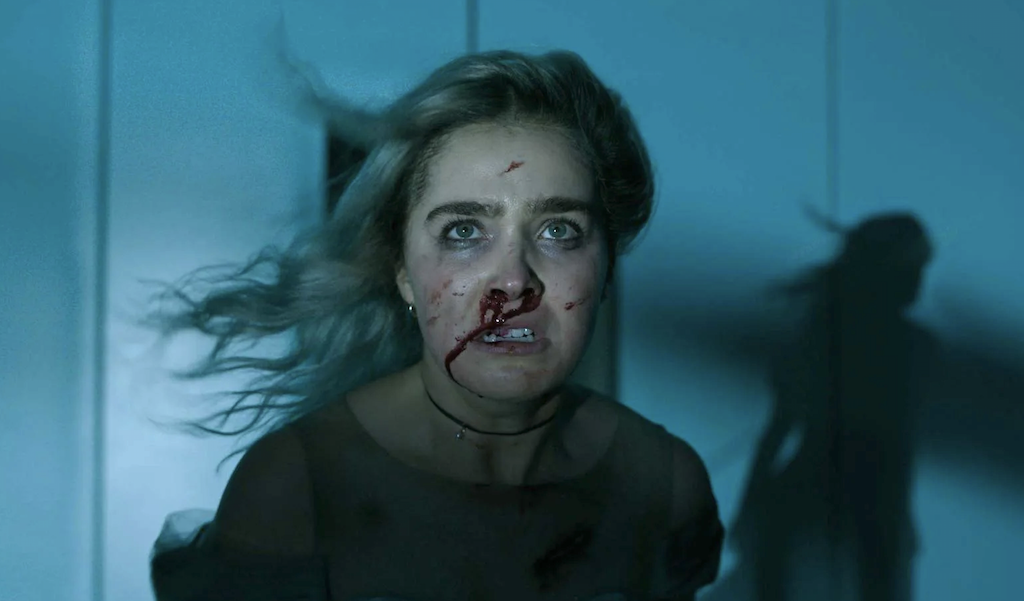
It’s not the cast’s fault. Verbinski has assembled an interesting and talented but star-free group of leads. Included among them are Michael Peña (Jack Ryan, Cesar Chavez) and Zazie Beetz (The Bad Guys, Joker) as cowed teachers in a totally dysfunctional school system where high school students refuse to part with their cell phones and hardly look up from them in class. Juno Temple (Fargo, Ted Lasso) plays a bereaved mother who’s lost her teenage son in one of the endless series of school shootings occurring all over the country. She’s soon drawn into a hush-hush government program that offers to clone school shooting victims, but its crudely routinized tech processes end up creating clones that look like the victims but have distressingly generic personalities. Haley Lu Richardson (The White Lotus, After Yang, The Edge of Seventeen) plays an edgy young woman wearing a bedraggled princess costume who’s literally allergic to technology, which has made her life so impossible that she’s all too willing to go on what’s clearly a suicide mission.
There are several others we barely get acquainted with before they’re killed by the militarized police or the heavily armed thugs in pig masks who’ve been assigned to stop the man from the future. One woman recruit had come to the diner seeking just a few minutes’ respite from the horrendously difficult life she’s leading that is now the norm for almost everyone. “I just wanted a piece of pie,” she says plaintively right before she’s shot down with an excess of gunfire that’s nauseating.
And of course, there’s the man from the future who’s traveled back in time from a sunless, depopulated postapocalyptic world where, as a child, all he had was his tech-phobic mother, until she got assassinated in a drone strike. His mission to avert that dystopian hellscape involves time travel back to the point where a heavily guarded nine-year-old genius in a suburban house completes the AI program that will lead to its takeover of the world and the drastic depletion of resources that ends most of humanity. All the man from the future wants to accomplish is plugging in a tiny hard drive to the boy’s computer system that adds a security feature limiting the worst of the AI outcomes.
AI itself can’t be stopped, he says: “It’s an inevitability in all timelines.”
And perhaps that’s the deciding factor that makes the movie such a slog. It may actually be too topical. It immerses us in things we worry about every day, urged on by frenzied social media commentary. We feel so sickened and helpless about these things — America’s rampant school shootings; the cratering educational system; the increasing atomization of our tech-addled society; the hostile militarization of the police force and the shady fascistic government forces unleashed with guns aimed squarely at the American people; and the looming AI juggernaut that seems to threaten the environment, the economy, the world of aesthetics, and human expression; and the job prospects of workers everywhere all at once.
Every scene in the film is there to illustrate these intractable social ills, and the man from the future rants about them in didactic monologues. And we’re already so overfamiliar with them anyway that satirical dark comedy seems redundant. We’ve seen all the memes already.
In the later stages of the big chase scene, an army of zonked-out teenagers under the control of their cell phones marches on our motley crew of rescuers, who try to board themselves into a suburban house and fight them off, zombie-film style. It’s unclear what these “zombies” can do to hurt anyone, since they only walk forward staring at their phones. But far worse than that: it’s such a tired idea, it revives in your mind for a moment the tired insult, “Okay, boomer.”
And maybe that’s the leading quality of the movie: exhaustion. It’s a movie about starting a revolutionary action to save the world that plays like the burned-out end of something.