In poll after poll, Americans across the political spectrum support a federal jobs guarantee. And yet it’s never mentioned in mainstream political discourse. New survey data makes the case even harder to ignore.
In 2024, the Center for Working-Class Politics (CWCP) and Jacobin published a report summarizing the state of public opinion on a federal jobs guarantee. Looking across nine publicly available polls conducted since 2018, we found an average of 59% support for the policy. That’s not a slim majority driven by one partisan base but a consistent, solid majority that spans the political spectrum.
Our report showed that Democrats backed a jobs guarantee at rates between 81% and 88%. Independents supported it at 56% to 74%. And even among Republicans, 46% expressed support, with stronger backing among those under forty-five. Perhaps most striking is the fact that voters who switched from Barack Obama to Donald Trump in 2016 showed 29% net approval for the policy, meaning support substantially outweighed opposition even among a group that had recently rejected the Democratic Party.
But we also found that the framing matters. Depending on the specific wording, support ranged from a high of 74 percent to a low of 46 percent. Proposals that highlighted additions like guaranteed health care or a high minimum wage performed worse than those emphasizing the personal economic and broader societal benefits of the program. But across virtually every poll, the basic proposition — that the government should guarantee a job to anyone who wants one — commanded majority support.
New Data: Support Holds Even When You Name the Price Tag
Critics of ambitious progressive economic policies often argue, sometimes correctly, that support would collapse if respondents were told the truth about how the program would be financed. In other words, big, bold programs always poll well until taxes come up. Yet new survey data suggests this may not be the case for a federal jobs guarantee.
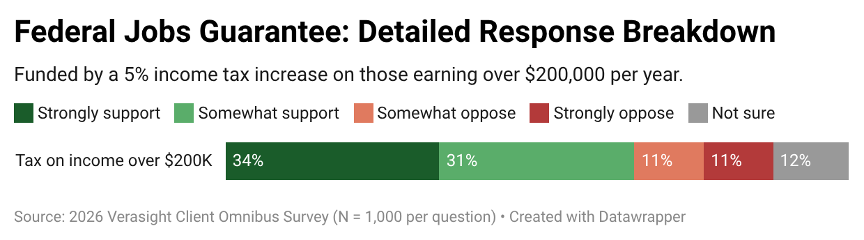
In March 2026, Verasight conducted a nationally representative survey of one thousand adults, who were asked to evaluate a jobs guarantee question written by the CWCP and Jacobin specifically for the survey. The question explicitly included a financing mechanism: a 5 percent income tax increase on those earning over $200,000 per year.
The CWCP and Jacobin deliberately set the tax threshold low to ensure the test was as difficult as possible — and yet this policy received supermajority support: 65% (34% strongly support and 31% somewhat support), with just 22% of respondents expressing opposition. An alternate version of the question that set the tax threshold much higher at $1 million received even higher support: 75%, including strong majorities among both independents and Republicans.
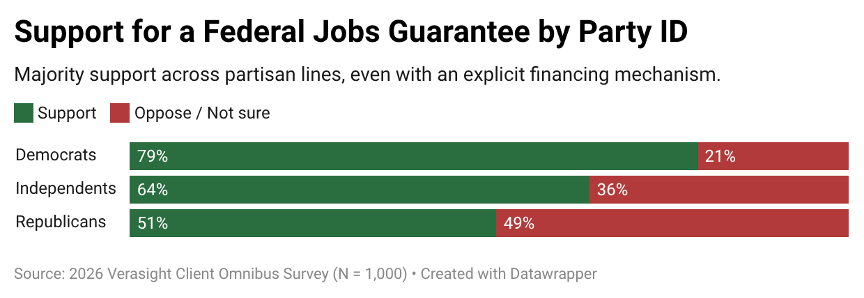
Across partisanship, 79% of Democrats, 64% of Independents, and 51% of Republicans were in favor of the policy. Both working-class and middle-class respondents also strongly supported a federal jobs guarantee: 65% of those without a four-year college degree versus 65% of respondents with a four-year college degree, and 69% of respondents making less than $50,000 per year versus 55% among those making over $150,000 a year.
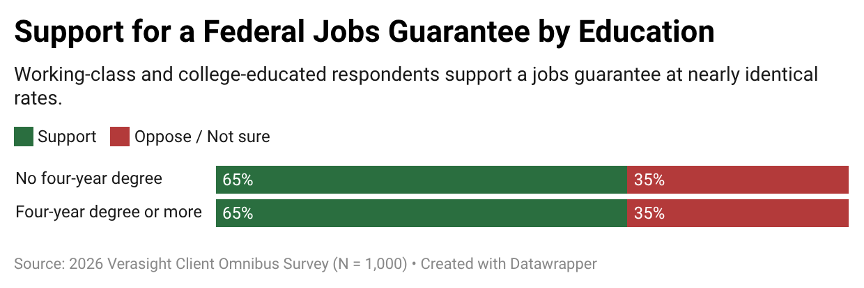
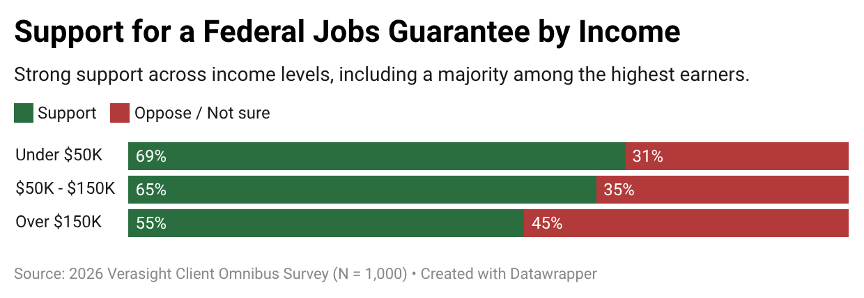
These identical support levels across educational lines are striking but not surprising. The economic anxieties currently driving demand for a jobs guarantee are no longer confined to working-class communities. Middle-class Americans increasingly face stagnating wages, job insecurity, and growing fears about what a new wave of automation (including AI) may do to white-collar employment.
When the threat of displacement feels real across the class spectrum, the appeal of a job guarantee cuts broadly. Simply put, there is no class trade-off in making a jobs guarantee the centerpiece of a progressive economic agenda. On the contrary, it may be one of the few policies capable of building a genuinely cross-class coalition.
Why a Jobs Guarantee Makes More Sense than a Universal Basic Income
To understand why a jobs guarantee could be so strategically valuable for rebuilding a progressive working-class majority, it helps to understand what work means to working-class Americans, and why it means something altogether different from what Democratic politicians often assume.
For many working-class Americans, the ability to provide for one’s family through hard work is not just a financial necessity but a source of dignity and self-respect. As Joan C. Williams argues in her recent book Outclassed: How the Left Lost the Working Class and How to Win Them Back, the working-class moral code centers on being someone who earns what they have, who doesn’t ask for help, who carries their own weight, who demonstrates — through effort and discipline — that they deserve what they’ve got. Government assistance, in this framework, is not experienced as generosity but rather as an implicit judgment that you cannot make it on your own.
When progressive politicians offer unconditional cash in place of good jobs, they might believe they are helping. Yet many working-class voters hear something else: a verdict, that someone has looked at their lives and decided they can’t make it on their own.
This is where the distinction between a jobs guarantee and proposals like a universal basic income (UBI) becomes critical. The usual knock against government programs among working-class voters is that they amount to rewards for not working that come at the expense of those who do. That critique does not apply neatly to UBI, which is universal rather than means-tested. But the political problem runs deeper than the means-testing question.
Even a universal cash transfer is easily decried — and is routinely framed by its opponents — as “paying people not to work.” The universality of UBI does not insulate it from this attack because the underlying objection is not really about who qualifies. It is about what the program says about the relationship between effort and reward. A check that arrives whether you work or not offends a deeply held working-class conviction that what people truly need is not charity but opportunity.
A jobs guarantee is totally compatible with these values. It says: if you want to work, there will be work for you. It offers opportunity, not a stipend. It addresses the real crisis facing working-class communities — the disappearance of stable, decent-paying jobs — without asking anyone to accept a totally new relationship to work that feels alien or demeaning. It provides help in the form that working-class people actually want: a chance to earn a living and contribute to something larger than themselves.
The Stakes of Getting This Right
The jobs guarantee is not a fringe idea. It is not an untested abstraction that only polls well when described in vague terms. Even when respondents are told exactly how the program would be paid for — through a tax increase on high earners — it receives supermajority support, and majority support across class and across the political spectrum. And unlike a UBI, it taps into the deep working-class conviction that what people need is not charity but the opportunity to do meaningful work at a decent wage.
None of this is to pretend the obstacles are trivial. A federal jobs guarantee is, whatever its values alignment, a proposal for a massive new government spending program — and critics are right to note that many working-class voters carry a deep, historically earned skepticism toward exactly that kind of federal commitment. That skepticism is real, and opponents of the proposal would not hesitate to weaponize it.
But consider the alternative. Certainly nearly every far more moderate economic proposal currently on offer from Democrats polls as well or better than a jobs guarantee. The problem, however, is that none of them are remotely up to the historic task at hand. Incremental reforms like targeted tax credits, a few workforce training programs, modest expansions to existing safety-net programs, capping out-of-pocket prescription drug costs, etc., are much easier to defend politically. But they are not the kind of sweeping, visionary intervention that could help to reshape who the economy works for.
We have forty years of evidence for what that approach produces: workers left further behind with each passing decade, the slow erosion of any credible Democratic claim to represent ordinary people’s interests, and, ultimately, the conditions that allowed a cynical right-wing populism to step into the void and reap the bitter fruit of that neglect. At some point, the strategic caution that presents itself as realism has to be recognized for what it actually is: a long, slow surrender.
A major working-class realignment toward the Left will only occur if progressives deliver sweeping economic legislation that gives working-class Americans a concrete, lasting stake in the Democratic coalition — the kind of constituency-building that defined the New Deal era. A federal jobs guarantee is exactly the kind of policy that could anchor that project: universalist in scope, work-centered in design, and broadly popular across the lines of party and class that currently fracture the American electorate.
The public appetite is there. The question is whether the Left is willing to take the risks that meeting this moment actually requires.