The Trump administration is determined to finally crush Cuba, through concerted actions to cut off its fuel supply. Resisting Donald Trump’s imperialism, the Nuestra América solidarity convoy is mobilizing to provide direct aid to the Cuban people.
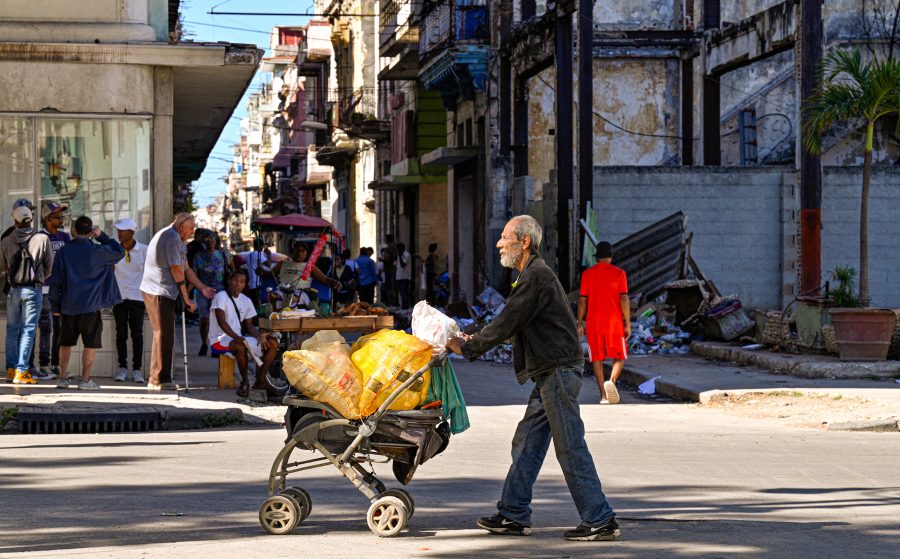
The Cuban Revolution has survived two-thirds of a century under US blockade but is today under greater pressure than ever. US government actions including the January 3 kidnapping of Nicolás Maduro, assaults on Caribbean sea-lanes, and a January 29 executive order imposing steep tariffs on states that supply oil to Cuba are all aimed at cutting off Cuba’s fuel supply and bringing the country to its knees.
Many reports tell of a dire humanitarian situation, with now-frequent power cuts and widespread shortages, worse even than in past crisis moments. Donald Trump and anti-communist ideologues like Secretary of State Marco Rubio seem determined to push Cuba into chaos. Threats against Cuba’s trade partners are designed to give the United States the final say over the island’s fate.
Still, Cuba does not stand alone. The Nuestra América Convoy has called for an international solidarity effort to bring humanitarian aid to the island on March 21. One of the organizers is David Adler, co–general coordinator of the Progressive International, and a veteran of the Gaza Freedom Flotilla. He spoke to Jacobin’s David Broder about the US pressure on Cuba, its ripping up of international law, and the need for practical solidarity with the Cuban people.
The Nuestra América Convoy has called for people from around the world to converge in Havana, Cuba, on March 21. What are you trying to achieve?
The first aim is to deliver critical aid to the Cuban people that can redress the humanitarian consequences of the January 29 US executive order, which establishes a fuel blockade around the island. It is an historic act of collective punishment.
It’s easy to sling around the word “humanitarian,” so it helps to be clear about the precise consequences of the executive order. It means that medicines expire before they can reach patients. It means that if a fire broke out, there’d be no fire truck to reach it. It’s a crisis with consequences that rise exponentially as its effects multiply across sectors.
Of course, this isn’t the first US effort to strangle Cuba, inflame a crisis on the island, and bring down an “adversarial” government. Since 1962, Washington has led a trade embargo of Cuba that doesn’t just prevent bilateral trade between these two countries, but — given the US’s outsize role in governing international trade — has also isolated Cuba even from third countries. Then there’s the fallacious US designation of Cuba — made by Donald Trump but left intact until the final week of the Biden administration — as a “state sponsor of terror,” which weaponizes US dominance of the international financial system to exclude Cuba from it. The latest executive order simply ratches up the pressure further.
The convoy’s second goal is to stand shoulder to shoulder with the Cuban people. The US has tried to make Cuba into an isolated no-go zone. That especially means undermining tourism, and the US’s allied governments have echoed this in parodied form. If Canada or France tell their citizens to leave or send planes to collect their tourists, it only serves the long-standing US agenda to isolate Cuba from the international community.
There’s an unbelievable amount of misinformation on corporate social media about the state of affairs on the island and the imminent collapse of the Cuban government. So we want people to come and understand Cuba firsthand, to speak with Cubans on the ground and understand the real consequences of this blockade.
The third goal is to apply pressure to governments to assume their own responsibilities under international law. Over the past two and half years, we have seen scores of states rhetorically committed to international law abandon those commitments in practice, as Israel both obliterated occupied territories in Palestine and waged a broader regional offensive from Syria to Lebanon and Iran. That has severely weakened the integrity of the international legal system meant to defend the rights of the most marginalized populations.
The strangulation of Cuba is applying this same playbook. Tragically, we’re again seeing guarded silence, even from many countries who have voted in the UN General Assembly to condemn the US blockade on Cuba. They know that this is wrong, but too many have refrained from sending the aid that Cuban people desperately need right now and energy that Cuba’s critical infrastructure requires for its people to survive.
You were already involved in the Gaza Freedom Flotilla. It served not just to bring aid to Palestinians but as a call to government action. Today the Trump administration is threatening to punish states who help Cuba. What can they do in this situation?
The January 29 US executive order is a menace not only to the well-being of the Cuban people but also to the broader principle of international solidarity.
That is because the Trump administration is both blockading the island and threatening sanctions on third countries that dare to break it. We should understand the order as an existential threat to the integrity of the international order. I think that many states have been slow to reckon with this.
One of the consequences has been to leave a country like Mexico alone in its brave and principled stand against the US blockade, sending ships carrying humanitarian aid to Cuba. There are many countries in the region that have access to natural resources that could service Cuba’s critical infrastructure. They range from friendly governments in states like Brazil and Colombia to others that are less overtly progressive but who still vote against the US blockade in the UN. These states, too, reckon that the US aggression against Cuba risks contagion if it is not confronted collectively; any of those countries could be the next target of the Donroe Doctrine.
The flotilla to Gaza wasn’t only about showing up the governments who failed to respond to their international responsibilities. It was also about linking sea- and land-based mobilizations to apply pressure on those governments. It said: if ordinary people can bring this humanitarian aid, knowing full well that it’s not sufficient, then states can and must rise to the occasion to provide the rest.
One hope is that by convening people from so many countries, from delegations from so many political forces, parties, unions, and movements all across the world, we can advance the idea of a multilateral mechanism that is powerful enough to stand up to the Trump administration — and protect the mothers, newborns, elderly, and sick people who are struggling right now in Cuba. Even if individual states do not feel they can act alone, their collective action can triumph over the fear that the Trump administration seeks to instill in allies and adversaries alike.
Many Western states have spoken about their greater independence from the US in recent months. Still, this has its limits, and they were more willing to stand up for the sovereignty of Denmark and Greenland than to denounce the US attack on Venezuela.
If the Trump administration and people like Marco Rubio are determined to strangle Cuba, what’s the hope of pushing back? What are the weaknesses in Washington’s line?
There are two ways to read the guarded silence about Cuba in Europe and the West more broadly. The first reads it as a consequence of geopolitical myopia. The second reads it as useful idiocy.
The more generous read is the “myopic” one, which basically says: we’re aware that Trump’s US is on a crusade to rewrite the international order, regardless of what institutions were established to regulate its unilateral, coercive moves. Still, Cuba isn’t really our problem. It’s over there in the Western Hemisphere. It’s a small island. And of course, it’s run by self-proclaimed socialists. This myopic reading holds that none of what’s happening far away will ever come and affect Europe.
Even just one year into the second Trump administration, we can see that this approach is shortsighted. It is not only that Trump’s aggression toward Cuba is morally wrong and outright illegal. It is also that threats mounted by rogue nations like the United States don’t just apply to the territories under direct assault but also threaten to whip back and affect all peoples across the world.
The “useful idiocy” read is that while Canadian premier Mark Carney makes speeches about the importance of middle powers standing up to the United States, his and other countries’ guarded silence ends up becoming further fuel for Washington to lead this regime-change operation in Cuba.
The logic of the executive order is that Cuba represents an extraordinary national threat to the United States. None of those middle powers are questioning that logic. What threat does Cuba present? Is it its support for anti-apartheid movements? Its enduring solidarity with the Palestinian people? The fact that it provides free health care to impoverished communities in so-called Third World countries while the US and Europe would rather protect the profits of their pharmaceutical companies?
It bears repeating: the primary threat that Cuba represents is its example to the world, about the nature of solidarity and the nature of self-determination, and seeking this kind of true independence from the United States after so many decades of domination.
If the Cuban Revolution has long represented such an example, how is that solidarity being realized or even “repaid” by others around the world now?
For over six decades, Cuba has not only stood up for itself but for the world. Take when Fidel Castro convened the so-called Continental Dialogue on the Foreign Debt in 1985. That wasn’t because Cuba was severely indebted or needed to pay back its loans to the [International Monetary Fund]. Rather, it was extremely concerned about the prospects for self-determination and genuine popular sovereignty in many of its allied nations. Similar forms of leadership have been visible in the G77 and in its role in forming the Hague Group for Palestine.
I think it’s important to situate Trump’s actions in a broader set of retributive acts for all countries that have dared to stand up for Palestine. For instance, the United States effectively leading an electoral coup in Honduras to put in place a new president whose first international visit was to Israel. Or take South Africa, being punished with sanctions; the US even used the specter of “white genocide” to create an immigration policy favoring white Afrikaners and punishing the African National Congress. Or take Colombia, where Washington has sanctioned President Gustavo Petro and his Pacto Histórico project ahead of this year’s elections as a result of his leadership and his forthrightness over the Gaza genocide.
It’s not like the US government just wakes up in the morning and refreshes its priors on its national interest. Rather, it actively seeks retribution on those who dare to rebel. And no country, no revolution, no political project has been more rebellious in the face of that imperial violence than Cuba. That’s true whether it’s in direct confrontation, in the case of the anti-apartheid struggle, or indirect confrontation, for example, when Cuba provided low-cost COVID-19 vaccines that were directly competing with the far more expensive products on offer from US and European pharmaceutical corporations.
The US is punishing Cuba in order to impose its global supremacy. So the resistance against this, the solidarity with Cuba, is also about stopping the US government’s ability to isolate and punish anyone who dares to stand up against it.
Cubans surely have many different perspectives; some analysts speak of generational divides. Even in times of great difficulties, like during the Special Period following the end of the Soviet Union, when many predicted that the Cuban state would collapse, it showed strength in depth.
The July 11 protests in 2021 were not the mass uprising that some observers hoped for. Still, this time the material crisis is tougher and longer, and the level of emigration shows how strong the pressure has been on Cubans. The US administration and figures like Rubio clearly hope to make the situation unbearable, and maybe hope to engineer a situation like in Venezuela.
What’s your sense of how much the Cuban Revolution’s resilience still holds and how Cubans are responding to this moment?
One of the remarkable aspects of what’s happening now in Cuba is how quickly the Cuban people and leadership are attempting to respond even to the most adverse conditions of their asphyxiation. Take the accelerated production of renewable energy: getting off of dependency on oil to try to use solar to power homes, schools, hospitals, and the like. I was speaking with a friend just yesterday from Camagüey who was saying that she’d never seen solar in her home community. She was just back there two weeks ago, and there were four new providers of solar panels and production to install them in homes and institutions. So there has been a massive push toward renewables, to resist this latest effort to destabilize the revolution.
Still, as I said, this executive order is ratcheting up a long-standing logic of strangulation, asphyxiation, oppression, and domination by the United States. What concerns me is whether Marco Rubio will even be satisfied to see a humanitarian crisis unfold in Cuba, whether he will be satisfied to see the deaths of newborns or the absence of neonatal care for their mothers, and whether he will be satisfied to see grandmothers and grandfathers die as a result of not having access to their life-saving medicine.
The critical aspect of this convoy is not only to deliver humanitarian aid but to show up, as the peoples of the world, to be present on the island, where there’s a real risk that the United States is preparing — as it is often preparing — a more aggressive form of intervention that would directly assault Cuban sovereignty.
We don’t know what that looks like, mostly because US foreign policy is made in the darkest halls of the Pentagon, in the darkest basements of Fort Bragg, and not in the bright lights of Congress or the court of public opinion. One crazy aspect of being a US citizen right now is watching our government commit these crimes and not even knowing what they’re planning to do in our name, in Cuba or anywhere else.
So we are responding as an emergency convoy, because Cuba needs these supplies now. It needs solar panels, medicine, and food to keep the island running and to sustain that creative resilience that has kept the revolution alive for so many decades. But we also need to be conscious of the machinations of a deep state that is always coming up with new ways to intervene in other countries, whether that looks like the operation in Venezuela or something entirely different.
We should revisit the story of the CIA’s many attempts to assassinate Fidel Castro to help understand how many three-letter agencies are working overtime right now thinking about how they can effectively take control of Cuba, and maybe annex its territory and recolonize its people in the name of US power.
The US government doesn’t articulate what its end game is here. There is no dialogue, and Washington doesn’t say what concessions it wants from the Cuban government. Amid this climate of US aggression, there’s no pressure valve to reduce tensions and find a way forward. But that’s why it’s also frustrating that the US Democrats appear to have memory-holed even what the man they call the greatest president in our lifetimes — Barack Obama — did.
Many of them are wondering what on earth can be done, and the likes of Rubio would have us believe that negotiation is impossible. Yet in a recent period where there was family reunification, remittances were flowing, and tourism was expanding, just over ten years ago, a successful round of negotiations led to a diplomatic thaw that brought a lot of peace and prosperity between these two countries.
What does Nuestra América want people to do, to that end?
Nuestra América is more than a single mission. This is a global movement. We are encouraging delegations from all over the world to do their collection of humanitarian aid. That’s what we saw, for example, in Mexico — filling plazas with stands to do the work of educating our neighbors, friends, and colleagues on what’s happening in Cuba.
We’ll be converging in Havana’s Malecón on March 21, in a great act of solidarity with the Cuban people, where we’ll distribute that humanitarian aid and march together to stand up, not just for the Cuban people, not just for international law, but for the most basic principles of humanity and decency. We began with a smaller mission, but there’s been so much interest and enthusiasm that we broadened it to encourage delegations to self-organize, to find their way to Cuba, to break the siege.
It’s now or never for the Cuban Revolution, against a determined US administration and a US secretary of state whose lifelong dream has been to plant a US flag once again in the heart of Havana. We know that if Washington succeeds in its regime-change efforts in Cuba, the rest of us might be next. This US administration and this country has gone so rogue that we need the courage, conviction, and moral clarity to stand up before it’s too late.