One of the Pentagon’s top officials driving the decision to blacklist Anthropic for refusing to allow its algorithms to be used for mass surveillance has a multimillion-dollar stake in one of the company’s competitors.
As the Pentagon moves to sideline a leading artificial intelligence firm over its refusal to support mass surveillance and autonomous weapons, one of the top officials driving the decision has a multimillion-dollar stake in one of its direct competitors, according to financial disclosures reviewed by the Lever.
This investment, among others, means a Pentagon decisionmaker may have a financial incentive to steer lucrative government contracts toward certain AI firms, even as concerns mount about the risks of artificial intelligence in warfare.
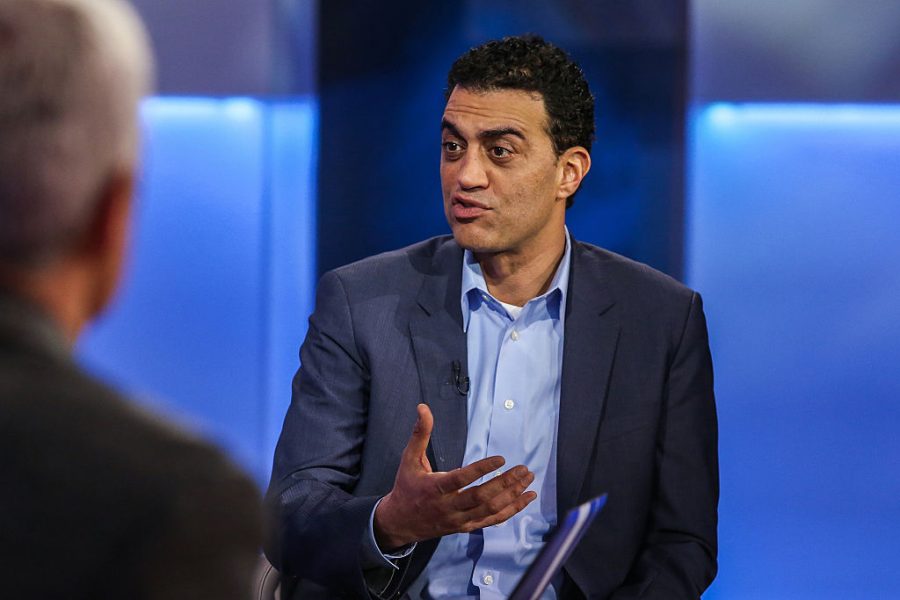
Emil Michael, the Trump administration’s undersecretary of defense for research and engineering and the Pentagon’s chief technology officer, has emerged as a central figure in the decision to blacklist the AI company Anthropic for refusing to allow its algorithms to be used for mass surveillance and certain military objectives.
Left unreported: According to a financial disclosure, Michael, a former Silicon Valley executive, holds millions in stock in an Anthropic competitor, Perplexity AI, as well as additional investments in other AI, cryptocurrency, and robotics companies with business before the Pentagon.
By designating Anthropic a “supply chain risk,” the Pentagon could damage its commercial business and government contracting prospects, benefitting rivals like Perplexity AI.
Michael pledged in his disclosure to not participate in any matters that have “a direct and predictable effect on my financial interests.”
A one-time Uber senior vice president, Michael also recently held investments in the cryptocurrency exchange Binance, whose owner had his 2024 money-laundering conviction pardoned by President Donald Trump last October.
Michael currently holds stock in the prediction market platform Kalshi, which he received as compensation for his prior consulting work there. Both companies have grown massively over the past year after receiving regulatory reprieves from the Trump administration.
Prediction platforms like Kalshi collect revenue for hosting betting markets on US military actions like the Iran War and have been plagued by concerns of both White House conflicts of interest and potential insider trading.
In total, Michael’s disclosure form lists an extensive array of stock holdings and other assets totaling between $121 million and $277 million, though he’s been forced to divest from some of those holdings since entering the government last May.
His remaining financial positions could still pose conflicts of interest for his high-powered role at the Pentagon, despite receiving little media coverage during his confirmation process last year.
“[These conflicts mean] the public will have reason to question whether your decision-making is biased toward benefiting your former employers, acquisitions, or investments rather than the public interest,” wrote Sen. Elizabeth Warren (D-MA) in a letter addressed to Michael during his confirmation hearing last March, though her letter did not cite the full list of investments.
The Office of Government Ethics issued Michael several certificates of divestiture for relinquishing investments in a variety of financial holdings, including the venture capital funds KQ Partners and Sequoia Capital, due to his high-level position in the government. The waivers qualify him for a major tax break.
“The Department of War maintains a rigorous, multilayered ethics framework that includes financial disclosure reviews, divestitures where appropriate, and screening to prevent conflicts of interest,” said a Defense Department spokesperson in a comment to the Lever. “Under Secretary [sic] Emil Michael, as with every DOW official, are in full compliance with all ethics laws and regulations. Any claims otherwise are false.”
A Perplexing Conflict
While “Department of Defense’s Chief Technology Officer” may sound like an obscure title, Michael wields immense authority over Pentagon procurement and contracting decisions, as recent developments have demonstrated.
The department’s high-profile feud with Anthropic, one of the major AI firms contracted with the government, reportedly began with a contentious meeting earlier this year between Michael and Anthropic’s CEO, Dario Amodei, over the terms of the company’s $200 million contract with the Pentagon.
In exchange for selling its AI models to the military, Anthropic pressed for guardrails to prohibit military use of its AI tools for fully autonomous weapons and domestic mass surveillance.
Michael reportedly refused to accept those restrictions, and when Anthropic pushed back, Defense Secretary Pete Hegseth blacklisted Anthropic from government contracts and labeled Anthropic a “supply chain risk,” a designation that could damage the firm’s commercial business.
As Anthropic took steps to take the matter to court, the administration quietly advanced a new provision forcing AI companies to prioritize Trump directives over safety protocols and privacy protections as a condition of doing business with the government.
OpenAI is reportedly taking over the Pentagon contract originally awarded to Anthropic.
Michael, meanwhile, has retained between $2 million and $10 million in Perplexity AI stock, a chatbot and large language model system that directly competes for market share and government contracts with Anthropic’s Claude AI assistant.
Michael formerly sat on the board of Perplexity AI, a position he resigned from at the start of last year, but he still holds millions in vested and unvested stock in the company, according to his financial disclosure. Once Michael resigned from the board, Perplexity could choose to purchase back his unvested stock at market price — but there is no filing or record indicating that the stock has since been sold.
Perplexity AI, which specializes in search engine tools and AI agents, is an active player in the ongoing race to turn government contracts into a key AI revenue stream. Last year, Perplexity was approved by the General Services Administration for “multiple award schedules,” making the company’s technology available for government-wide use across departments.
From his time as an investor and past consulting work, Michael holds other major investments that could pose potential conflicts. He owns between $350,000 and $750,000 in stock in Collaborative Robotics, which builds robots with reactive AI technology and recently held a Pentagon contract worth $250,000 that expired in 2025.
Michael also recently held between $100,000 and $250,000 in vested common stock in the AI company Pronto, which offers a centralized autonomous transportation and logistics system.
Pronto received a $1.25 million two-year contract from the Department of Defense in 2022, which was renewed in 2024 and will be up for renewal again this year. Pronto repurchased the stock in 2025, according to Michael’s disclosure.
According to Michael’s ethics disclosure, he will avoid any policy decisions that could impact these investments. “I will not participate personally and substantially in any particular matter that to my knowledge has a direct and predictable effect on my financial interests in any of these entities,” the disclosure reads.
Betting on Blockchain and AI
As a consultant, Michael worked for other companies in the AI and blockchain industries, several of which he continues to be invested in. That includes between $15,000 and $50,000 in both Crossroads.ai, which uses AI for data analysis and digital advertising, and 1Money Network, a blockchain company for stablecoins.
Blockchain is the underlying digital infrastructure that powers the cryptocurrency sector, but it can be used for other technologies as well. The Defense Department has proposed adopting blockchain technology to support various logistics projects and could solicit bids from private companies for such work.
Senator Warren has also questioned how Michael’s previous senior roles at Uber and DPCM Capital, Inc., a special-purpose acquisition company, could influence his work at the Pentagon. In 2022, DPCM acquired a quantum computing startup called D-Wave Systems, which is eligible for Defense Department contracts.
“Mr. Michael’s new role may position him to help secure military contracts for companies he’s tied to, such as D-Wave as it seeks a [Defense Department] contract to provide quantum computing services, or Uber as it seeks to provide ride services from military bases,” Warren wrote in her letter to him last year.
Michael does not own any stock in either Uber or D-Wave, according to his disclosure. He continues to hold between $50,000 and $100,000 in stock options in the Kalshi prediction market.
He previously held between $30,000 and $100,000 in stock in the Binance cryptocurrency exchange, another company he consulted for that could be affected by federal policy decisions. According to his ethics disclosure, Michael’s vested stock holdings in the company would have expired three months after he assumed his current Defense Department position in May 2025, unless Binance chose to extend the investments. There is no indication that the company did so.
In 2025, Trump’s Securities and Exchange Commission dropped a Joe Biden–era lawsuit against Binance for securities violations. Amid Trump’s broader pro-crypto agenda, the industry has boomed — boosting the value of firms tied to Michael’s investments.
Trump regulators have also signaled a lax regulatory approach to prediction markets, even as questions persist about oversight, conflicts of interest, and potential insider trading.
This article was first published by the Lever, an award-winning independent investigative newsroom.