As democratic socialism returns to the US public eye, socialists need to make clear how their vision differs from the liberalism most Americans are familiar with. Here are five crucial distinctive elements of a socialist policy agenda.
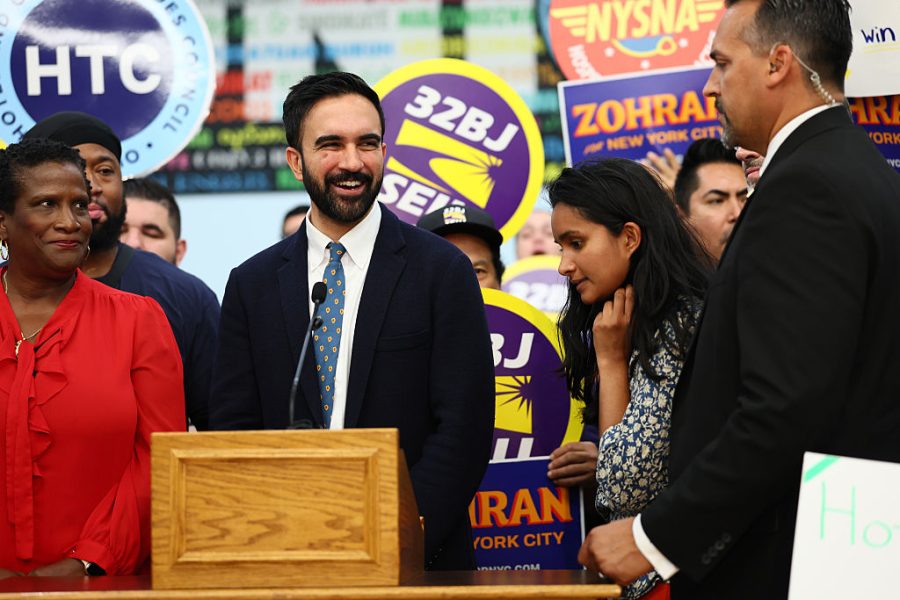
It’s increasingly difficult for US political commentators to neglect the centrality of socialism to the country’s affairs. We now see a spate of polling results and other commentary testifying to the popularity of socialist ideas, if not the label, as well as to the prospects of rising political stars like Zohran Mamdani in New York City, Katie Wilson in Seattle, and Omar Fateh in Minneapolis.
Whenever democratic socialism has a moment in the mainstream media, as it is having now, pundits and reporters ponder what “democratic socialism” really means. Those on the Left speculate on how, if at all, it differs from “social democracy” — generally taken to refer to the more egalitarian economic arrangements observed in the Nordic countries, and to a lesser extent across Western Europe. The relationship between democratic socialism and social democracy is a matter of dispute on the Left, but in general, democratic socialists imagine a more far-reaching transformation of economy and society than they expect from social democracy.
I would contend that democratic socialism and social democracy are more alike than different, and so the term “social democrat” can be kosher again. The important justifications for seeing a close connection between democratic socialism and social democracy are twofold. First, in practical political terms in the here and now, they are identical. Take Medicare for All (M4A), for instance. Whatever you think M4A is or should be, there is nothing inconsistent between M4A advocacy, social democracy, and democratic socialism.
Second, the European nations whose policies most Americans are comfortable with — and that American socialists like Bernie Sanders point to as models — often are led by governments and parties that self-identify as social democratic. It’s the word “socialism” that tends to scares Americans, not the content offered by most socialist politicians. Yet while the terminology of “socialism” still scares many people, “social democracy” is unfamiliar and foreign-sounding, so it is not a very politically effective label either. Clearly, Mamdani, Wilson, and Fateh, among others, are finding a language that appeals, without running away from the socialist label.
In the immediate term, then, the difference between the two concepts may not matter too much. Unless you think the capitalist state can be replaced wholesale, in one fell swoop, you are interested in politically feasible reforms achieved through our maddeningly dysfunctional democratic processes. The “socialist reforms” that many are finding digestible are not categorically different from the common and old advances of social democracy in Europe, so by all means, let’s have more of it. And the popularity of figures like Mamdani, Sanders, Fateh, and Alexandria Ocasio-Cortez are due to the prospects they offer for reforms, not to a revolutionary smashing of the state.
Some on the Left, including fellow Jacobin contributors, want to stress the difference between the status quo and socialists’ desired end state. In so doing, however, there is the risk of glossing over the essential, inescapable path from here to there and narrowing socialists’ political appeal and accomplishments. My contention is that socialism is as much about the steps toward the goal as the goal itself. Neither means anything without the other.
Socialism is an important brand, but it is something more: it reflects a particular objective — in a nutshell, the reduction of alienation in the Marxian sense. The chief means for conquering alienation is increasing democratic control of the economy. Following Karl Marx, the central democratic decision is the disposition of the aggregate accumulation of “surplus value,” including the composition, distribution, and level of net investment. National economic planning would be opened up to popular input. At the enterprise or business-firm level, workers would take over management of day-to-day operations. This is all foreign to liberalism but not to social democracies around the world (though the extent of worker management in social democratic countries is still rather limited).
When Sanders broke the national political ice on the word “socialism” in 2016, I recall sappy messages to the effect that “socialism is nice; even your public library is socialist.” But that’s wrong — socialism is so much more than that.
Here I want to describe some economic policy projects that might define a distinctively socialist (or social democratic) approach to policy in the United States today, one that pushes beyond the frontiers of liberalism. These are differences in kind, not of degree. For the principal US social democratic projects, I suggest the following breakdown:
- Labor power
- Industrial policy
- Social insurance
- Social ownership
- Anti-federalism
There are traces of all of these in the history of liberal social policy, but I want to highlight the categorical distinctions between liberal and socialist approaches to each element. Such distinctions can give rise to political themes and to explicit campaigns.
(Socialists also crucially differ from liberals in our commitment to internationalism and our opposition to the United States’ militaristic imperialism. But I focus here on the distinctive elements of socialists’ domestic policy agenda.)
Labor Power
The great liberal John Kenneth Galbraith proposed or at least popularized the idea of “countervailing power” as a justification for elevating trade unionism. The implication was the desirability of a “fair” political competition between labor and capital.
Who needs fair? As anarchists say, “No gods, no masters!” We want to stack the deck in favor of the working class — or at least unstack it from its contemporary extremely biased state. This is one distinction between socialism and liberalism. There has been plenty of thinking done about how to do this, but the objectives are clear: remove constraints on union organizing and agitation.
The Obama administration disgraced itself in this context by its weak support for the public employee upsurge in Wisconsin. Both Barack Obama and, before him, Bill Clinton sold out their own allies in labor with their advocacy of anti-worker “free trade” deals. Joe Biden made a bit of a splash by not merely calling for labor peace and a labor-management kumbaya but by explicitly favoring the contract sought by the United Auto Workers in their historic strike against the Big Three automakers. It says a lot about the Democratic Party that this was an unusual milestone.
Industrial Policy
Again, we got a taste of industrial policy (IP) under Biden and now a bit more, albeit of a perverse nature, under Donald Trump. The idea is to restructure the economy — to shift the composition of what is produced — in the direction of higher-value-added industries. That means higher profits and wages and ultimately more tax revenue. Liberalism has been historically unfriendly to IP, in obeisance to the mythical free market.
How would IP be pursued? The first problem is to determine which industries to expand and then to reckon with which ones would contract (and disemploy people, often at great personal financial harm). The tools for Biden’s attempt at IP were disproportionately tax credits. Relief for anyone negatively affected was usually nonexistent, though Biden broke this pattern temporarily with his extraordinary COVID-era expansion of unemployment benefits.
For Trump, it’s whatever idea comes into his howling wilderness of a mind, legalities aside. His objective here has been showing off, to demonstrate that our national CEO can deliver tangible factories and good manufacturing jobs. It’s mostly a con. If anything, the scandal of the Georgia raid by Immigration and Customs Enforcement (ICE) and the ensuing mistreatment of Korean workers will have a negative impact on foreign direct investment in the United States.
For socialists, the tools for IP would be a mix of direct grants, loan guarantees, and public enterprise. An important qualification is to ensure transition assistance for workers negatively affected by structural changes in the economy in the short term.
An obvious candidate for IP is production in the service of transition away from fossil fuels. That means solar, wind, and maybe nuclear. (I’m skeptical of the latter because I doubt our regulatory apparatus is up to enforcing prudent safety standards, but I won’t get further into that thicket of weeds.) For energy aficionados, there is also the need for a robust, national power grid.
A negative example of IP has been the US government’s historic support for automobile transportation and lack of investment in social transit. A leading case is our pathetic intercity passenger rail system, aka Amtrak. There are also urban intraregional rail systems begging for upgrades, support for which is plausibly in the national interest.
The climate benefits of social transit are obvious. Since our metro regions are the drivers of the national economy, so, too, is the health of the cities at their centers. We may be getting a teaspoon of this with Mamdani’s free buses — hopefully a prelude to more.
One branch of IP is trade policy. Here, too, we see a clear difference between liberal and social democratic approaches. Trade policy can be used to actively restructure a domestic economy, not merely to facilitate whatever corporations are wont to do. Liberalism tends to default to the latter, since traditionally Democrats have been in bed with Big Tech companies and finance, who desire government protection of their “intellectual property.”
As mentioned above, a common objective of IP is supporting higher-value-added industries. This of course is what most other nations want to do as well, so negotiation is required to get a division of the spoils that is superior to whatever would happen absent such negotiations — a different kind of trade deal. Trade deals can serve IP goals, and not incidentally, the interests of labor. Liberals, with their emphasis on free-trade deals that effectively prioritize the interests of capital, have been on the wrong side of this struggle.
Another branch of IP emphasized by liberals is antitrust. Again, the underlying motivation for breaking up big corporations is for the sake of a mythical free market, a delusion upheld by liberalism. It is true, there can be opportunities to enhance market efficiency by breaking up monopolies. But what tends to be overlooked is the option of replacing monopolies with public enterprises. That’s the social democratic or socialist alternative.
Social Insurance
The chief basis for social welfare in the social democratic nations of Europe has been their social insurance schemes. The idea is you tax people to finance benefits against likely, adverse events, what Franklin D. Roosevelt called “the great disturbing factors of life.” Injury, illness, and involuntary unemployment are top of the list, followed directly by retirement, disability, and death of the family breadwinner.
Social insurance should not necessarily be financed through progressive taxation; the idea is people should be willing to pay for what we are selling. If they aren’t, something is wrong with us or with the product. One benefit of the approach is that it provides political robustness to a program. It’s harder to take something away if people have been paying for it and feel they are owed a debt.
The liberal commentary about social insurance has been unhelpful. In the case of Social Security, it has featured flat-out bogus predictions of insolvency or crackpot remedies such as individual, privatized stock market accounts. Long ago, someone suggested that, if he hadn’t been consumed by the scandal with Monica Lewinsky, Bill Clinton might have wrecked Social Security with privatization.
In the case of health care, we have of course the Rube Goldberg Obamacare system. I would not deny it was an improvement in its time, but more straightforward, simpler models are available and on view in other countries. Even here in the United States, we still have the federal Veterans Administration, which employs its own doctors and provides health care directly.
The biggest poison pill in Obamacare was spurious, liberal defense of deficit reduction that constrained the subsidies made available to the insured. At the root of Obama’s crippled health care reform effort was the Democratic establishment’s mantra “We believe in the market.” Of course, if they had a clue what a market really is, either in ideal terms or in the real world, their behavior would be very different.
But the Left has also been mixed up about social insurance, including cash benefits. In the matter of health insurance, it is reduced to the slogan of taxing the rich to pay for M4A. First, socialism will require more dough than we can get just by taxing the rich and corporations. The idea of focusing taxes on the rich has reached absurd lengths with the Democratic Party’s now-standard assurances that it doesn’t want to further tax anyone earning less than $400,000 annually, or some similarly ridiculous number.
Second, M4A is an empty box. What is it, exactly? Existing Medicare, for all? I’m on it, and no thanks. Medicare covers only 80 percent of catastrophic expenses. For most, including me, 20 percent of a catastrophic expense is still a catastrophe. Furthermore, it’s hard to find doctors who accept Medicare patients.
Some other version of Medicare? What exactly? The possibilities are endless, and you wouldn’t like some of them. The Left needs to deliver specifics about what its envisioned national health system, or national health insurance plan, would look like, including how it will be realistically financed.
On cash assistance, we have the faux-left dead end known as the universal basic income (UBI). Not for nothing have some libertarians latched onto it. The hope is to set up all cash assistance to be like “welfare,” then come in swinging with the wrecking ball. If you’re for socialism, consider what social democratic governments actually do: it’s social insurance, not UBI.
Social Ownership
Here we are out past Bernieland. Bernie says he is uninterested in “nationalizing the means of production.” (So am I, to be honest; I don’t want the US Congress trying to run Nvidia.) That hasn’t stopped Sanders from making some friendly noises about Trump’s machinations in establishing US government stakes in tech companies, however.
As usual, there are many incremental way stations. Once again, Mamdani gives us a taste with his public grocery stores. At one point, in the teeth of the COVID-19 pandemic, even the loathsome Andrew Cuomo fiddled with the idea of New York State producing protective equipment to deal with the Trump administration’s shortages. In 2020, California governor Gavin Newsom took steps to acquire COVID supplies the federal government was failing to provide.
Perhaps the two most pressing needs for social ownership are in the fields of energy policy and housing. In both, the private sector has proved itself utterly inadequate. We rely too much on fossil fuels, and housing costs, due in large part to supply shortages, have become prohibitive for aspiring homeowners and renters.
It perhaps feels a little easy to say, “Well, the government can build this stuff.” But it is also true. As I mentioned above, we will need much more revenue to do so, a bullet most liberals are not willing to bite.
Social democrats can first sell the program; if you build it, people will be willing to pay. Liberals usually wring their hands and lead with, “Gee, how will we pay for it?” But if what you build is more beneficial than foregone tax revenues, it is more difficult for the other side to take it down. If it is not, then somebody screwed up somewhere.
Anti-Federalism
Finally, there is the conundrum of US federalism. Decentralization of the public sector in the United States is extreme by international standards and retards economic and social progress. Back in the eighteenth and early nineteenth century, “anti-federalism” meant opposition to a strong central government, in favor of states; I mean the opposite.
Centralization begins with an expanded revenue system — more taxes, and not exclusively progressive ones. Such revenues could go to the states in part while serving the purposes described above.
Some public services are properly national in scope and require federal design, funding, and management. Examples already mentioned are intercity rail and a national power grid. Transition off of fossil fuels must be a national policy, though implementation can and will likely be decentralized and incremental.
What’s so bad about federalism? Income and wealth, as they are in most nations, are unevenly distributed geographically. The larger the nation, the greater the burdens of a unitary central government. Insofar as we assign taxing and spending to local jurisdictions, we get inadequate public funding and gross inequality. A state tax is better than a blizzard of local taxes. For one thing, it raises more revenue, even if the rate is the same. And a federal tax is better than fifty state taxes.
It is possible to take the principle too far, since people have sorted themselves out geographically, to some extent, based on preferences for public services, and it is possible to excessively flout those preferences. I would say we presently have the reverse problem, however — too much indulgence to decentralized finance.
A Social Democratic Alternative
On all these dimensions, social democratic or socialist policy visions are categorically or conceptually distinct from “more liberalism.”
In a nutshell, the Left can make political hay by advocating more power for labor, industrial policy, social insurance, social ownership, and less federalism. These are well-regarded ideas. Making clear that democratic socialist politics need not mean a pell-mell avalanche of new and unfamiliar programs can reduce people’s fears about the ideology. The popularity of Mamdani’s baby steps in these directions attests to their political viability, as do the polls that suggest that people are receptive to the content of democratic socialism, even if the label makes some apprehensive.
A common alternative understanding of democratic socialism foregrounds the question of the political power of the working class. I find this notion amorphous. Who, exactly, is the working class, and how does it, whatever “it” is, win and exercise that power?
One idea in this vein is worker ownership, or at least worker control of workplaces. There is no question such an arrangement would be an improvement, but the gains can be exaggerated too. Workers at a particular workplace could be as collectively self-seeking as the owner they replaced, and there are still all the problems inherent in commodity production. There are also questions about how control without ownership would be meaningful or how the transfer of firm ownership should be financed.
Worker ownership of individual firms encounters the same problem as local financing of public services that I discussed in Jacobin recently. There will be rich firms and poor firms, and their geographic locations will be haphazard, fomenting inequality.
Labor management of firms is a benign improvement, but it seems a dubious candidate for a systemic improvement. So, too, with cooperatives or renters’ unions. Of course, these are not novel ideas nor is there anything wrong with them. There have been attempts in the past, and there are many existing examples. But in the absence of broader change, their spread would still leave us with capitalism.
A socialist vision has to go beyond the atomized management of firms or a proliferation of cooperatives. The crucial political point is to grasp a dynamic of comprehensive change, through the inauguration and expansion of progressive policies and institutions that strengthen workers’ bargaining power and expand democratic public control over the economy.
Socialists championing these reforms can offer a robust, realistic alternative to liberalism while showing the American public that the “S-word” is nothing to be afraid of. And if they start by enacting just some elements of this agenda, they can grow momentum and popular support for more changes to build a less alienated economy.