In spite of the Gaza genocide, Israel still has plenty of customers for its high-tech exports, especially the weapons it produces. But it is experiencing a debilitating brain drain as secular, highly educated Israelis are emigrating in growing numbers.
In the last quarter of 2023, Israel was simultaneously reeling from the shock and trauma of the October 7 Hamas attack on the cities and kibbutzim of the Gaza Envelope and mobilizing for a campaign of revenge and retaliation. Over 200,000 Israelis were evacuated from communities bordering the Gaza Strip and Lebanon, and some 300,000 reservists were mobilized.
In the following months, the Israeli economy was dislocated. Consumer spending, imports, and exports declined dramatically. Ultimately, nearly 50,000 businesses went bankrupt.
Meanwhile, Israel’s global brand is in the trash can. Its genocidal campaign in Gaza put it in bad odor among progressive circles worldwide and across much of the Global South. But the economic disruption that Israel has experienced to date has been manageable for its leaders.
Downgrades and Capital Flows
Gross Domestic Product (GDP), the total monetary value of goods and services, is a common crude indicator of economic health. By that standard, the Israeli economy was in distress in late 2023. In the final quarter of the year, GDP shrank by 19.4 percent. Annual GDP growth for 2023 was only 1.8 percent, down from 6.5 percent in 2022.
For comparison, the US economy grew by 2.9 percent in 2023 and 2.5 percent in 2022. These are considered “good” numbers for a developed capitalist economy. Israel’s rate of GDP growth exceeded the United States in every year from 2015 to 2023.
War-related costs, which the Bank of Israel estimated at $80 billion from 2023 through 2025, drove Israel’s 2024 government budget deficit to nearly 7 percent of GDP — more than double the EU’s guideline of 3 percent of GDP for Eurozone member states. By raising taxes, the government brought its 2025 budget deficit down to 4.7 percent of GDP, still well above the EU’s benchmark. For comparison, the Congressional Budget Office estimates the 2025 US budget deficit to be 5.9 percent of GDP.
Another common measure of economic health is government debt as a percentage of GDP. In 2024, Israel’s debt surged to 69 percent of GDP, up from 61.3 percent in 2023 and well above the 60 percent required for Eurozone members. The current US government debt is about 120 percent of GDP. But no other country has the special privilege of printing dollars to pay its debts.
Based in part on these macroeconomic indicators, the major international rating agencies downgraded Israel’s credit rating, increasing the interest rate it had to pay to borrow money to cover its budget deficit. However, despite a higher than desirable budget deficit and debt as a percentage of GDP, the Israeli economy rebounded sufficiently so that, by late 2025, S&P upgraded Israel to A with a stable outlook. This is an investment grade indicating minimal risk of default, though still weaker than AA or AAA. Moody’s more pessimistically maintained its September 2024 downgrade of Israel to Baa1 with a negative outlook, though it recently upgraded its outlook to “stable.”
Capital flight was significant in 2023 and 2024. Impelled by the mass weekly protests against the Benjamin Netanyahu government’s assault on the independence of the judiciary, institutional investors transferred over $8 billion out of Israel by June 2023. In the year following October 7, 2023, they moved an additional $40 billion out of the country.
Norway’s Sovereign Wealth Fund has completely divested from the occupation, and the Danish Pension Fund has withdrawn all investments from Israeli banks. The Irish Strategic Investment Fund has divested approximately €3 million from five Israeli banks and from Rami Levy, which operates several supermarkets in the West Bank.
However, these sums were offset by substantial capital inflows in 2024 and 2025. Record acquisitions of Israeli start-ups by US firms and record Tel Aviv stock exchange prices in 2025 suggest that while international and local capitalists may have questions about Israel’s economic stability, they are far from the point of abandoning it.
Growth Engine
The high-tech sector is Israel’s economic engine. It employs about 11 percent of the workforce who pay around 25 percent of all income taxes. Its products and services comprise about 64 percent of exports and 20 percent of GDP.
Israel’s high-tech industries, and the closely related military-surveillance-industrial complex, are fully integrated into global circuits of capital. High-tech firms employ about 409,000 people locally and 440,000 more outside the country. More than a hundred Israeli companies trade on New York’s tech-rich NASDAQ exchange, the most of any foreign country after China and Canada. Managerial and technical personnel shuttle between Israel and Silicon Valley and other high-tech US hubs; some remain abroad for years at a time.
A look at two firms, Intel and Nvidia, simultaneously illustrates elements of uncertainty and of resilience in Israel’s high-tech sector. Intel has invested $27 billion in Israel, more than any other foreign firm. It employs about 9,000 people, down from 12,000 in 2021. In 2017, Intel bought Mobileye, which makes sensors and cameras for driverless vehicles, for $15.3 billion. At the time, this was the largest foreign acquisition in Israeli history.
In early 2024, with a $3.2 billion subsidy from the Israeli government, Intel announced a $25 billion expansion of its chip manufacturing operations in the southern Israeli city of Kiryat Gat called Fab 38. In June of that year, after several rounds of global cost cutting and layoffs, Intel announced that it would postpone launching operations at Fab 38 to 2028 or later. As one part of the facility is nearly completed, forecasters have predicted that Intel will either put it into operation or sell it to another firm.
The Palestinian Boycott, Divestment, and Sanctions campaign has claimed that it was responsible for the postponement of Fab 38 and attributes it to Intel’s loss of confidence in the Israeli economy. However, Intel was more powerfully motivated by its global failure to compete with Advanced Micro Devices (AMD) and Nvidia in manufacturing AI chips and subsequent declines in market share, profits, and stock prices. Unless Intel’s global fortunes nose-dive, it will not abandon Israel, where its capital investment amounts to nearly 10 percent of its global footprint, for the foreseeable future.
Nvidia is Israel’s fastest growing employer with 5,000 employees. In December, it declared Israel to be its “second home” and announced that it will invest $1.5 billion in constructing a new research and development (R&D) campus in the Haifa suburb of Kiryat Tiv’on and a nearby server farm. Its physical presence there will match the size of its Silicon Valley headquarters. The facility, designed to accommodate 10,000 employees, positions Nvidia to overtake Intel as Israel’s largest private employer.
The rise and fall of competitive firms is how capitalism is supposed to work, though Intel’s $3.2 billion government subsidy and Nvidia’s steep discount, worth about $21.7 million, on leasing land in Kiryat Tiv’on highlight the reality that there is never a “free market.”
Led by cybersecurity and AI, Israeli high-tech remained strong overall. In 2024, start-up firms raised around $11 billion, a 13 percent increase over 2023. Cybersecurity raised the most capital, 39 percent of the total, while aerospace and military achieved the greatest year-over-year growth with a 143 percent increase in capital investment. In 2025, Israeli start-ups raised $15.6 billion in private capital, up 68 percent from 2023. There were eighteen IPOs during the year.
Cybersecurity and AI firms led the way in making 2025 a record high of $60 billion for mergers and acquisitions. Two enormous acquisitions dominated: Google bought cloud security platform Wiz for $32 billion and Palo Alto Networks purchased CyberArk Software for $25 billion. These deals strengthen the relationship between Silicon Valley and Israel’s military-intelligence apparatus. The four cofounders of Wiz, the founders of CyberArk and Palo Alto Networks, and many others employed in high-tech are veterans of Military Intelligence Unit 8200.
Israel has established itself on the frontiers of innovation known as deep tech, with breakthrough technologies based on new scientific discoveries and advanced engineering. But as the size of the Wiz and CyberArk acquisitions suggests, the sector may be entering a period of consolidation where it is dominated by industry giants, not start-ups.
The Arms Industry
As might be expected, Israel’s military-surveillance-industrial complex remained strong. Israel is a world leader in the “new military urbanism” — crowd control, border surveillance, and counterterrorism — that has burgeoned since 9/11. Israel’s homeland security sector comprises six hundred firms, of which three hundred export training, services and goods, mainly surveillance technologies, with an annual value of over $3 billion. In 2024, Israeli arms exports broke a record for the fourth year in a row to reach $14.8 billion, up from $13 billion in 2023 and compared to between $7.5 and $8.5 billion in annual sales from 2018 to 2020.
Lockheed Martin (LMT) illustrates Israel’s integration into the global arms industry. LMT is the world’s largest arms manufacturer by sales volume. Lockheed Martin Israel was established in 2014. It operates offices in Tel Aviv and Beersheba, which is developing as a hub of military-oriented high-tech.
LMT has been arming Israel since 1971, and its F-16 fighter jets have been the mainstay of its air force since 1980. LMT is the lead contractor, with Northrop Grumman and British BAE as secondary partners, for the notoriously over-budget and underperforming F-35 stealth fighter jets. Israel has contributed prominently to the project and will eventually acquire at least seventy-five F-35I Adirs, with Israeli-customized avionics.
LMT’s coproduction agreements with Israeli enterprises for F-35 components have an anticipated value of over $4 billion, perhaps rising as high as $6 billion. In 2014, Israel Aircraft Industries, which was state owned but is in the process of privatization, opened a new production line to manufacture over eight hundred pairs of F-35 wing skins valued at $2.5 billion. Cyclone, a subsidiary of Elbit, Israel’s largest privately owned military manufacturer, produces F-35 aerostructures, while Elisra provides its electronic warfare suite and state-owned Rafael manufactures the F-35’s advanced weapons and sensors.
The F-35 and many other US military aircraft use the Joint Helmet Mounted Cueing System, a digital eyepiece developed by Elbit and Rockwell-Collins. LMT vice president for customer requirements, retired US Air Force Gen. Gary North, proclaimed, “There’s a part of Israel in every F-35 that’s ever been built.” In December 2017, Israel became the first country outside the United States to deploy operational F-35s. It currently operates more than forty of them.
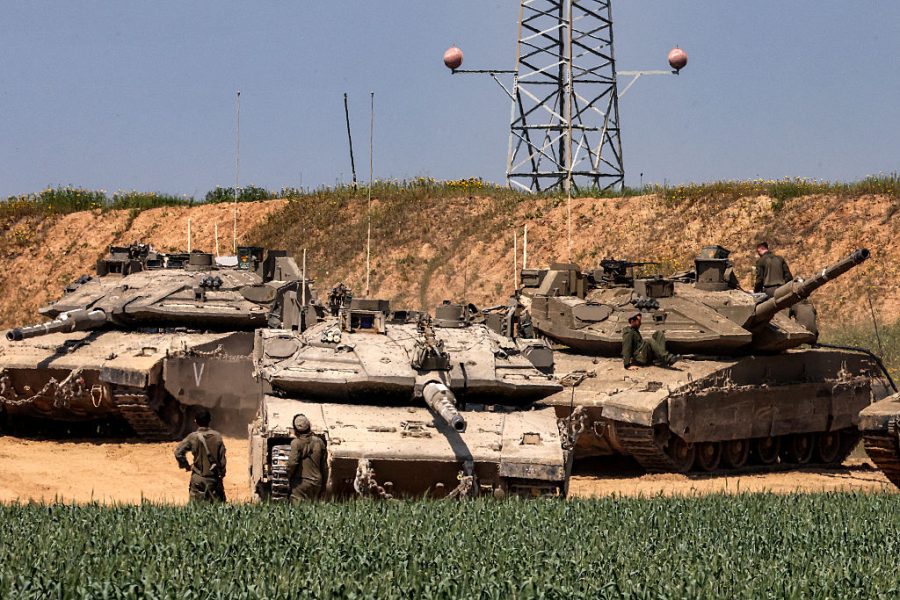
The Merkava (chariot), Israel’s main battle tank, was designed and is mostly built in the country itself. But it is also integrated into global military production supply chains. MTU, a German subsidiary of Rolls-Royce, manufactures the MT-883 engine for the Merkava and Israel’s Namer (tiger) armored personnel carrier. While most of the engine’s components are manufactured in Germany, they are assembled in Muskegon, Michigan, by Rolls-Royce Solutions America. This makes it possible for US military aid to fund Israel’s purchase of the engines, and it ties hundreds of US jobs to this supply chain, making it politically difficult to cut it off.
The Merkava’s transmission system is designed by the German firm Renk and manufactured under license in Israel. When Germany briefly paused arms sales to Israel in 2025, Renk CEO Alexander Sagel described its likely response to a more protracted freeze: “If we cannot produce [transmissions] in Germany, we will relocate these volumes to a different plant, for example, to the US . . . This might take maybe 8 to 10 months, but if there’s no move forward, we will do it because we have this business.” That is to say, Renk needs Israel’s business as much as Israel needs Renk’s tank transmissions.
Export Markets
There have been some ominous signs for the future of Israel’s military export sector, although, with the exception of Spain, Israel’s major European arms purchasers have so far limited themselves to symbolic actions. France banned Israeli military firms from participating in the June 2024 Eurosatory, a major global arms fair. In 2025, Spain canceled a contract signed just before October 7, 2023, to buy 168 launchers and 1,680 anti-tank missiles valued at $325 million from a subsidiary of the Rafael firm. This came after the cancellation of a $7.53 million order for bullets.
In July 2025, Slovenia became the first EU country to impose an arms embargo on Israel, announcing that it had halted arms purchases from Israel shortly after October 7. The next month, however, Haaretz reported that Slovenia had used EU work-arounds to continue purchasing military equipment worth approximately $970,000 from Israel in 2024, not including anti-tank missiles and the maintenance of previously purchased materiel.
In August 2025, Germany, Israel’s second-largest arms supplier after the United States, announced that it was suspending the sale of some weapons that could be used in the Gaza Strip. But in November, after Donald Trump’s phony “ceasefire” was announced, Germany resumed arms exports to Israel.
In December 2025, weeks after Germany received the first of its Arrow 3 air defense systems from Israel, it announced an expanded $6.5 billion Arrow agreement, making this the largest-ever Israeli military export deal. Israel Aerospace Industries jointly developed the Arrow with Boeing and the US Missile Defense Agency. The US government gave Israel about $1 billion in R&D funds for the Arrow from 1988 to 2002.
Despite the demurrals of Spain and Slovenia (and Ireland, which does not buy weapons from Israel), Europe was the largest purchaser of Israel’s 2024 military exports, with 54 percent of the total, up from 35 percent in 2023, followed by the Asia-Pacific region at 23 percent. The Abraham Accords signatories — the United Arab Emirates, Bahrain, and Morocco — accounted for 12 percent of Israel’s arms exports, up from 3 percent in 2023. This figure does not include under-the-table purchases of surveillance and other equipment by Saudi Arabia and other Gulf Arab countries. Genocide has not deterred Arab autocracies from doing security-related business with Israel.
Other sectors of the Israeli economy have flourished despite (or in some cases because of) its decimation of Palestinian society in the Gaza Strip. In December 2025, Israeli concluded a $35 billion deal to supply Egypt with natural gas from its Leviathan field in the Mediterranean in which Chevron Mediterranean Limited holds a 40 percent stake.
Egypt loudly proclaimed that this was a commercial arrangement with no political implications. However, it is difficult to believe that Egyptian dependency on Israel for natural gas will not inform its post-genocide policy on Gaza. About half the income from the deal will flow into Israel’s state coffers, a significant contribution to lowering the budget deficit in coming years.
The war also delivered windfall profits in some sectors. In 2024, when El Al had a monopoly on flights from Israel to North America, its profits were greater than its cumulative annual profits in the previous fifteen years. The respected Stockholm International Peace Institute reported that Elbit, Israel Aerospace Industries, and Rafael, Israel’s largest military industries, recorded combined revenues of $16.2 billion in 2025.
Banks benefitted from government compensation to businesses and individuals evacuated from war zones and from the $8,000 per month salary replacement program for reservists, totaling about $18 billion as of mid-2025. Because of Israel’s consumption-based domestic economic structure, those transfers fed economic activity without increasing unpaid debts on bank balance sheets, inflation, or causing a balance-of-payments crisis.
Emigration
The increased rate of emigration is the single most important development of Israel’s post–October 7 political economy that, if not checked, will signal that educated, secular, cosmopolitan, and disproportionately Ashkenazi Jews do not envisage a future Israel in which they wish to live. Emigration to the United States and Europe is not entirely a post–October 7 phenomenon. The 2020 census recorded 191,000 Israelis living in the United States. Some estimates are as high as 500,000. About 20,000 Israelis, perhaps more, live in Germany, over half of them in Berlin.
From 2009 to 2021, about 36,000 Israelis left the country annually. Perhaps prompted by the escalation of violence accompanying the 2021 Unity Intifada, 43,400 departed in 2021 and 59,000, in 2022. An October 2025 Knesset report found that 82,800 Israeli citizens departed in 2023 and a similar number in 2024 — a historic loss of human capital.
This population drain was offset by 24,200 returning in 2023, and 23,800 the following year. About 75,000 were projected to depart in 2025. Subtracting returnees from departees leaves about 58,000 net annual departures in 2023 and 2024. In December 2025, the Israel Advanced Technology Industries Association reported that 53 percent of companies received increased relocation requests to positions abroad from Israeli employees — “a trend that may, over time, harm the local innovation engine and Israel’s technological leadership.”
The trend of academics leaving the country is most pronounced in STEM fields. Most of the degree holders living abroad come from affluent, disproportionately Ashkenazi localities in greater Tel Aviv and Haifa, and Omer, a suburb of Beersheba. The Council of Presidents of Israel’s Research Universities warned, “When about a quarter of PhD graduates in mathematics and computer science choose to build their future abroad, the State of Israel is steadily losing its comparative advantage.”
In addition to the departures of personnel from the country, there are signs that Israeli high-tech may be losing some of its vigor. According to a report of the Israel Innovation Authority (IIA), employment in high-tech has stagnated since 2022 and decreased in 2024 as part of the workforce has left the country. IIA CEO Dror Bin described this as “a moment of truth” for the industry:
On the one hand, Israel is consolidating its position as a global Deep-Tech center, second only to the US. On the other hand, output is flat, R&D roles are shrinking, and entrepreneurship is declining. These are not marginal data points but indicators of risk we take very seriously.
Long-Term Problems
Will the long-term consequences of the genocide transform “indicators of risk” into “indicators of collapse”? Not yet.
The roots of the current strains on Israel’s political economy long predate the Gaza genocide. Israel was in a serious recession in 2003 when Benjamin Netanyahu became finance minister in Ariel Sharon’s Likud government.
His remedy was to enhance the power of capital over labor by cutting the top individual income tax rate from 64 percent to 44 percent and the corporate tax rate from 36 percent to 18 percent, selling off publicly owned enterprises, capping government spending, raising the retirement age, and cutting government support for education, welfare, and health care. Netanyahu’s Likud-led governments since he returned to power in 2009 have accelerated and broadened this process.
In Israel, the structural tendency of capitalism — especially in its high-tech, military-surveillance, neoliberal form — to exacerbate inequality even as it creates great wealth takes the geographic shape of concentrating capital investment in the greater Tel Aviv metropolitan area, while the disproportionately Mizrahi, Ethiopian, and Russian geographical peripheries are impoverished. Both the Gaza Envelope towns of Sderot, Ofakim, and Netivot that were attacked on October 7 and the Lebanese border area towns of Kiryat Shmona, Metula, and others evacuated in response to sporadic Hezbollah rocket fire are in periphery zones.
When Israel’s neoliberal economic transformation began in 1985, it was one of the most economically equal countries in the world. In recent years, it has typically been the fifth-most unequal of the OECD countries. The United States is the most unequal country in the OECD.
In late 2025, Israel Tax Authority data revealed that Israel’s top decile receives 83 percent of all capital gains and 45 percent of all income. Another recent report by Israel’s National Insurance Institute showed that 27.1 percent of all Israeli families struggled to afford adequate food in 2024.
As is the case with all socioeconomic indicators, Palestinian citizens of Israel were worst off, with 58 percent of households food insecure. Among Haredim (ultra-Orthodox Jews), the other large community enduring high rates of poverty, 25 percent of households are food insecure. These are consequences of Netanyahu’s neoliberalization drive rather than the Gaza war.
The gap between the top 10 percent and the rest is the principal internal fracture in Israel’s political economy. In a settler-colonial society like Israel, economic inequality roughly overlaps with the inequality of colonizers and colonized. Until October 7, this tension was managed by stealing Palestinian lands and redistributing the benefits of the post-1967 expanded settler-colonial enterprise to Jewish members of the pro-Netanyahu, Likud-led coalition that is comprised of the heavily Mizrahi working and lower-middle classes, settlers, Haredim, and elements of the high-tech and military-surveillance sectors.
Haredim were secured for Netanyahu’s coalition by the continuing exemption of religious seminary (yeshiva) students from the draft and providing housing for them in the West Bank (over 140,000 Haredim live in the settlement cities of Modi’in Illit and Beitar Illit). In recent years, the government has allocated over $1 billion annually for Haredi educational institutions, stipends for married men who study rather than work, and support for social welfare and cultural/religious programs. The proposed 2026 budget of $205 billion includes about $1.6 billion for Haredi institutions and projects.
The war exacerbated structural tensions between Haredim and the rest of Jewish society because most Haredim do not serve in the military while most non-Haredi Jews do. In June 2024, Israel’s Supreme Court unanimously ruled that the government must draft Haredim. The Bank of Israel warned that the draft conscription law currently under discussion by the Knesset Foreign Affairs and Defense Committee was inadequate to significantly reduce the strain on reserve soldiers or the cost of maintaining them in service. Recriminations over this issue led the Ashkenazi Haredi United Torah Judaism party to withdraw from the government, leaving it with only 60 out of 120 Knesset seats.
The cabinet has adopted a 2026 budget, which the Knesset must approve. The debate will surely feature grandstanding and temper tantrums. The Mizrahi-Haredi Shas party has already threatened not to support the budget if it does not include $86 million for food stamps for “their” children that they claim the coalition agreement promised them. If the Knesset fails to adopt the budget by the end of March, the government will be legally obliged to resign.
No coalition members desire this outcome. All would prefer to hang on until the Knesset elections scheduled for October, which are unlikely to alter Israeli policy on Palestine whatever Netanyahu’s personal fate may be.
Prospects
While secular, cosmopolitan Jews are emigrating in larger numbers, religious and traditional Jews, especially the fascist messianists who have been driving the policies of the current government, have been reshaping an Israel to their liking for decades. They have been the beneficiaries of the political economy of occupation. Along with the spectacular growth of the military-surveillance-industrial complex and its global exports, this has enabled Israel to avoid the protracted crises experienced by other states that have embraced market fundamentalism and authoritarianism.
Chile became the laboratory for this political economy and governance model under Augusto Pinochet, who came to power in 1973 in a US-supported coup and ruled until 1990. The victory of José Antonio Kast, an ultraright figure whose father was a member of the Nazi party, in Chile’s recent presidential election is a cautionary sign that this model remains alive as one response to the continuing effects of the global financial crisis of 2008.
Adam Fabry dubbed Hungary the “vanguard example of the wider shift towards authoritarian-ethnicist neoliberalism across the world” as perfected by the regime of Victor Orbán. Other exemplars are Italy under the governments of Silvio Berlusconi and Giorgia Meloni as well as India under Narendra Modi. Similar political movements are in a strong position to assume power in countries like France and the UK and are gaining strength in Germany.
Israel is a beacon for these regimes and movements. Except for Chile under the outgoing left-wing president Gabriel Boric, they all supported Israel’s genocide. The governments headed by Orbán, Meloni, and their counterparts elsewhere trade with Israel, ignore its violations of human rights, and echo its vilification of Muslims.
In the Middle East, Saudi Arabia and the United Arab Emirates are comfortable with ethnonationalism, as are authoritarian neoliberalizers that lack significant fossil fuel resources such as Turkey, Egypt, Morocco, Tunisia, and Jordan. They tolerate Israel’s brutalities and denial of Palestinian rights because any democratic popular movement would threaten to destabilize their own regimes.
Three countervailing forces could transform the risk factors in the Israeli political economy into a serious crisis: continued high rates of emigration of educated Jews; a sharp change in US policy toward Israel/Palestine, such as an arms embargo or sanctions on war criminals; and effective Palestinian political action.