The dance marathons of the Great Depression have gone down in legend as a way of turning desperate people into fodder for exploitative entertainment. The spirit of the marathons is alive and well in the contemporary world of reality TV.
The venue was New York’s Madison Square Garden (MSG), June 1928. This was not the Madison Square Garden you and I might know, but rather a sturdy, rectangle-shaped arena located in New York’s Hell’s Kitchen. (It was the third building to bear the MSG name; the current home of the Knicks, in Midtown Manhattan, is the fourth.)
The 1920s were roaring loudly; choose your favorite Gatsby trope. Skyscrapers sprouted up all over Manhattan like steel and glass dandelions. Bootleg booze fueled the city’s nightlife, sexual expression was on the rise. It was an era of the Madam, with underground queens like Polly Adler providing an archetypal heavily connected women who provided powerful men with their midnight kicks.
And a new form of entertainment had arrived in the city: the dance marathon. Madison Square Garden was the venue of what was dubbed “The Dance Derby of the Century.” Its scale, organizers said, would be unprecedented.
The premise was simple: competing couples would dance on the arena floor continuously, twenty-four hours a day, for the entertainment of a paying audience. For every hour, contestants were permitted ten minutes of rest. This would continue until only one mighty couple remained, with no maximum time limit. The winners would scoop $5,000 — almost $95,000 in today’s money.
The Train for Long Island
Dance marathons evolved from an earlier, more stripped-down version of the spectacle. At these events, a single participant, typically a woman, would attempt to continually dance without rest for longer than anyone else on record. Of all the women to attempt this test of endurance, history most clearly remembers Alma Cummings, a dance instructor who, in 1923, swayed away with six different men for twenty-seven consecutive hours at the Audubon Ballroom, a vaudeville house in Washington Heights, New York.
One photographer snapped Cummings in the aftermath — her feet soaking in a bowl, a weary but genuine smile etched across her face — holding up a pair of shoes with gaping holes in the soles like two moon craters. The image inspired numerous other hopefuls to try and beat the record. Attempts became so common in the following weeks that a new record holder would often still be resting from their exertions when the news came through that their time had already been eclipsed.
Dance marathons, such as the 1928 Madison Square Garden derby, were a higher level of pageantry. These were more directly competitive contests — participants were not facing off against the clock but against each other. And while spectators had been in attendance to bear witness to the achievement of Cummings five years earlier, the pomp and spectacle of dance marathons was more tailored to sell tickets, entertain a crowd, and, ultimately, make a profit.
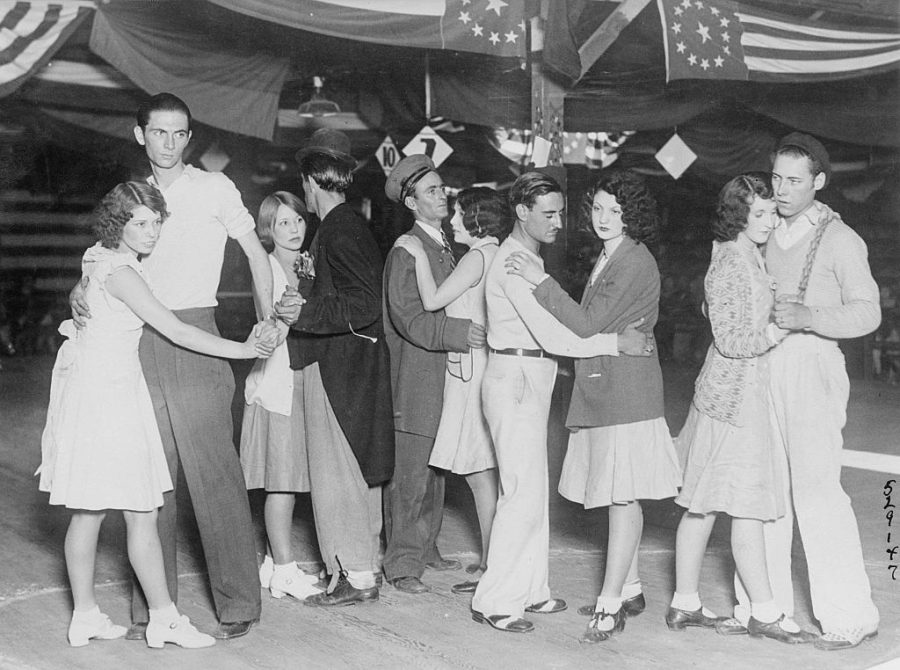
Chief promoter of the Madison Square Garden event was Milton D. Crandall, a shrewd organizer determined to build a sense of occasion around his latest endeavor. The arena was decorated with the flags of various nations, as if to lend an Olympian legitimacy to proceedings.
Coats of arms adorned some of the red-and-white-striped canvas tents that were set up around the arena for contestants, as well as staff such as doctors, masseuses, and beauticians. A rostrum was constructed in the center of the arena to station an orchestra; potted palms were installed to decorate the dance area. There was a certain level of professionalism to the handling of contestants too. All had passed a medical exam to allow them to compete; team numbers were assigned to those who were successful.
It fell on Andrew Jackson Gillis, the mayor of Newburyport, Massachusetts, described as “the world’s championship endurance mayor,” to fire the starter pistol. With three squeezes of the trigger, as many as one hundred and thirty-four couples began their long dance.
To allow for so many entrants, makeshift beds were jammed into dressing rooms, with some even spilling out into corridors. But a lack of space was a temporary problem. During the first two days of the competition, thirty-five couples were eliminated; thirty-three more went on day three. By the fifth day, just twenty-nine couples remained.
There was no rule that stated contestants were required to dance in time to the music, so some duos shuffled as slowly as possible to conserve energy. Still, the Amateur Athletic Union (AAU) estimated that contestants covered the equivalent of about forty miles a day.
Among the competitors were Jimmy Scott and Olga Christensen, team number 83, former colleagues at a dance school who felt confident they could stay on their feet for an entire week — enough, they deduced, to scoop the grand price. But the contest stretched into a second week. And then a third. By the fifteenth day, nine couples still remained. To allow each other to sleep as they danced, Scott and Christensen developed techniques to remain in motion while taking their partner’s weight.
Despite these inventive methods, contestants began to hallucinate due to fatigue. At one point, Scott found Christensen attempting to pull away from him. When he asked what was wrong, she replied, “To the waiting room.” “What for?” the bemused Scott inquired. “To wait for the train.” “What train?” “The train for Long Island.”
Team Number 7
At first, the event attracted only a small number of spectators. Yet as the days fell off the calendar, and the ability of participants to remain vertical became ever more improbable, interest in this strange novelty grew. By the time the marathon had been whittled down to nine remaining couples, it was estimated that 21,000 spectators were entering the arena every twenty-four hours.
The price of admission rose accordingly from $1.50 to $3.30. The New York Times printed daily updates; Time would later publish a lengthy report. Esteemed guests included former heavyweight champion Jack Dempsey and screen star Mae West.
As the attention mushroomed, so did the furor. Rumors swirled of a contestant at a dance marathon in Wilkes-Barre, Pensylvania, who had suffered an internal hemorrhage a week after he left the dance floor, panicking New York officials.
The person with ultimate authority was the city’s Health Commissioner Louis I. Harris, who entered the job with the stated ambition of adding ten years to the life of the average New Yorker. Facing mounting pressure, Harris issued the order: Crandall had to shut it down.
The scene at the Garden became ridiculous. With half an hour to go before the imposed shutdown deadline, Crandall mounted the rostrum to announce he was moving the entire event to a more accommodating state. “In this land of the free and home of the brave,” he shouted, “no one ever got stomach ulcers from dancing. . . . Every participant except the male member of team Number 7 has agreed to follow me to New Jersey tonight.”
This was news to the male member of team Number 7 — or Edward J. Leonard, to give him his proper name. He rushed at Crandall, threatening to punch his lights out for the suggestion he was ready to quit. The crowd cheered Leonard on; Crandall was booed, hissed, and pelted with fruit.
Despite the chaos, it was announced minutes later that an injunction had been secured that would allow the marathon to continue twenty-two hours longer. Couple Number 7 was permitted to remain on the floor.
Health Commissioner Harris finally closed the show on June 30, its twentieth day. With no outright winner, the prize money was distributed evenly to the eight remaining couples at a party in honor of their achievement three days later.
Endurance Tests
Despite the truncated and chaotic ending, the Madison Square Garden event was considered a success. Controversial, for sure, but a good ol’ time nonetheless. Feeling he was onto a good thing, Crandall continued to promote dance marathons until the mid-1930s, when he was shot and killed by Chicago gangsters outside one of his own events. One could read the grizzly scene as the reflection of a horrible truth: any sense of innocence around dance marathons had by this point been shattered.
The year after the drama and jubilee of Madison Square Garden, the Great Depression swept across America like a typhoon of misery. Unemployment swelled, poverty was rampant, the nation’s social fabric began to fray and tear.
In these conditions, dance marathons thrived. While the most prominent early participants tended to be professional dancers or people who saw themselves as specialists in endurance, the economic collapse created a new, much larger base of contestants: the downtrodden, the dispossessed, and the desperate.
Dance marathons did make it to parts of Europe, but they remained most popular in the United States, part of a curious interest the American public were taking in endurance tests. Poll sitting, marathon swimming, and cave sitting all experienced surges of popularity. As the contestants became more deprived, the contests got longer.
When a dance marathon came to town, the wannabe participants lined up, not because they held out much hope of winning the grand prize — although the money certainly would have been welcome. No, it was a much more basic need: as long as they could hang on in a dance marathon, they would have shelter and food. In fact, promoters began to fear what they called “hotel dancers”: people who’d enter for just a night or two before moving on.
To combat this, some introduced rules such as a minimum threshold of time on the floor. If contestants fell short, they risked forfeiting their personal belongings. In They Shoot Horses, Don’t They?, a 1969 film starring Jane Fonda that codified the idea of the Depression-era dance marathon for a new generation, one character leaves the contest for the simple reason that he’s been offered an interview for a fortnight of work elsewhere. For these lowly survivors, there was no passion for the pageantry of the event.
Sticking It Out
Townspeople were often reluctant to have a dance marathon in the area. Religious groups and conservative leaders denounced them as scandalous — a symptom of the total collapse of morality, another form of popular entertainment degrading America’s youth. Movie theater owners did not want the competition and wielded the loyalty of their patrons to help their protests.
In the face of such opposition, promoters had to be transient, sweeping into towns like Monorail magnate Lyle Lanley of Simpsons fame, hosting their events, and moving on quickly. Despite opposition, there was always an audience of interested locals ready to pay at the door.
In Chicago, a camera crew was on hand to capture the rack and revelry. In the footage, an on-screen reporter reveals that 126 couples began their long dance on August 30, 1930. A calendar attached to the back of one male contestant reveals the date of filming: January 28 — 151 days of continuous dancing.
And what most couples are doing does indeed look like “dancing.” Slow and unenergetic, but dancing. Except for Frankie and Betty. No, what Frankie is doing is shuffling with his partner collapsed in his arms, dead to the world, as though she’d just been hauled up from a crypt.
“I feel pretty tired,” says Frankie, clutching the woman awkwardly. “After going five months, we all feel tired, but we hope to win.”
“How’s Betty?,” asks the reporter, gesturing toward the woman being dragged around like an army sack. Frankie tries to wake his partner up so she can speak for herself. Some shaking and shouting finally jolts Betty into life. “Hey, what month is this?” she yells.
After some frazzled mumbling, Betty sets up her partner for a triumphant declaration. “You think we can stick it out, Frankie?” asks Betty. “Oh, you betcha,” he says. “We’re going to anyway, until the end.”
Pushing the Limits
Some promoters dreamed of the dance marathon becoming a great American pastime, located in its own niche somewhere between theater and sport. But unlike boxing, which since the 1860s has been molded by the wide acceptance of the Queensbury Rules, dance marathons had no governing bodies or settled standards — indeed, organizers would often change the rules depending on what they thought the contest needed or audience desired. If a shutdown was imminent, promoters could simply reduce or remove rest periods to bring a swift end to the show. Then it was on to the next town, to do it all over again.
Still, the outline of your common dance marathon typically went as follows: for forty-five (sometimes fifty) minutes out of every hour, contestants had to be in constant motion. So miserable would these movements become that some organizers took to replacing the name “dance marathons” with “walkathons” (which also helped circumnavigate the protestations of religious groups that felt dancing was heresy). This was for twenty-four hours a day.
Showers had to be squeezed into the short breaks. Some men shaved while still dancing by propping a mirror on their partner’s shoulder. Meals were served on large tables set up in the middle of the dancefloor; contestants could still not stop moving as they ate. Typically, a couple was eliminated when one of their knees touched the ground.
Early dance marathons were relatively wholesome, just people testing themselves for personal achievement. But as they began to stretch into obscene amounts of time, the public became invested not just in spectacle of endurance but in storylines. Love stories and other narratives were often manufactured by organizers.
Weddings became part of the show, sometimes legally binding and sometimes not. It suited contestants who were more likely to receive money and gifts from onlookers if they could raise interest in their own story. Some were invited to sing — a useful platform for those dreaming of a career in a more glamorous side of show business.
Undeniably, though, the arenas were packed with spectators who just wanted to watch people suffer; exhaustion was the spectacle. The dance halls became Roman coliseums of bedraggled gladiators, forced into combat through economic circumstances, for the tossed pennies of the more fortunate onlookers. To maintain interest, contests within the contest were also formulated. The most notorious were the races that saw couples, sometimes tied together or even blindfolded, compete to stay in the marathon by running laps around the dance floor.
Eternal Recurrence
By the late 1930s, the popularity of dance marathons was on the wane. The craze had never quite shed its controversial reputation enough to invade the popular consciousness. Mainstream acceptance could have been attainable if the top organizers had managed to unite, but all attempts to settle on common goals or rules flatlined. As the Depression petered out, so did the marathons.
As the years past, dance marathons became universally acknowledged as exploitative. This was a judgement advanced by the play Marathon ’33, which opened in 1963, and the movie They Shoot Horses, Don’t They?, based on a novel by Horace McCoy, who had himself worked as a bouncer at the events on the Santa Monica Pier in California. In the film, the desperate contestants include an elderly sailor and pregnant woman, while the marathon is run by a promoter who exploits his position for sexual favors.
For the finale, the titular mystery that the movie has been teasing is revealed when Fonda’s character asks her dance partner to shoot her so she can escape the cruel absurdity of America. It echoed the story of Seattle woman Gladys Lenz, who in 1928 attempted suicide shortly after competing in a marathon. “The world was aflame, and we made this movie about capitalism and greed and people being destroyed by it,” reflected Fonda years later.
Everything is fated to return in new, often more cursed, forms. While dance marathons were never again popular, they do have an offspring: reality TV. Once the concept of contrived but formally unscripted television starring ordinary members of the public began to take off in the 1990s, some producers hit on a winning formula: humiliation.
Not all reality TV is cheaply exploitative — at its best, it can echo the culture and society of its era in enlightening ways. But exploitation has too often been a core feature. As long as there have been haves and have-nots, the haves have sought to leverage their wealth to encourage others to humiliate themselves for amusement; a grim reality of poverty is that dignity is hard kept.
Shows that were nominally singing contests demanded constant fresh meat to ridicule and stigmatize. Even a seasoned parliamentarian like George Galloway succumbed, astonishing viewers of Celebrity Big Brother in 2006 by getting down on all fours and pretending to be a cat. The word “meltdown” is now more associated with reality TV contestants than with nuclear reactors. All for prime-time entertainment.
The same impulses that drove the popularity of dance marathons come through in modern media. Love Island has proved a busy gateway to minor celebrity status, calling to mind the entrants who saw the competitions as a way into the entertainment industry. Married at First Sight, a show that follows strangers who “get married,” is a direct descendent of the weddings that would take place on dance marathon floors for the public’s voyeuristic delight.
The biggest YouTube channel in the world also adheres to the same core principles. MrBeast offers huge sums of cash for people at the bottom of the capitalist crush. The drama is derived from how life-changing the money can be — a reminder that for many people, all other avenues to attain such comfort can feel blocked off.
Today we mostly remember dance marathons as a funny curio, an interesting peculiarity of their time. But while forms of entertainment can go out of style, the impulses that lend them their power can stretch across generations. If there’s one key lesson to take a century later, it is that wherever there is an opportunity to exploit desperate people, someone from a layer above them will take advantage of it.