Built around real audio recordings of the Palestinian girl’s final moments, The Voice of Hind Rajab is a docudrama like no other. Jacobin spoke with the film’s director, Kaouther Ben Hania, about Hind Rajab’s death and the urgency of post–October 7 cinema.
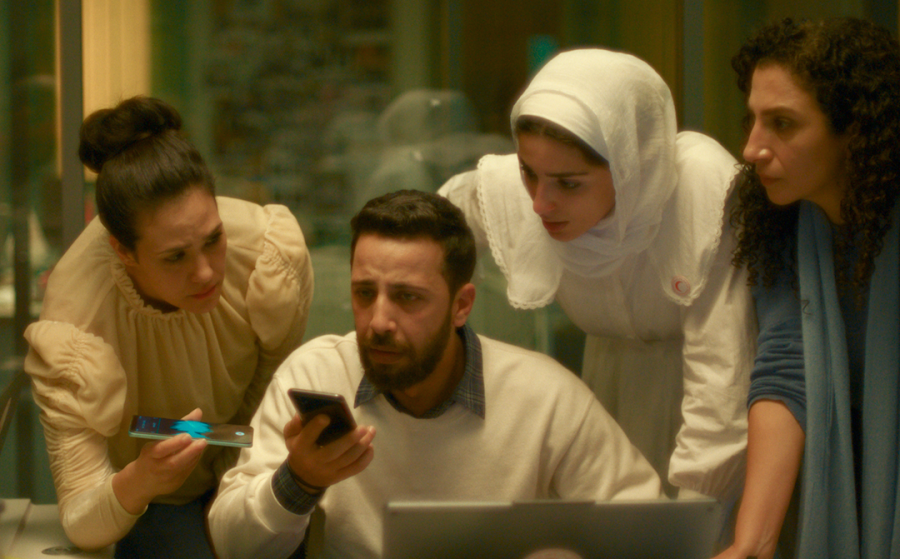
For decades, François Truffaut’s The 400 Blows has stood as cinema’s definitive portrait of an unhappy childhood. Kaouther Ben Hania’s devastating new film, The Voice of Hind Rajab, may finally dislodge it. Centered on the real-life story of a five-year-old Palestinian girl, the film renders Truffaut’s adolescent anguish almost quaint by comparison.
Built around real audio recordings, The Voice of Hind Rajab is a haunting docudrama that focuses on the final phone calls of a young Palestinian girl, using her recorded voice to bear witness to civilian suffering and the human cost of war. It has earned the Academy Award nomination for Best International Feature Film. Writer-director Ben Hania’s tour de force has creatively encapsulated the gobsmacking misery that has been unleashed since October 8, 2023, upon the children of Gaza, where “a staggering 64,000 children have reportedly been killed or maimed . . . including at least 1,000 babies,” according to an October 8, 2025, United Nations Children’s Fund (UNICEF) report. Hind Rajab has since become a symbol for all of Palestine’s suffering children. In April 2024, months before Ben Hania’s film, the little girl galvanized Columbia University students to occupy a building and rename it “Hind’s Hall” in her honor.
This is the second Oscar the Tunisia-born Ben Hania has been up for; the auteur’s 2023 Four Daughters was nominated for Best Documentary Feature. The Voice of Hind Rajab’s executive producers include Brad Pitt, Joaquin Phoenix, Rooney Mara, Alfonso Cuarón, and Jonathan Glazer, who directed 2023’s The Zone of Interest, which won the Best International Feature Film Oscar that year. Interestingly, James Wilson, the producer of that movie about Auschwitz, also produced The Voice of Hind Rajab, along with Odessa Rae, who coproduced 2023’s Best Documentary Feature Academy Award winner, Navalny.
The Voice of Hind Rajab is in Arabic with English subtitles. Kaouther Ben Hania was interviewed via Zoom in New York.
How did you decide to make a film about Hind Rajab?
It wasn’t a decision. I can’t say I “decided.” I decided later, in a rational way. But at the beginning, it was for me — I couldn’t forget her voice, I couldn’t get her voice out of my head. I know when I have a strong feeling about something that I can’t . . . you know? I made a movie about it just to share what I felt with the audience. It’s like it haunted me.
And then to deal with it, I needed to do the movie, to make a rational decision to make the movie, because this story says a lot about where we are as a human species. I can’t unhear it or look away. I did this movie so people don’t look away also. We don’t want to see this, but it’s very important to see it.
What happened to Hind and her family?
It was last week two years ago that this happened in Gaza. You have this family in this car with Hind Rajab, because her mother wanted to protect her from rain. They are in this car, and they are fired at by the Israeli army. So at this point, all of them are dead, except two girls. Layan [Hamadeh] — she’s fifteen. Layan got the Red Crescent in Ramallah on the phone, and she was killed while she was on the phone with them.
So, the only survivor is Hind Rajab. She’s not even six — she’s younger. And she’s the only survivor. You have this little girl inside this car, surrounded by the dead bodies of her family, and she’s telling the Red Crescent employee, “Come and get me.” There is an ambulance eight minutes away, but they can’t send it. They need the approval from the Israeli army; otherwise the Israeli army will shoot the ambulance.
All the movie is them [Red Crescent workers in their Ramallah call center] trying to calm the little girl on the phone, but also navigate all the bureaucratic — bureaucracy by design — obstacles to get the green light to send this ambulance to [get] this girl.
There are no [plot] spoilers in this movie, because it’s a true story. It was in the news. We know that the ambulance was bombarded meters away from the car. We know also because there is evidence. We have the recording, and then the call with Hind Rajab ended. For twelve days, her family and the Red Crescent have no news from its two paramedics sent to save Hind Rajab and [no news] from Hind Rajab. For twelve days, because this [whole] place was under siege. After twelve days, when the Israeli army left, we discover what happened with them, which is not a happy ending like in a fictional movie. No Hollywood ending.
Why was Hind in the vehicle with her relatives?
There was an evacuation order, in the morning, [for] the Tel-al Hawa neighborhood [in Gaza City]. So, they needed to evacuate. Hind’s mother had Hind and her younger brother — because it was raining, it was winter, she wanted to protect them in the car of their uncle. This is not in the film, but the boy didn’t want to go in the car, and he jumped and stayed with his mother. And then they fled in the car — the family, the couple [Hind’s aunt and uncle], four children, and Hind with them.
An IDF tank fired on the vehicle?
Before telling this story, I based everything on the investigation. As you may know, the Israelis at first denied their presence in this place. They said, “It’s not us.” Then you have investigative work done by Forensic Architecture, which is a London-based investigative agency, who proved, analyzing the sound, which kind of weapon, which kind of Israeli tank. And with the satellite images [of] the tank. You can read its investigation; it’s online.
Another investigation was also done by the Washington Post; they did a great piece about what happened that day. In the recording that I got from the Red Crescent to tell this story, which is the basis, the backbone of this movie, you have this little girl talking about tanks. Not one tank — “The tanks are coming.” “The tanks are here.” And you have Layan, who said before dying, “The tank is near me,” and then we hear the sound, which, [according to] Forensic Architecture analysis, is the precise sound of a weapon used by Israeli tanks.
Tell us about the actors and their relationship to the real-life individuals they play.
I wrote the screenplay with the help of the real people. They told me everything I needed to know. I did the casting with them in my mind. I needed Palestinian actors who could portray those four persons I had been talking to. When I found those four actors, I put them directly in contact with their counterparts, the person the actor is portraying. They became very close. They talked a lot. Often, the real person told the actor stuff they didn’t tell me. Because they felt more in a mirror way.
How fact-based are the events as depicted on-screen?
All the recording is a document, the voices, the phone talk — all this is a document. What I did with the actors, they say word-for-word what the real [Red Crescent] person said. But all of the off[-phone] conversation . . . in the offices of the Red Crescent, this is what happened in the offices between the persons working there. It’s based on the testimony of the four real employees, Omar, Rana, Nisreen, and Mahdi. Because I had the recording, but I wanted to know what happened off the recording. It’s based on their testimony.
Your film visually takes place in that Red Crescent office in Ramallah. Why, cinematically, as a screenwriter and director, did you decide not to dramatize Hind in the vehicle? Why didn’t you show the ambulance drivers trying to rescue her, or the IDF?
Because, first of all for me, it wasn’t respectful of the memory of this little girl to do the mise-en-scène. We are in a very touchy place, and this question of filming the death of a child and doing the mise-en-scène of the death of a child is something so ethically questionable. There’s no need. Why? It would make my movie worse.
What I love in cinema is radical choices. When you stick with one place, when you stick with one point of view, and you manage to tell the story through this point of view, why do I need to skip to every point of view? I don’t know what happened in the tank. I don’t have any firsthand source telling me who was in the tank, what they said; it’s not like the Red Crescent employees. They wanted to tell me their testimony. They shared with me, everything, all the archive of that day.
The Israelis said, “We weren’t there.” Then they said, “We are investigating.” Till now, till today, they are investigating themselves. So, I don’t know what happened. And I don’t know what happened in the car with Hind. All I know about what happened in the car, I heard it in the recording. So, doing the mise-en-scène of all this, why? It will make my film . . . it’s not a very clever choice. I found that the fact we stay with Hind, we understand everything with this document, which is the sound, [is] way too powerful. Because her voice is powerful, because what she said is powerful. Not showing but hearing, imagining, it’s way better.
Your film has deservedly won and been nominated for many awards, including the Academy Award for Best International Feature Film. There seems to be a new wave of Palestine-themed pictures: movies like yours, All That’s Left of You, Palestine 36, and so on. Why are these films breaking into the consciousness of Western and global audiences now?
Palestinian movies and Arab voices existed, a long time ago. The problem is always, and it is still the case, distribution. Those voices, they arrive here because Watermelon [Pictures] fights, because we fought, because [All That’s Left of You director] Cherien Dabis was in a big fight. Because we want the world to hear more. And the Academy, also, has been doing a great job [in the last few years] to open its doors — because it had been too white, too old — to open its doors to other voices from the world.
And I know from sources that you have a small part who is not happy with this. They don’t want movies like The Voice of Hind Rajab to be at this stage in the Academy. This is to say that those voices existed before. But now, because of what happened in Gaza, people wanted to see the other perspective. But the other perspective, which is the Palestinian, Arab perspective, is shut down. You can’t imagine the fight we [have had]; [it’s still happening with] those two movies [All That’s Left of You, Palestine 36]. Because Annemarie Jacir’s film [Palestine 36] was forbidden in Jerusalem by the Israeli army. It’s not something new, but people [now] have more curiosity here to hear the Palestinian way of seeing things, or the Palestinian story.
Your style of filmmaking combines elements of documentary and feature films, in Four Daughters and The Voice of Hind Rajab.
I did my thesis at Sorbonne Paris Trois about the frontier between documentary and fiction. It’s something I’ve been thinking about in theory before searching on it and trying it throughout all my filmography. My first movie was a mockumentary. Four Daughters was a hybrid. It’s the story that tells you what is the best way to tell it. For example, Hind Rajab’s story — for me, doing it in a pure documentary mode wasn’t the perfect way to tell this story.
First, because not all of the Red Crescent dispatchers wanted to talk in front of the camera. Second, because for me it was very important to tell this story in the present tense, in the moment where saving this little girl was possible, to show why they couldn’t do it. So, when you don’t have the archive of this present moment, I had only this scene, I put it in the phone at the end. When I don’t have archive, I bring actors, I do reenactments, and I know that it’s a risky choice because when people see actors, they think about artifice. That’s why I needed to have this contract with the audience, [to be] very clear that those are actors, the voice is real, and even actors stop acting at some point. If you remember in the movie, sometimes they stop acting, and they start listening to their real counterpart-perspective character.
When the unthinkable happens, the bombing of the ambulance despite having a green light, a meter away from the car — at this moment I needed to go to something more archival.