The killing of El Mencho, Mexico’s most wanted drug lord, won’t slow the cartels, reduce violence, or stop the flow of drugs.
While the United States is on the precipice of another war in West Asia, only a few months after the abduction of Venezuela’s president and with the football World Cup only a few months away (and FIFA joining Donald Trump’s Board of Peace), Mexico’s most notorious drug lord and the FBI’s most wanted man, Nemesio Rubén Oseguera Cervantes, better known as El Mencho, the leader of the Cártel de Jalisco Nueva Generación (CJNG), was killed in Tapalpa, a town two hours southwest of Jalisco’s state capital, Guadalajara, Mexico’s third-largest city and one of the host venues for the upcoming World Cup. Mencho was taken down in an operation conducted by Mexican special forces “within the framework of bilateral cooperation, with US authorities providing complementary intelligence”; the CJNG was designated as a terrorist organization by the Trump regime last year and is widely regarded as Mexico’s most powerful criminal organization.
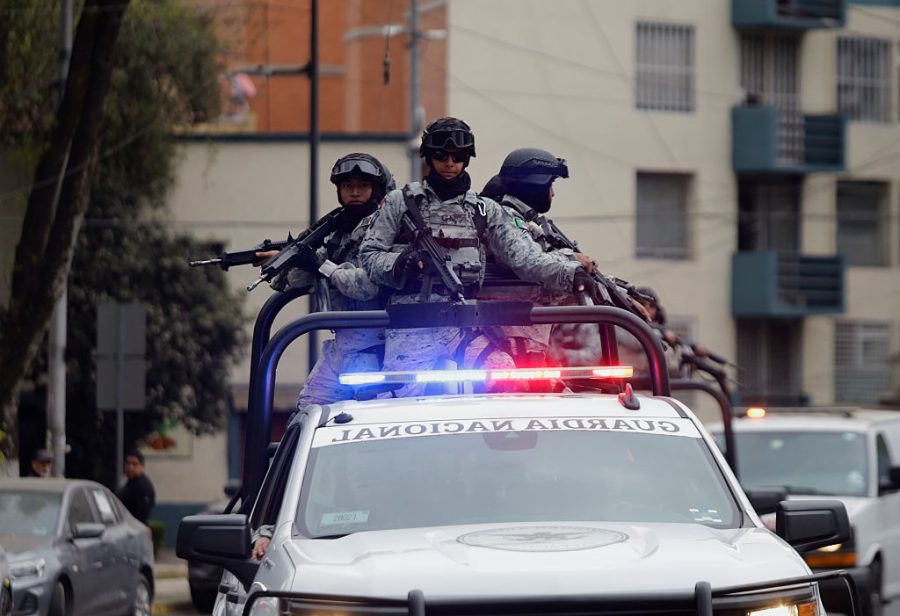
Rumors about El Mencho’s death have been circulating for years, either from kidney problems or some unspecified cause, but this time his death has been confirmed by the Mexican government; he was tracked down through a mistress, according to the authorities. The killing of El Mencho sparked an immediate reaction from CJNG forces in the form of narco blockades on what veteran journalist Ioan Grillo described as an “unprecedented scale” in at least fifteen different Mexican states, along with the torching of targets such as oil trucks, buses, pharmacies, and banks. As of writing, the death count includes several civilians, including a pregnant woman, twenty-five members of the state and federal security forces, and thirty “criminals.” Tourists and locals in affected areas were advised to shelter in place, while 2,500 additional troops are being deployed to Jalisco
As the political scientist Benjamin Lessing argues in a landmark paper on criminal insurgencies, “When cartels turn to fighting strategies, I argue, their aim is not to conquer the state but to constrain it — to change its behavior, which in the case of states means policy outcomes. In wars of constraint, the function of violence is generally coercive.” In this sense, criminal violence does not represent an attempt to destroy the state but forms a negotiation with it; the message in this case is that Mencho might be dead, but the power of the organization remains intact.
While Claudia Sheinbaum’s government is taking credit for El Mencho’s death, there is no doubt that this was in part a response to pressure from the Trump regime, as well as Morena’s critics who accuse the party of being soft on “cartels,” exemplified by the idea that AMLO’s crime strategy was actually “hugs not bullets” rather than handing over responsibility for law enforcement to the military. Of course, Trump’s officials and cronies were quick on the draw to claim credit for Mencho’s death.
It’s almost impossible to follow what exactly is happening on the ground; for instance, social media was suddenly full of false reports that Guadalajara airport had been taken over by cartel sicarios, and of old videos of CJNG armored cars. There is a legion of monetized blue tick X accounts, operator podcasts. and organized crime YouTubers, along with MAGA or MAGA-adjacent influencers and politicians, that conjure up the specter of “the cartel,” not a named organization but a monolith that supposedly controls Mexico and has captured the state. The reality of the fragmentation of organized crime in the country and the removal of two generations of leaders from the board does not trickle down to this analysis shaped more by Taylor Sheridan and Netflix’s Narcos than the realities of the Mexican drug trade.
The Kingpin Strategy and the Specter of the Cartel
For nearly fifty years, the United States has pursued a strategy of taking out the leaders of major drug trafficking organizations as the centerpiece of its drug wars. El Mencho joins the litany of past slain iconic designated drug villains deemed as the most violent and dangerous traffickers of their day in the never-ending “war on drugs.” Other slain drug bosses include Ramón Arellano Félix (2002); Arturo Beltrán Leyva, known among other things as “the boss of all bosses” (2009); and the particularly sadistic ex-US-trained special forces operator Heriberto Lazcano Lazcano, aka “Z3” (2012). The better-known El Chapo and El Mayo, along with the original Guadalajara Cartel bosses Miguel Ángel Félix Gallardo and Rafael Caro Quintero, to name a few more of Mexico’s most infamous drug lords, are all fading away in American prisons. Félix Gallardo is the exception and is serving a life sentence in Mexico. However, nobody can seriously claim that any of these deaths or arrests has made Mexico a less violent country or seriously reduced the overall power of organized crime, let alone hindered the flow of drugs to the United States and the rest of the world.
Colombia’s kingpins, from Pablo Escobar to the leaders of the Cali Cartel, suffered similar fates, with Dario Antonio Úsuga David, aka Otoniel of the Gulf Clan, being the most recent to fall, but the country has never exported more cocaine as a new generation of smaller more horizontally organized and discreet traffickers have continued to operate along with paramilitary and guerrilla organizations. Where Mexico was dominated by a few major organizations over the last few decades, there are now hundreds of small criminal splinter groups, regional factions, and gangs spread across the country, in large part as fallout from the kingpin strategy.
The capture of El Mayo profoundly destabilized Sinaloa and neighboring states through a cartel civil war, which has seen a 400 percent spike in homicides as of last year, with over 2,400 murders and 2,900 disappearances since September 2024. Removing a major player in such a fractured criminal landscape can be deeply destabilizing and tends to make things more dangerous and disordered. The war between the Beltrán Leyva Organization and the Sinaloa Cartel began with the arrest of Alfredo Beltrán Leyva and saw almost 10,000 people killed between 2008 and 2011. The effects of this past destabilization and violence are directly evident in the current violence. There are thus very good reasons to fear that the death of El Mencho could spark similar violence as factions of the organization seek to consolidate their position in the coming months in Jalisco and beyond, as was almost always the case when past capos were killed or captured. Just as the Sheinbaum administration has made real gains in the overall public security situation in Mexico.
In reality, the idea of the drug cartel as a vertically organized single entity has always been a convenient fiction serving the interests of US foreign policy. While Mexico’s mafias are very real and dangerous and embedded in Mexico’s political economy, they are best thought of as overlapping interests, regional clans, and horizontally organized structures that form a system of international and domestic drug trafficking (and other illegal commodities from wildlife to minerals), extortion, and other criminal interests rather than centralized organizations. As Benjamin Smith, a leading historian of the Mexican drug trade, told me a few years ago:
It is there, for example, in the term “cartel.” American drug agents started to use the term cartel in the late 1980s to describe Mexican traffickers. The term “cartel” immediately brought to mind OPEC, price controls, and the perversion of good old, fair-minded, Anglo-run capitalism. And it promised victory. Destroy the cartel, and you destroy the drug trade. Yet the DEA [Drug Enforcement Administration] knew that the traffickers didn’t operate as a cartel at all. These were networks of intermarried families and friends, which all played small roles in creating this market ecosystem.
Even if Mexican organizations describe themselves as “cartels,” this is more of a matter of self-branding than an accurate assessment of their functioning. As the literary critic Oswaldo Zavala argues in his book, Drug Cartels Do Not Exist:
The narco in Mexico and the United States works like Tony Soprano’s clever trick. The narco appears in our society as a fearsome Pandora’s box that, we believe, would unleash endless death and destruction if opened. If we could overcome that fear and confront what we call the narco by finally opening the box, we would not find a violent trafficker, but the official language that invents him: we would hear words that would slip through our fingers like sand. Let’s open the box then.
And that box has been opened again and again.
Narcoterrorism
Trump’s second term has been characterized by an official language in which the narco becomes the narcoterrorist, a demonic being looking to destabilize and kill America through drugs rather than an illicit capitalist. This is hardly new; Ronald Reagan used the same justification for his aggressive foreign policy and support for bloodsoaked dirty wars in Latin America. As the Gipper declared back in 1986: “The link between the governments of such Soviet allies as Cuba and Nicaragua and international narcotics trafficking and terrorism is becoming increasingly clear. These twin evils of narcotics trafficking and terrorism represent the most insidious and dangerous threats to the hemisphere today.” More recently, there was the fever dream of an alliance between Islamic terrorists and drug cartels.
There is a long history of CIA support for right-wing drug traffickers from Laos to Colombia. A former Honduran president who proudly boasted that he wanted to shove the drugs “right up the noses of the gringos” was recently pardoned by President Trump. As Seth Harp pointed out, US-occupied Afghanistan was arguably the biggest narcostate in history. Narcoterrorism is a useful fiction rather than an actual thing; were the drug profits that allowed the Contras to rape and pillage their way through the Nicaraguan countryside, Cuban counterrevolutionaries to blow up passenger planes, or Colombian paramilitaries to apply chainsaws to the limbs of campesinos narcoterrorism? All of the aforementioned groups had more of a political agenda than the late El Mencho, who as far as anyone can tell sought to influence rather than replace the state.
El Mencho and the CJNG
The CJNG’s entry into Mexico’s criminal landscape was a direct consequence of infighting and regrouping after the death and capture of past kingpins. The organization’s origins lay in the Valencia clan, a major trafficking clan hailing from Michoacán that used to disguise shipments of drugs through their avocado export business. The Valencias’ organization, also known as the Milenio Cartel, was at one point one of the most profitable mafias in the world. However, the Valencias were forced out of their home state of Michoacán by their rivals and regrouped in Jalisco as an ally of the Sinaloa Federation — in particular of Ignacio Coronel Villarreal, aka “Nacho Coronel,” a pioneer of the synthetic drug industry. El Mencho began his criminal career as a minor heroin dealer in the Bay Area before he served time in a US prison and was deported back to Mexico, where he worked as a cop and married into the Valencia clan, but he really made his name for leading a paramilitary force in the war against the Zetas; Mencho’s group was known as “Matazetas” (Zeta killers).
After Nacho Coronel’s death in 2010 and the capture of several of the leaders of the Valencia clan, the CJNG emerged as the new force in Jalisco after eliminating a few rivals. Its rise was based on the combination of the financial expertise and international networks of the Valencia organization with the innovations in synthetic drug production introduced by their former partner Nacho Coronel and the paramilitary violence of El Mencho. The CJNG’s infamy was in large part due to the organization’s willingness to engage in direct conflict with state forces, including famously downing a military helicopter during a previous attempt to take down Mencho in 2015, and more recently pioneering the widespread usage of drones. The CJNG also killed or attempted to kill numerous state officials, including Omar García Harfuch, the current secretary of security and civilian protection, and earned a deserved reputation for brutality. Or that’s at least how the official narrative goes. The CJNG, according to think tanks and official reports, has a presence in every single Mexican state and all fifty US states, as well as numerous countries, in particular Ecuador and Colombia, with a reach as far as China and Australia in terms of its trafficking networks. It has billions of dollars in assets and is reportedly involved in everything from illegal mining in Colombia to the illicit wildlife trade.
The Logic of the War on Drugs
Since Richard Nixon first declared a war on drugs in 1971, in large part to justify a crackdown on the New Left, there are now more drugs on the market than ever before, and they have never been easier to get hold of; if anything, the price has been dropping from South Africa to Europe. As a thought experiment, it’s worth asking at this point if actually winning the war on drugs is the goal, if the agencies waging it are dependent on the threat posed by narcotrafficking for continued budgets in the tens of billions, and if it serves as justification for repression at home and intervention abroad.
To return to Mexico, its drug war, launched by Felipe Calderón in 2006, has seen well over 300,000 deaths and over 130,000 disappearances, with at least 16,000 people missing in Jalisco alone. And yet the drugs are still flowing, the profits are still coming in, and even if they are more fragmented, Mexican organized crime groups are not going away anytime soon. While one should always take such reports with a grain of salt, given the highly fluid nature of the business and how exactly membership is designated, as of 2023, Mexican organized crime groups had 175,000 members — making them the fifth-biggest employer in the country, according to new research published in the journal Science.
Why then is Mexico’s drug trade so violent? As Benjamin Smith argues in his book, The Dope, violence was rare in resolving disputes between traffickers until the 1970s; family ties and the state officials who regulated the trade were able to resolve disputes without violence. Violence became a systemic feature of the trade only after America’s war on drugs arrived in Mexico through Operator Condor, a militarized campaign targeting poppy fields in the so-called Golden Triangle, the remote rural mountainous areas of Durango, Sinaloa, and Chihuahua that form the heartland of Mexico’s drug trade. Operation Condor also enabled the state to target various radicals and peasant guerillas that had emerged in the 1970s, as the historian Alexander Aviña has shown. The current levels of violence in Mexico are a direct result of a breakdown in the ability of the state or any single organization to regulate the drug trade. The North American Free Trade Agreement (NAFTA), the fall of the Institutional Revolutionary Party (PRI), and the vast profits being earned in the industry transformed the logic of organized crime.
In Smith’s words:
Private protection rackets soon came into conflict as different groups sought a monopoly of certain zones. Trafficking organizations — which had previously concerned themselves with moving products — now got interested in controlling space. And they fought other organizations to do so. The drug trade became the drug war — or, more precisely, a conflict between drug trafficking organizations to control a distinct, geographically delimited protection racket.
These protection rackets extend beyond the drug trade to taxing legitimate industries, to oil theft and everything from bootleg designer clothes to brothels, and increasingly the domestic drug trade. Dozens of smaller organizations and local factions compete over these rackets, driving conflicts beyond the state’s ability to control and increasing levels of violent competition. At this point, it is at least worth asking if this is one of the goals of drug policy, rather than simply a consequence of shortsightedness and/or misguided policies. After decades of the kingpin strategy, leading to more violence and drug trafficking, it is reasonable to wonder if its goal is to destabilize and fragment the sovereignty of Mexico and other states, even if Mencho was killed by Mexican special forces.
Regardless of what happens following Mencho’s death, the fall of another kingpin will do little to stem the power of organized crime and the interests that benefit from disorder, including those currently in the White House.